



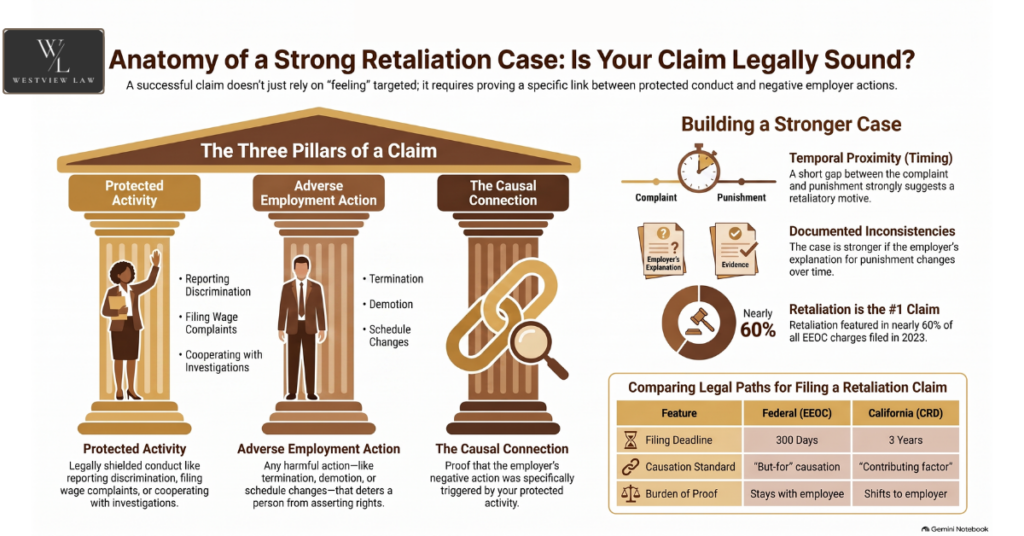
A strong retaliation case rests on three things: a protected activity, an adverse employment action, and a causal connection between them. Workplace retaliation happens when an employer punishes someone for asserting a right such as reporting discrimination, filing a wage complaint, or cooperating with an internal investigation. Recognizing it early matters, because the evidence that proves retaliatory motive tends to disappear the moment someone is walked out of the building.
Westview Law represents employees in retaliation cases. Of Counsel Taylor Markey served as an Assistant Regional Attorney at the U.S. Equal Employment Opportunity Commission, where she led systemic discrimination litigation, and founder David M. Safvati was named a Super Lawyers Southern California Rising Star from 2022 through 2024 and recognized in Best of the Bar’s Top 100 Verdicts in California for 2024. The firm’s name was built inside courtrooms rather than around them. If you suspect retaliation, contact us today for a free case review.
This article sets out what a strong retaliation claim actually requires, what evidence supports it, and how the process works from first complaint to potential legal action.
What Is Retaliation?
Retaliation occurs when an employer takes a negative action against an employee because that employee engaged in legally protected conduct. The conduct is protected; the punishment for it is unlawful.
Both federal and state laws prohibit it. Title VII of the Civil Rights Act bars retaliation against anyone who opposes discrimination or participates in a proceeding about it. California’s Fair Employment and Housing Act does the same at the state level, and Labor Code section 1102.5 adds separate protection for employees who report suspected legal violations.
Federal law sets the minimum standard, and California adds additional protections on top of it. The same set of facts can often support a claim under either system, and the choice between them is not merely procedural; the filing deadlines, the causation standard, and the size of the employer covered all differ. Working out which route fits is one of the first real decisions in a case.
The pattern is recognizable once you know what to look for. An employee raises a discrimination complaint and finds their shift pattern rewritten the following week. Someone reports safety violations and receives their first negative performance review in six years. A worker cooperates with an internal investigation, and the employer quietly moves them to a role with no path forward.
None of those employers announced what they were doing. Retaliatory behavior is rarely labeled, which is why documentation is so important. Taylor Markey, an employment attorney at Westview Law, often advises clients, “If something feels wrong after you speak up at work, trust that instinct enough to document what changed.”
Why Is Retaliation a Serious Issue?
Retaliation is the most frequently alleged basis of discrimination in the United States. EEOC data shows that the agency received 81,055 charges in fiscal year 2023, and retaliation featured in close to 60% of them, as it has every year for well over a decade. It is not a fringe problem.
For employees, the damage runs past the paycheck. Lost wages and blocked promotions are measurable, but so is the effect of making someone an example. Colleagues watch what happens to the person who spoke up, and they draw conclusions. A single retaliatory termination can silence an entire department more effectively than any policy.
For employers, the exposure is real and often larger than the underlying complaint. A retaliation claim can succeed even where the original discrimination complaint fails, because the two are legally separate. For example, an employee who complained in good faith about conduct that turns out not to be unlawful is still protected from punishment for making the complaint. Remedies can include lost wages, emotional distress damages, and punitive damages where the conduct warrants them. Addressing a complaint properly costs an employer far less than defending what it did to the person who made it.
It is worth being realistic about pace. A retaliation lawsuit moves through agency investigation, then a right-to-sue notice, then civil proceedings with disclosure and depositions, and that sequence rarely resolves quickly. Employees who understand the timeline from the start tend to make better decisions about settlement than those expecting a fast result, which is an argument for starting early, not for not starting.
What Are Protected Activities in Retaliation Cases?

A protected activity is conduct that the law shields from reprisal. It falls into two broad groups: opposing something you reasonably believe is unlawful and participating in a process that examines it.
Opposition covers raising a discrimination complaint with a supervisor or HR, objecting to harassment, refusing to carry out an unlawful instruction, or making a wage complaint. Participation covers filing a charge with an agency, giving witness testimony, or taking part in an internal investigation.
Whistleblowing sits alongside both. Under Labor Code section 1102.5, an employee who reports what they reasonably believe to be a violation of law to a government agency, to a supervisor, or to anyone within the organization with authority to investigate is protected, whether or not the suspected violation is ultimately established.
One point is regularly misunderstood. Protection does not depend on being right. An employee who complains in good faith about conduct they reasonably believed was discriminatory keeps their protection even if an investigation clears the employer entirely. Losing the underlying complaint does not forfeit the right to avoid punishment for making it.
Legal Framework Surrounding Protected Activities
Several statutes operate at once, and which one applies can change the outcome. Title VII prohibits retaliation in employment discrimination matters. The Occupational Safety and Health Administration (OSHA) protects employees who report safety violations. FEHA covers the same ground as Title VII at the state level and reaches smaller employers. Section 1102.5 protects reports of suspected legal violations of any kind.
The Equal Employment Opportunity Commission enforces the federal provisions, investigates charges, and issues the right-to-sue notice that permits a federal case to proceed. In California, the Civil Rights Department performs the equivalent function for state claims. Deadlines differ sharply between them: 300 days to file with the EEOC and three years to file with the CRD.
The causation standard differs too, and this aspect is where California claims become materially stronger. Federal retaliation claims under Title VII require but-for causation, as established by the Supreme Court’s decision in University of Texas Southwestern Medical Center v. Nassar. Section 1102.6 sets a different test for California whistleblower claims, confirmed by the California Supreme Court in Lawson v. PPG Architectural Finishes in 2022.
An employee need only show, by a preponderance of the evidence, that retaliation was a contributing factor. The burden then shifts to the employer to prove by clear and convincing evidence that it would have taken the same action for legitimate, independent reasons, and it does not shift back.
What Qualifies as an Adverse Action?
An adverse employment action is any employer action harmful enough to deter a reasonable person from asserting their rights. Termination, demotion, salary reduction, job reassignment, and unfair performance reviews all qualify as examples of workplace retaliation. So do less obvious moves: exclusion from meetings, removal of responsibilities, or a schedule change that makes a role unworkable.
The governing standard comes from Burlington Northern & Santa Fe Railway Co. v. White, where the Supreme Court held that an action is materially adverse if it might well dissuade a reasonable worker from making or supporting a charge of discrimination. That test is deliberately objective, and it is broader than the standard for discrimination claims.
Not every unwelcome decision is retaliation, and a credible claim has to account for that. Companies restructure, budgets tighten, and genuine performance problems exist. What separates a legitimate business decision from a retaliatory one is usually whether it would have happened regardless of the complaint, which is exactly the question the burden-shifting framework is built to answer. An employer with a documented, consistent record supporting its decision is in a completely unique position from one whose reasoning first appears after the employee speaks up.
Proving the Connection
Establishing a causal connection is where most retaliation cases are won or lost. Employers rarely leave a record of retaliatory motive, so the link is usually built from circumstantial evidence.
Timing is the most important factor. An adverse action following closely after protected activity supports an inference of retaliation, and the shorter the gap, the stronger the inference. Timing alone is rarely enough, but combined with other evidence, it becomes difficult to explain away.
The other elements are comparison and inconsistency. How were similarly situated employees treated who did not complain? Did the employer’s stated reason exist before the complaint or appear afterwards? Did the explanation change between the termination meeting and the paperwork? A performance problem first documented three weeks after a discrimination complaint invites questions the employer has to answer.
Retaliation Case Strength: What Helps and What Hurts?
Not every retaliation claim has the same evidentiary strength. Timing, documentation, the employer’s explanation, and how other employees were treated can all make a case stronger or give the employer a stronger defense. The table below summarizes the key factors that can strengthen or weaken a retaliation claim.
| Factor | Stronger Case | Weaker Case |
|---|---|---|
| Timing | Adverse action happens soon after the complaint | Significant time passes with no other evidence |
| Documentation | Emails, messages, complaints, and reviews create a clear record | Most evidence is based on memory or verbal conversations |
| Employer’s explanation | The employer’s reason changes or appears after the complaint | The employer had a documented reason before the complaint |
| Treatment of coworkers | Similar employees who did not complain were treated more favorably | Comparable employees were treated the same way |
| Performance history | Strong performance record before the protected activity | Documented performance problems existed beforehand |
| Direct evidence | Manager makes statements linking the complaint to the adverse action | No direct evidence of retaliatory motive |
| Pattern of conduct | Multiple negative actions follow the protected activity | One isolated workplace decision with a legitimate explanation |
| Causal connection | Several facts point toward retaliation | Timing is the only evidence connecting the events |
Proving Employer Retaliation: A Step-by-Step Guide
Retaliation claims are built from records rather than recollections. These four steps protect a claim while it is still possible to do so.
Step 1: Document Evidence of Retaliation
According to Paul Marks, an employment attorney at Westview Law, “Retaliation cases are often won or lost on the details, so documenting what happened early can make a real difference.” Keep dated records of every incident, like what happened, who was present, and what was said. Preserve internal communications, emails, performance reviews, and written complaints, along with witness statements from colleagues who saw the change in treatment.
Step 2: Seek Legal Advice
Speak to an employment lawyer as soon as you suspect retaliation, not after the process has run its course. Legal counsel can identify which statutes apply, which deadlines govern, and what evidence needs preserving before access to company systems ends.
Step 3: File a Complaint With the Relevant Agency
A retaliation complaint goes to the EEOC or, in California, the Civil Rights Department, and the deadlines are not the same: 300 days federally versus three years under FEHA. Filing requires details of the protected activity, the adverse action, and the timeline connecting them.
Step 4: Prepare for Potential Legal Action
Once an agency issues a right-to-sue notice, a civil claim becomes possible, and a further deadline starts running. Understanding what litigation involves, from disclosure to depositions to the realistic timeline, helps you make decisions about settlement from an informed position rather than a hopeful one.
How Can an Employment Attorney Help?
Most people arrive with a strong instinct and thin proof. They know the timing was wrong. What they usually lack is the comparison evidence, the internal documents, and the record showing when the employer’s account changed. Turning that instinct into something a court can work with is the first job. Paul Marks regularly advises, “Speaking with an employment attorney early can help you understand your deadlines and protect evidence before it disappears.”
The second is strategic, which claims to bring, whether the state or federal route fits the facts and how to preserve every deadline while the file is still being built. In California, those choices matter more than most people expect, because the standard of proof under section 1102.6 is considerably more favorable than the federal alternative.
Ready to Pursue a Retaliation Claim?

Retaliation law exists because only rights that can be asserted safely are real rights. A strong retaliation case comes down to the same three elements every time: protected activity, adverse action, and a causal connection supported by well-documented evidence. The claim can stand even where the original complaint does not.
If you suspect your employer retaliated against you, the most useful thing you can do is act while the evidence is still reachable. Consider speaking with an employment attorney early to understand your rights and options before taking your next step.
Wondering whether you have a strong retaliation case? Westview Law represents employees, not employers, with Of Counsel Taylor Markey bringing experience from her time as an Assistant Regional Attorney at the U.S. Equal Employment Opportunity Commission and founder David M. Safvati recognized as a Southern California Super Lawyers Rising Star from 2022 to 2024. With courtroom experience and a track record of handling serious employment disputes, our employment attorneys in California know what is at stake when an employer crosses the line. If you believe you are facing retaliation, contact us to request a free case review.
Frequently Asked Questions About Retaliation in the Workplace
Retaliation claims can arise when an employer takes adverse action because an employee engaged in legally protected activity. California law provides retaliation protections under FEHA and other laws, with the specific requirements depending on the protected activity involved.
What Evidence Is Needed for a Strong Retaliation Case?
To prove workplace retaliation, employees should present evidence of the protected activity, the employer's retaliatory actions, and a connection between the two. Emails, a formal complaint, negative performance evaluations, disciplinary records, and witness statements can provide clear evidence in employment retaliation cases.
How Can I Prove Retaliation in the Workplace?
To prove workplace retaliation, an employee generally needs to show protected activity, an adverse employment action, and a causal connection between them. Timing, inconsistent explanations, company policies, and other compelling evidence can help establish unfair treatment and hold an employer accountable.
What Are Common Examples of Retaliation in the Workplace?
Depending on the circumstances, wrongful termination, demotion, reduced pay or hours, changed assignments, discipline, harassment, or other actions that materially affect employment may constitute retaliation. A hostile work environment or negative performance evaluations may also support a retaliation claim when they are connected to protected activity, although not every unpleasant workplace action constitutes retaliation.
How Does Timing Impact the Strength of a Retaliation Case?
A short gap between protected activity and adverse action can provide evidence of a causal connection, particularly when supported by other facts. An experienced attorney or legal team, including California employment attorneys at a law firm, can help evaluate the evidence, present evidence through the legal process, and pursue a favorable outcome where the claim supports available remedies such as financial recovery or damages for emotional harm.
Disclaimer: This article is general information about workplace retaliation under federal and California law. It is not legal advice, and reading it does not create an attorney-client relationship. Every case turns on its own facts, and deadlines apply. Speak with a licensed attorney about your circumstances before relying on anything here. Past results do not guarantee future outcomes. Attorney Advertising. Westview Law PC, 1880 Century Park East, Suite 1100, Los Angeles, California.