


Usually, you can't sue for injuries at work unless there is fraud involved or your employer deliberately hurt you in some way, removed safety guards from heavy equipment, or didn't have insurance for workers' compensation. There are other ways to sue as well, but you need to act quickly because deadlines are tight and the outcome depends on which route you take.
Westview Law represents California employees in wrongful termination, retaliation, and disability discrimination cases, the claims that surface when an employer punishes a worker for getting hurt. Founder and managing partner David M. Safvati is a Fellow of the American Board of Trial Advocates, and one of his trials was recognized among the Top 100 Verdicts in California in 2024. Of Counsel Taylor Markey previously served as an Assistant Regional Attorney for the U.S. Equal Employment Opportunity Commission, and the firm’s attorneys bring more than 40 years of combined experience. If you were fired, demoted, or pushed out after a workplace injury, schedule a free consultation with our dedicated team.
This guide covers how workers’ comp works, where it falls short, what to do after you get hurt, and when a civil lawsuit makes sense.
What Is Workers’ Compensation?

Workers’ compensation is a state insurance system that pays benefits to injured employees for work-related injuries and illnesses. Under California Labor Code section 3600, employers owe these benefits without regard to negligence, which makes it a no-fault system. You don’t have to prove anyone did anything wrong. Labor Code section 3700 requires every employer except the state to buy workers’ compensation coverage or get state approval to self-insure.
Under the workers' compensation system, injured workers receive benefits that they can rely upon; they don't have to fight about who is at fault for their injuries. As compensation for this, the law shields employers from most lawsuits for the same injury.
According to the DWC’s Guidebook for Injured Workers, benefits typically include medical treatment, temporary disability payments of about two-thirds of lost gross wages, and other benefits such as permanent disability and death benefits. Workers hurt in 2013 or later may also qualify for a job displacement voucher worth up to $6,000, which is how California now handles vocational rehabilitation.
The DWC lists covered injuries from single events like a fall, repeated exposures like hearing loss from constant noise, work-related illnesses, and some stress-related psychological injuries. The Bureau of Labor Statistics reports that California private employers recorded 344,500 nonfatal workplace injuries and illnesses in 2024, a rate of 2.9 cases per 100 full-time workers. Federal civilian workers fall under separate workers’ compensation laws, the Federal Employees’ Compensation Act.
What Are the Limitations of Workers’ Compensation?
One big limitation is that the system doesn't account for things like financial compensation for pain and suffering or punitive damages. Disability payments replace just part of lost earnings, and there are caps based on weekly amounts as well. Section 3600 also does not pay benefits if injuries result from the worker's own intoxication, injuries they inflict themselves, or fights they start.
A common misconception is that employer negligence opens the courthouse door. It usually doesn’t. Even gross negligence generally stays inside the comp system, because the law doesn’t ask whose negligence contributed to the accident. Instead, Labor Code section 4553 raises your compensation by one-half when the injury came from the “serious and willful misconduct” of the employer or a managing officer. That’s additional compensation through a petition, not a civil lawsuit.
The other misconception is that filing a claim is a firing offense. It’s illegal. Labor Code section 132a bars employers from firing or discriminating against a worker for filing a claim, with remedies that include reinstatement, lost wages, and extra compensation of up to $10,000. A firing like that can also support a workplace retaliation claim in civil court, where damages aren’t limited by the comp schedules.
What Happens When Workers’ Compensation Is Not Enough?

The most common way to seek further compensation is a third-party claim. Labor Code section 3852 says filing for comp doesn’t affect your right to sue any person other than the employer. Third-party lawsuits often target negligent drivers, property owners, and makers of defective equipment or toxic substances. Under section 3601, you can also sue a coworker whose intoxication or “willful and unprovoked physical act of aggression” caused the injury.
Suing your employer directly is rare. Labor Code section 3602 allows legal action for a willful physical assault by the employer, for fraudulent concealment that aggravates your injury, and for defective products the employer made and sold to others. Section 4558 covers an employer’s knowing removal of a power press guard. When an employer fails to secure coverage, section 3706lets the worker sue, and section 3708 presumes the employer was negligent.
Workers' compensation benefits move quickly and do not require evidence that someone is at fault. On the other hand, personal injury lawsuits can compensate you for all losses suffered. Here's a comparison of the ways these two paths work, as frequently asked by injured workers.
| Factor | Workers’ Compensation Claim | Personal Injury Lawsuit |
| Proof of fault | Not required | Must prove negligence or fit a statutory exception |
| Who pays? | Employer’s insurer or self-insured employer | Third party, its insurer, or the employer in exception cases |
| Medical expenses | Covered | Recoverable, past, and future |
| Lost wages | About two-thirds of gross wages, capped | Full lost income and earning capacity |
| Pain and suffering | Not available | Available |
| Punitive damages | Not available | Possible on clear and convincing proof of malice, oppression, or fraud |
| Deadline | 30 days to give notice; 1 year to file | Generally 2 years |
| Attorney fees | Approved by the WCAB, normally 9% to 12% | Contingency percentage of the recovery |
What Are the Steps to Take After a Work Injury?
Work through these steps in order after a workplace accident. Acting quickly protects your health, your paper trail, and your right to benefits.
Step 1: Report the Injury to Your Employer
Tell a supervisor in writing right away, because Labor Code section 5400 requires notice within 30 days after the injury occurs. Once your employer knows about an injury needing more than first aid, section 5401 gives it one working day to hand you a DWC-1 claim form and a notice informing employees of their potential benefits.
Step 2: Seek Medical Attention
Get treatment and tell every provider you were injured at work. After you file the claim form, section 5402 requires your employer to authorize medical coverage within one working day, up to $10,000 while the claim is pending.
Step 3: Keep Detailed Records
Write everything down as soon as you can remember it clearly. Make a note of any symptoms, days when you didn't work, and phone calls with the insurance adjuster.
Step 4: Collect the Right Documentation
Keep your medical reports, incident report, signed DWC-1 form, pay stubs, and denial letters. Claims that aren't denied within 90 days of filing are presumed compensable according to Section 5402, so the filing date is important.
Step 5: Get Legal Advice Early
Comp proceedings generally must start within one year under section 5405, and most personal injury claims carry a two-year limit under Code of Civil Procedure section 335.1. An experienced attorney can spot third-party liability or retaliation in time.
Step 6: Choose the Right Attorney
Hire a workers’ compensation attorney for benefits disputes, a personal injury lawyer for third-party cases, and an employment lawyer if you were fired. Check the license on the State Bar of California’s attorney search and get the fee terms in writing.
When Should You Consider Suing Your Employer?
There is logic to bringing a lawsuit if certain facts align with some common scenarios. Your injury was caused by someone else rather than your employer; your employer had conduct that fits exceptions in sections 3602, 4558, or 3706; or your employer let you go or reduced your job responsibilities after you got injured. Also, a really career-ending injury usually ends up being worth much more than workers' compensation payments.
Negligence is when someone doesn't act reasonably and prudently; for example, driving through a red light. An accident that happens because something unforeseeable goes wrong (like equipment failure) is not considered negligence since there was no duty of care that wasn't fulfilled. Whatever the case, compensatory insurance kicks in. But negligence by someone outside the company allows you to sue them, while negligence by an employer that constitutes intentional harm will only allow suing if there are some exceptions under law.
Take photos of the scene, write down contact information for witnesses, write a letter requesting your employer to preserve video footage and maintenance logs, and be sure to connect your medical records to the incident. Most disputes settle before going to court through free help from DWC Information Assistants, negotiation by third parties, or mediation, but speaking to Human Resources or an adjuster does not stop deadlines for filing.
What Potential Compensation Can You Recover From a Work Injury Lawsuit?

A personal injury lawsuit can recover what comp never pays, including future medical bills, full lost wages, pain and suffering, and emotional distress. Punitive damages are possible under Civil Code section 3294, but only on clear and convincing proof of oppression, fraud, or malice. If you recover in a third-party case, the comp insurer can usually seek repayment of benefits it paid.
A well-known example of an exception came from Johns-Manville Products Corp. v. Superior Court, 27 Cal.3d 465 (1980). Reba Rudkin worked at Johns-Manville’s Pittsburg, California, plant for 29 years starting in 1946 and breathed asbestos the whole time. He alleged the company had known since 1924 that asbestos was dangerous and that it hid his disease and its cause from him, from the doctors it retained to treat him, and from the state.
The California Supreme Court dismissed the company's petition for review and allowed the plaintiff to pursue his lawsuit further. The court held that the tort bar (bar on suing) still prevents a lawsuit against an initial injury but allows a cause of action for aggravation of illness due to fraudulent concealment by the employer. Now that rule is in Section 3602(b)(2). This rule limits recovery to damages for the harm caused by this aggravation.
How Can an Attorney Help if You Have Been Involved in a Work Injury?
When handling workplace injuries personally, an attorney looks at all aspects of the accident rather than just looking at the files of compensation. This involves investigating who else was involved, digging into maintenance records, and figuring out how much a permanent disability might cost someone throughout their career. They also track every deadline and coordinate with any civil suits so the insurance company does not reduce the amount recovered.
Sometimes the most valuable claim isn’t about the injury at all. Workers fired after reporting an injury or denied light duty may have claims for wrongful termination or failure to accommodate that can restore financial support the comp system lacks the ability to provide.
Labor Code section 4906 bars comp attorneys from collecting a fee until the appeals board approves it, and the DWC’s fee disclosure statement says those fees normally range from 9% to 12% of the benefits awarded. Civil lawsuits usually run on a contingency fee, a percentage of the recovery with no fee if there isn’t one, which is how Westview typically handles employment matters.
Ready to Recover Damages for a Work Injury?
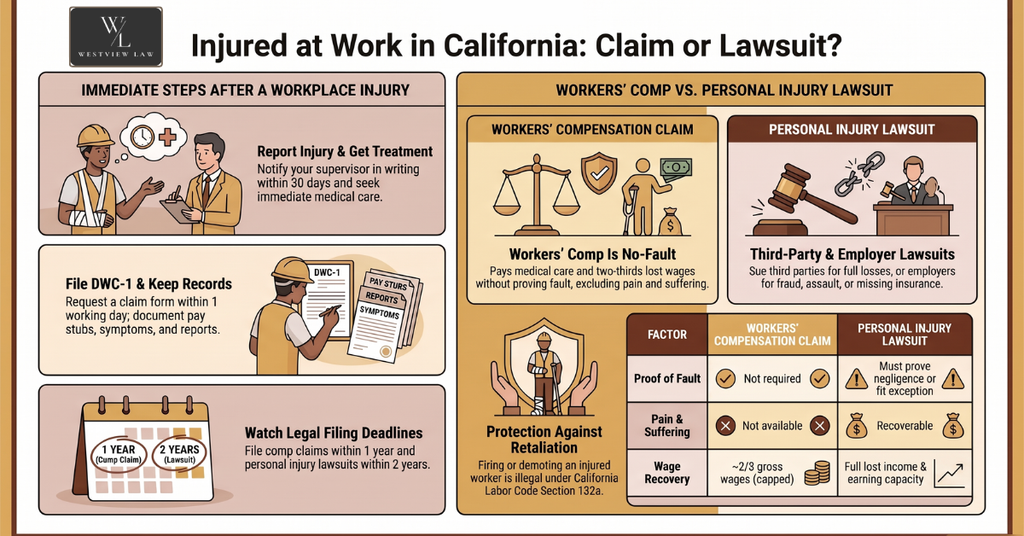
Workplace injury claims in California usually begin with workers' compensation and must pay benefits regardless of who is responsible. Sometimes the compensation isn't enough. A lawsuit will be filed if another party was responsible, if workplace conduct falls under an exception, or if there is no coverage.
File a report within thirty days, seek medical care, and watch out for the deadlines after one year and two years. Speaking briefly with an employment attorney might help you figure out which way to go based on your specific details.
Were you fired, demoted, or pushed out after getting hurt on the job? Westview Law fights for California employees in wrongful termination, retaliation, and disability discrimination cases, the claims that surface when an employer punishes a worker for an injury. Founder David M. Safvati is an ABOTA Fellow with a 2024 Top 100 California Verdict, and Of Counsel Taylor Markey is a former EEOC Assistant Regional Attorney. With over 40 years of combined experience on your side, schedule a free consultation today.
Frequently Asked Questions
People get hurt at work, and they generally get workers' compensation instead of suing their boss. But there are some exceptions that people should be aware of. We hear these questions from workers most often.
How Do I Know if I Can Sue My Employer for a Work Injury?
You can only sue your employer directly in a very limited number of cases, such as assault that is intentional or fraud where information has been concealed. If an accident was caused by someone who works for another company, you can usually sue that other company instead.
What Are the Steps to Take if I Want to Sue My Employer for a Work Injury?
Report injuries within 30 days; seek medical attention promptly and file DWC Form 1 claim as soon as possible. Preserve evidence and consult an attorney before the two-year deadline for personal injury claims.
Can I Sue My Employer and Still Receive Workers' Compensation?
You generally cannot sue your employer directly, but you can pursue workers' compensation benefits and bring a lawsuit against someone else at the same time. Section 3852 protects that separate lawsuit, but the insurance company might try to get back any money you recover.
What Types of Work Injuries Are Covered by Workers' Compensation in California?
The coverage includes injuries from one incident as well as repetitive motions or exposure to hazardous substances at work, along with certain types of illnesses that result from employment. Benefits are also available for temporary and part-time workers.
How Can a Law Firm Like Westview Law Help Me With a Work Injury Case in California?
Westview Law handles cases for workers who have suffered retaliation, wrongful termination, or discrimination based on disability. They handle these matters on contingency and serve clients throughout California from their office in Los Angeles.
Disclaimer: This article is for informational purposes only and does not constitute legal advice. Reading it or contacting Westview Law does not create an attorney-client relationship. Attorney Advertising. Prior results do not guarantee a similar outcome. Westview Law PC, 1880 Century Park East, Suite 1100, Los Angeles, CA 90067. Responsible attorney: David M. Safvati, California State Bar #326605.