




You should sue your employer when the law is broken and the harm is real, not just because you were treated badly. Unfair and unlawful aren't the same, and this difference makes suing hard because it comes down to what your employer did, not how it felt. Knowing your rights before taking action is really important because that choice can affect your earnings, your recommendations from previous employers, and your future employment prospects.
Westview Law is a Los Angeles firm whose employment attorneys act for employees. Founder David Safvati clerked in the chambers of the Presiding Judge of the Los Angeles County Superior Court and is a Fellow of the American Board of Trial Advocates, an association limited to lawyers who have tried cases to verdict. Taylor Markey, of counsel, spent years prosecuting discrimination cases for the federal government at the Equal Employment Opportunity Commission. We handle employment matters on a contingency fee basis, so if you are weighing whether to act, contact us for a free case evaluation.
Below we cover types of violations, what legal actions should be taken initially, how to decide if you have a case, what kinds of emotional distress claims are about, and also what are the real dangers or risks involved in suing.
What Are Employment Law Violations?

Employment law violations refer to violations of specific laws and not just behavior that is unpleasant. Being treated poorly by a supervisor doesn't constitute an actual lawsuit. Some people think firing is unfair when really it follows the law. If your boss fires you for reporting misconduct, for refusing to provide reasonable accommodations, or for failing to pay overtime that you're due, that would be considered a violation of the law. Legal cases depend on whether or not those laws have been broken.
Four categories cover most employment disputes. Workplace discrimination means an adverse decision based on a protected class, and the protected characteristics include race, sex, age discrimination for those over 40, disability, religion, national origin, and sexual orientation.
Harassmentbecomes actionable when it is severe or pervasive enough to create a hostile work environment, with sexual harassment the most commonly reported form. Wrongful termination covers firings for an unlawful reason, such as taking leave for a sick family member or making a formal complaint. Wage disputes cover unpaid wages, minimum wage shortfalls, unpaid overtime, and missed breaks, all governed by state and federal wage laws.
Determining seriousness is mostly about discerning patterns and evidence. One vague comment contrasts sharply with a series of documented events that have witnesses. Ask if behavior has repeated itself; whether others witnessed the behavior; whether it came after a valid complaint you made; and whether your job responsibilities or earnings suffered as a result. Questions like those are much better at distinguishing between just a complaint and a claim than how strongly you feel about it.
Impact goes beyond just the paychecks; unfair treatment at work really takes a toll on sleep quality, health status and home life. People often downplay how much a hostile environment costs them personally until something happens. This should be named clearly because this personal cost needs to be considered along with legal analysis and not kept apart from that consideration.
Two layers of law protect employees. Federal protections come from Title VII, the Americans with Disabilities Act, the Age Discrimination in Employment Act, the Family and Medical Leave Act, and the Fair Labor Standards Act, which protect workers in every state.
California adds the Fair Employment and Housing Act, which reaches employers with five or more employees where most federal statutes require fifteen, so eligible employees at small companies often have state claims and no federal one. The Equal Employment Opportunity Commission (EEOC) enforces the federal discrimination laws, investigates charges, and issues the right-to-sue notice that lets you file in court. It is not a small operation: the EEOC received 88,201 charges in fiscal year 2025.
What Are the Legal Steps to Take Before Suing Your Employer?
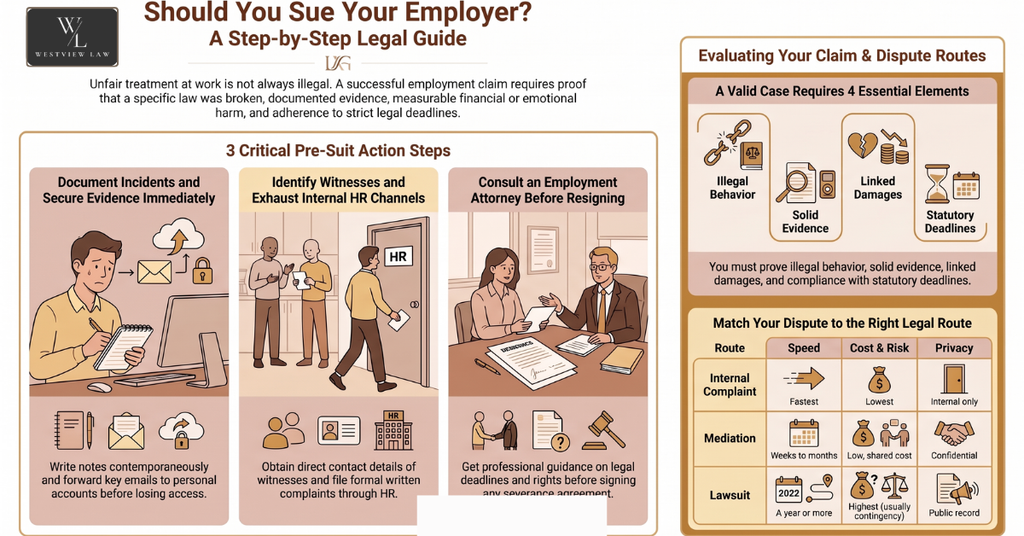
Very little of this process starts in a courtroom. These steps come first, and skipping them weakens everything that follows.
Step 1. Document Every Incident as It Happens
Write down the date and everything that happened or was said and who else was there. Keep those notes someplace apart from work systems. Notes you write at the time are much better than writing a summary long after the event.
Step 2. Gather the Supporting Material
Collect emails, memos, text messages, performance evaluations, your employment contract, pay slips, and any documents that show how other similar employees have been treated. Move any files that are currently stored solely in work accounts to personal ones since access usually ceases when you leave.
Step 3. Identify Your Witnesses Early
Get contact information of people who witnessed behavior or heard comments along with direct contact details rather than relying solely on the internal directory. Witness statements can really be the difference between just your word and real evidence.
Step 4. Use the Internal Procedures
Report the issue through writing to Human Resources and follow company procedures for grievances. Keep copies of all communications you send and receive. This is important both practically and legally because responses from employers or lack of response often turns into evidence later on.
Step 5. Consult an Employment Lawyer Before You Resign or Sign
A lawyer can explain what legal options you have, which legal basis apply, when deadlines are due and what exactly a severance agreement takes away. Generally speaking, most employment disputes are reviewed without cost involved, so talking about them doesn't carry any risk.
How to Determine If You Have a Valid Case

For a strong case there are basically four elements: illegal behavior, proof that this happened, a link between the behavior and damage done, and that no time limit has passed yet for dealing with the matter. Most people tend to concentrate on just the first element and then ignore the others. Strongest cases are usually quite ordinary and have very good documentation compared to ones that have weak paperwork but are dramatic.
Evidence and reliability matter much more than arguments based on law. Written records are more credible than memories; contemporaneous records are more credible than those that come later; and witnesses who work for the same employer are particularly believable because they have nothing to gain by being helpful to you. Employers generally do not admit things directly, so most cases rely on timing and inconsistencies as well as the discrepancy between what an organization says and what its own documents say.
If the case goes through, compensation usually includes different components. You get back money you have lost as salary from when something illegal happened until the matter is resolved. Also called "future pay," front pay compensates for future losses that would be difficult to recover.
Emotional distress damages compensate for the psychological harm. Punitive damages are available where the conduct was intentional and malicious, and California imposes no statutory cap on compensatory or punitive damages under state law, while federal claims are capped between $50,000 and $300,000 by employer size. Attorney's fees and court fees are recoverable in many employment cases, which changes the economics considerably.
Time limits end more legal claims than weak facts do, and the legal process starts with a deadline rather than a courtroom. In California, you generally have three years to file an administrative complaint with the Civil Rights Department and 300 days to file a charge with the EEOC, then one year from a state right-to-sue notice or 90 days from a federal one to enter the court system.
A wrongful termination claim based on public policy runs two years. Acting promptly is not just about deadlines, though: evidence disappears, witnesses leave, and memories blur while you deliberate.
Can You Bring an Emotional Distress Claim Against an Employer?
Psychological distress results from actions taken by an employer and includes things like stress, depression and problems with sleep alongside suffering in one's personal life. Unlike physical injury which has something that can be photographed evidence and unlike financial loss where you have an invoice or receipt, this kind of distress is very hard to prove and easy for employers to contest as well.
There is a threshold question most articles skip, and it decides whether the claim exists at all. Workers' compensation is generally the exclusive remedy for injury arising out of employment, and the California Supreme Court held in Cole v. Fair Oaks Fire Protection District (1987) 43 Cal.3d 148 that distress caused by normal parts of the employment relationship, such as demotions, criticism of your work, or friction over grievances, cannot be brought as a civil claim.
Livitsanos v. Superior Court (1992) 2 Cal.4th 744 confirmed the test. Distress claims are absorbed into workers' compensation unless the employer's conduct contravenes fundamental public policy or exceeds the risks inherent in employment.
In Accardi v. Superior Court (1993) 17 Cal.App.4th 341, the Court of Appeal held that emotional distress from sexual harassment under the Fair Employment and Housing Act is founded on conduct outside the normal employment environment, so exclusivity does not bar it. In practice, this means that workers can generally claim distress arising from discrimination, harassment, or retaliation, while distress from ordinary management decisions, no matter how poorly handled, is usually not claimable.
Strong evidence here needs specifics. Medical records and notes written by a doctor or therapist documenting things like anxiety and depression are the strongest proof. And an attending clinician can testify based on observations made.
Expert testimony can link behavior at work to diagnosis. Supporting claims with your old journals that show changes over time and statements from family and colleagues who have seen these changes all help. Medical bills and other related costs also back up the financial aspect of this situation as well.
Employers respond predictably to these claims. They say the stress or problem you describe comes from other parts of your personal life; they point out you never mentioned this before; they assert that any treatment for that issue preceded any alleged misconduct; and they say that whatever happened was just normal management actions so they shouldn't be considered exclusive. Showing early documentation addresses the first three points. Getting the legal theory right also helps with the fourth point since framing of the claim is important along with the evidence behind it.
What Are the Potential Cons and Risks of Suing Your Employer?

Retaliation is the fear people raise first, and the law addresses it directly. Labor Code section 98.6 creates a rebuttable presumption of retaliation where an adverse action follows protected activity within 90 days, and allows a civil penalty of up to $10,000 per employee.
Section 1102.5 protects whistleblowers on similar terms, Government Code section 12940(h) covers retaliation under state discrimination law, and Labor Code section 6310 protects employees who report unsafe conditions. Protection is real, but it operates after the fact, and knowing you can sue again is cold comfort while it is happening.
Navigating career consequences is much harder to legislate. Litigation becomes part of public records and although it is illegal for new employers to refuse to hire someone because they sued an old one, proving that is not easy. Most people bringing such cases don't plan on returning and figuring out at the start whether reinstatement or simply leaving cleanly will shape their overall strategy right from the beginning.
Financial and emotional costs really exist but are often overlooked. Most employment lawyers operate on contingency fees, so legal costs typically come out of any recovery rather than personal savings. Plaintiffs who win their case frequently get to recover attorneys' fees and other costs from employers as well.
The most significant cost is time. Going through contested hearings can drag on for years and you have to go into great detail about the worst moments of your work life to others whose job it is to cast doubt on you. Settlements are reached much sooner and avoid most of that.
Mediation and arbitration are the main alternatives. Note that arbitration may not be optional for you: the Ninth Circuit held in Chamber of Commerce v. Bonta, 62 F.4th 473 (2023), that federal law preempts California's attempt to ban mandatory employment arbitration, so a clause in your employment agreement is likely enforceable. Please review what you signed before assuming you have a choice of forum.
| Route | Speed | Cost and risk | Privacy | Control of outcome |
| Internal complaint | Fastest | Lowest | Internal only | Employer decides |
| Mediation | Weeks to months | Low, shared | Confidential | Both sides must agree |
| Arbitration | Months | Moderate, often employer-paid | Private | Arbitrator decides, limited appeal |
| Lawsuit | A year or more | Highest, usually contingency | Public record | Judge or jury decides |
Ready to Protect Your Employment Rights?
When deciding whether to sue, you need to ask yourself some straightforward questions. Has your boss broken actual laws rather than just doing things unkindly? Can you back this up with documents and witnesses? Is there still time to bring legal action? Have you tried using internal processes? If your answers say "yes" to these points, then you probably have something that is worth going after and if they say "no", a good employment law attorney can usually let you know quickly and save you from unnecessary effort.
Do not make that call alone, and do not make it slowly. Resolving workplace disputes well depends on acting while the evidence still exists and the clock is still running, and securing legal representation early is what keeps every route open. The initial assessment costs nothing.
Thinking about whether you should sue your employer? Westview Law represents employees in Los Angeles and throughout California, handling employment matters on a contingency fee basis. Founder David Safvati is a Fellow of the American Board of Trial Advocates, while Of Counsel Taylor Markey previously prosecuted discrimination cases for the federal government at the Equal Employment Opportunity Commission. If you believe your employer has violated your rights, contact us today for a free case evaluation and to learn what options may be available to you.
Frequently Asked Questions
Feeling like you've been treated unfairly at work and believing that there are legal grounds for recourse are two distinct things and that gap is where most of the questions people ask about this topic arise. What we often hear from folks who are weighing whether to do something.
How Do I Know if I Have a Valid Reason to Sue My Employer?
Getting treated unfairly alone is not usually sufficient for someone to win an unfair dismissal case. Being fired because you've complained about something, being denied reasonable accommodation for a protected characteristic, or harassment based on protected status usually is. And it's important to have legal representation who can look at the details of your situation in just one conversation.
What Steps Should I Take Before Deciding to Sue My Employer?
Record each incident as they occur; collect emails, reviews and pay slips and bring up any issues via the official internal channels of your employer first. Get legal advice before you quit or sign anything; this will be free and it will also strengthen what follows."
Can I Sue My Employer for Workplace Injuries or Unsafe Working Conditions?
Generally speaking, workers compensation is the main recourse for dealing with workplace injuries and it usually bars most civil lawsuits against your employer. There are some narrow exceptions though for cases of willful assault or if an employer is uninsured. You can still go after someone who is responsible or file reports about unsafe conditions with Cal/OSHA.
What Legal Protections Do Employees Have Against Retaliation for Filing a Lawsuit Against Their Employer?
There are some overlapping pieces of law that apply here. Section 98. 6 assumes retaliation has happened if someone takes adverse action against someone who has engaged in protected activity within ninety days; there is also a penalty of up to $10,000 per employee. Sections 1102. 5 and 6310 also offer protections to whistleblowers and safety. Counting retaliation separately means that bringing complaints can result in separate legal action.
How Can a Lawyer Help Me Determine if I Should Sue My Employer?
A skilled employment lawyer looks at all the facts and makes sure that every claim supported by evidence gets flagged. They also give you an idea of how long something might take and how much money it could be worth before you decide to go ahead. It's important to ask whether they work with workers or not; if they actually win actual cases; and how fees work out because what works well for one kind of claim may not work as well for another.
Disclaimer: This article is for informational purposes only and does not constitute legal advice. Reading it or contacting Westview Law does not create an attorney client relationship. Employment claims depend on the specific facts of each case, and no particular outcome is implied or promised. If you believe your employer violated the law, consult a licensed California attorney promptly, because filing deadlines continue to run.