


In general, how long you have to sue your employer in California is three years from when the discrimination happened to lodge a complaint with the Civil Rights Department. After that department sends you a notice allowing you to sue in court, you have another year to actually file a lawsuit. Employment lawsuits play out using multiple time limits depending on what your boss did wrong rather than how you label the problem.
Westview Law represents employees in California. Taylor Markey, of counsel, prosecuted Title VII, ADA, ADEA and Equal Pay Act cases as an Assistant Regional Attorney at the U.S. Equal Employment Opportunity Commission, so the administrative process is one she has worked from the inside. Paul Marks has practiced since 1988, is a Commissioner on the California Commission on Access to Justice, and belongs to the American Board of Trial Advocates. Employment matters are typically handled on a contingency fee basis, so if you are unsure whether your applicable deadline has already passed, contact us today for a free case evaluation.
In this article, we will cover what the statute of limitations is, when the different types of claims related to employment have to be filed by, any special cases that can push those deadlines further out, and actions to take right away if there's an ending to employment.
What Are the Statute of Limitations in California Employment Law?

Statute of limitations is a time limit set by law under which you can file a lawsuit alleging wrongdoing has occurred. It begins at the moment of wrongful action, and after this period expires, courts in California will simply dismiss the case regardless of how much solid evidence there is. This rule exists because people forget things over time; witnesses disappear and records are thrown out of regular retention schedules anyway, so the law sets a date beyond which defendants do not have to respond.
In employment law, this gets complicated, because one firing can generate several claims with different clocks. Being fired after complaining about workplace discrimination can support a Fair Employment and Housing Act claim, a common law wrongful termination claim, a Labor Code retaliation claim, and a breach of contract claim, and those deadlines are three years, two years, three years, and four years. Filing one late does not necessarily sink the others.
A second layer catches people out. Most California employment cases involving discrimination, workplace harassment, or retaliation require you to file a claim with a government agency before suing, a requirement called administrative exhaustion. That creates two deadlines in the legal process: an administrative deadline to file with the agency, then a separate legal deadline to start court proceedings after it finishes.
What Are the Different Types of Employment Claims?
The deadline that applies varies depending on what kind of legal issue you have; knowing these different main categories helps. For example, if it's about wages or wrongful termination, there is a specific time frame for filing as well.
Wrongful Termination
Wrongful termination means being fired for a reason the law forbids, not simply one that feels unfair. California employment is presumed at will, so the claim arises where an employer fires someone for reporting illegal conduct, taking protected leave, refusing to break the law, or because of a protected characteristic. Wrongful termination claims are the most common workplace disputes California courts see, and wrongful termination cases account for a large share of the state's employment filings.
Discrimination
Workplace discrimination occurs when one person treats another unfairly because of certain traits that are protected by law. Under California law, these traits include race, skin color, ancestry, national origin, religious beliefs, sex, gender identity or expression, sexual orientation, people age 40 and over, disabilities, genetic information, medical conditions, marital status, veteran status, and reproductive health choices. Title VII of the Fair Employment and Housing Act applies to employers with five or more employees; this standard is less stringent than federal law.
Harassment and Retaliation
Workplace harassment is unwelcome conduct based on a protected characteristic, severe or pervasive enough to alter working conditions, and California applies it to employers with even one employee. Retaliation claims arise when an employer punishes protected activity, such as complaining about harassment or assisting an agency investigation. They frequently outlive the underlying complaint, because retaliation is its own unlawful act with its clock.
Wage Disputes
Wage disputes cover unpaid wages, unpaid overtime, missed meal and rest breaks, and misclassification as an independent contractor or exempt employee. California has some of the strongest wage protections in the country, and employees can recover unpaid amounts along with penalties for late or incomplete payment. These claims often move through the Labor Commissioner before ever reaching court, which gives them a different process and timeline than the other categories here.
What Are the Wrongful Termination Statute of Limitations in California?
The headline figure is three years. Under Government Code section 12960, an administrative complaint alleging a Fair Employment and Housing Act violation must be filed with the Civil Rights Department within three years of the unlawful act. Assembly Bill 9 extended that deadline from one year, effective January 2020, so any source saying twelve months describes a law that changed six years ago.
Not every claim moves at the same pace. Other claims run differently, and the deadlines below matter most in practice.
| Claim | Deadline | Authority |
| FEHA administrative complaint to the Civil Rights Department | 3 years | Gov. Code § 12960 |
| Civil lawsuit after a state right-to-sue notice | 1 year from the notice date | Gov. Code § 12965 |
| EEOC charge (California) | 300 days | Federal deferral-state rule |
| Civil lawsuit after an EEOC right to sue letter | 90 days | Federal rule |
| Wrongful termination in violation of public policy | 2 years | CCP § 335.1 |
| Written employment contract | 4 years | CCP § 337 |
| Oral contract | 2 years | CCP § 339 |
| Unpaid wages and statutory Labor Code claims | 3 years | CCP § 338(a) |
| Labor Code § 1102.5 whistleblower retaliation | 3 years | CCP § 338(a) |
There are several things that affect these deadlines. Claims you make are the most important, as claims for both contract disputes and public policy violations often have different deadlines. If your employer is a public body, a non-FEHA civil claim generally has to be brought within six months according to Government Code section 911. 2. Arbitration agreements can also change where an arbitration case goes, and sometimes they reduce the time frame as well. So read carefully the agreement you signed when you were hired.
A workers' compensation claim runs on its own track. The deadline can also be extended. The continuing violation doctrine treats a series of related acts as one violation running from the last, and the California Supreme Court set the test in Richards v. CH2M Hill, Inc. (2001) 26 Cal.4th 798: the acts must be similar in kind, recur with reasonable frequency, and not yet have acquired a permanence that would tell a reasonable employee further informal efforts were futile.
Equitable tolling can pause the clock where an employee reasonably pursued another remedy first, as in McDonald v. Antelope Valley Community College District (2008) 45 Cal.4th 88. The delayed discovery rule postpones accrual until you have reason to suspect both the harm and its wrongful cause, per Fox v. Ethicon Endo-Surgery, Inc. (2005) 35 Cal.4th 797. Time as a minor or without legal capacity is excluded under Code of Civil Procedure section 352, and where an employer concealed what it did, courts can stop it from relying on the deadline at all.
Determining if something constitutes an exception is really hard, and guessing isn't a good idea either. Practical tests include checking if an action happened repeatedly instead of just one time, seeing if you pursued a grievance internally sincerely, and whether you could have reasonably known why something happened at the time. If any of those conditions apply, consult an employment lawyer in California before deciding that this matter is closed.
How Long Do You Have to Sue for Wrongful Termination in California?

The truth is that it depends very much on the specific theory involved. Most people actually have multiple theories they could pursue as well. If you get fired because of something that is protected under FEHA (Fair Employment and Housing Act) or if you're fired because you complained about some protected thing, then you would be on the FEHA track.
You need to file a complaint with the Civil Rights Division within three years. Then you have one year from receiving a "right to sue" notice to file a civil lawsuit. But there is an important distinction here: this year doesn't start counting from the day you receive the notice; it starts when you get the notice. Some people have lost their cases because they didn't understand this difference.
If the claim is that you were fired for a reason violating fundamental public policy, such as refusing to commit an illegal act or reporting workplace safety violations, that is a tort with a two-year limit under Code of Civil Procedure section 335.1 and no agency filing first. A Labor Code section 1102.5 whistleblower claim runs three years and also needs no administrative exhaustion. Since the shortest applicable deadline governs, assume your real one is the earliest on the list.
Steps to Take Immediately After Termination
What you do in the first week shapes what is provable later. Work through these in order.
Step 1. Request Your Personnel File in Writing
In California, you have rights to check and copy your payroll records. When you ask for them in writing, that makes a date certain of when the employer received the request. Requesting them along with other records like pay stubs is also good.
Step 2. Preserve Your Own Evidence
Keep track of performance reviews, emails, texts, and any notes regarding why you've been let go, and transfer anything stored strictly on company accounts to your personal ones before they have access to that information removed. Take screenshots that include clear date information rather than relying just on memory later.
Step 3. Write a Dated Timeline
Keep track of when you made complaints or disclosures or asked for things and who you talked to as well as any actions taken against you as a result. Actions over time are important under continuing violation theory, and you should focus on noting patterns rather than just firing alone.
Step 4. Do Not Sign Anything Yet
It is typical for severance agreements to release claims and shorten time limits. Once signed, these agreements become quite hard to reverse. Have an employment lawyer look at it before you agree.
Step 5. Identify Your Witnesses
Let colleagues know about any changes to their treatment and any comments they heard. Please include contact information that doesn't rely on having an office directory. People tend to disperse quickly after downsizing.
Step 6. Consult an Employment Attorney Immediately
An attorney can distinguish every available claim and which one has the nearest filing deadline, which is very important because this is something that moves quickly in the process. Many employment lawyers in California review cases for free.
What Is the Importance of Acting Promptly After a Wrongful Termination?

Failing to meet deadlines also means that claims and related legal recourse go away. Courts simply dismiss cases if they receive them too late and don't get to the facts. So an employer who has clearly broken the law goes unpunished because papers were filed late. There is no partial credit either; employers routinely raise this defense as something normal.
Taking action early also increases the value of a case, including an award for attorneys' fees. Evidence still exists, and witnesses are available and can recall details; moreover, the employer hasn't yet gone through a legitimate retention process that gets rid of necessary records. Taking action early preserves possibilities that slowly disappear, like trying to file with both agencies. That is because their time limits differ: deadlines close quickly and most people haven't made up their minds yet.
What Is the California Statute of Limitations for Discrimination?
The California Civil Rights Department, which used to be called the Department of Fair Employment and Housing and was renamed in July 2022, deals with discrimination complaints at the state level. You file an administrative complaint, and then the agency investigates that complaint or sends you a letter immediately, allowing you to sue directly if you prefer. Fees aren't charged; you don't have to hire a lawyer either, but many find advice useful first.
The timeframe is three years from the discriminatory act to file with the agency, then one year from the right-to-sue notice to file in the California Superior Court. The Civil Rights Department recorded 16,924 employment right-to-sue complaints in 2024 alongside the matters it investigated itself.
What Alternative Legal Routes Are Available?
California also sets much shorter deadlines for making complaints. Under California law, charges alleging discrimination need to be filed with the Equal Employment Opportunity Commission (EEOC) within 300 days as opposed to the usual 180 days because California has its own enforcement body.
After receiving a letter from the EEOC that you can sue, you have just 90 days to bring your case in federal court. By comparison, normally there are three years from when discrimination happens before you can take legal action federally and one year if the complaint involves retaliation or equal pay. There's thus quite a difference.
Systems vary beyond just timing; federal law puts an upper limit on total compensatory and punitive damages based on company size, but California does not have such limits. Also, federal laws usually require there to be at least 15 employees before FEHA applies to as few as five.
Under an agreement to share work, filing one complaint properly preserves both charges. Under Government Code section 12965, once there is a pending federal charge, the state clock stops ticking. Violations of wage law also proceed via the California Labor Commissioner or through the courts; generally speaking, claims for unpaid wages and other related things have a three-year time limit.
Ready to File a Lawsuit Against an Employer in California?
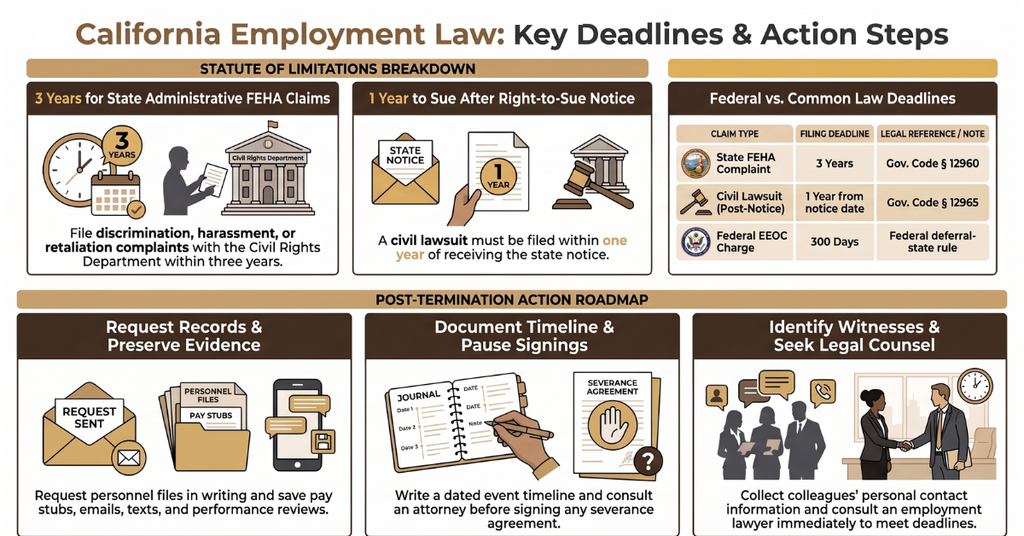
Deadlines are clear but very strict. For filing a discrimination case at the state level you have three years; then you have one year from a notice to file a lawsuit; 300 days for charges under federal law; 90 days after a federal notice; two years for a public policy claim; and four years for contracts and three for most wage disputes.
There are exceptions though. Doctrines such as continuous violation, equitable tolling and delayed discovery do exist, but they're not things you can count on. They are just arguments that must be made and proven. Consult an employment attorney as soon as possible to understand your options and protect your rights.
If you think your employer acted unlawfully, find out which clock you are on before it runs out. Bring what you have, even if incomplete. Westview Law's employment lawyers represent employees throughout California and review cases at no cost, so contact us today for a free consultation.
Frequently Asked Questions
When you get let go unfairly versus being fired illegally is very different and knowing which is true makes all other issues clearer. Here are the questions we hear most from people weighing a claim.
Can I Sue My Employer in California After Being Fired?
Yes, if firing someone violates the law rather than simply being unfair, at-will employment does not allow employers to terminate employees because of characteristics that are protected, because of reporting illegal behavior, or because they have taken protected leave. Whether or not you can sue right now depends on which deadline is applicable and whether that deadline has already passed.
Are There Exceptions to the Statute of Limitations?
Yes, there are some exceptions to the statute of limitations, such as the continuous violation doctrine, equitable tolling, and delayed discovery if one suspects they have been harmed. Children are also excluded from this limitation period, and an employer can lose its right to use this period if they conceal their actions.
How Long Do I Have to Sue My Employer in California?
Claims of discrimination, harassment, or retaliation can be filed with the Civil Rights Department within three years, and you have one year from receiving a notice that you may sue. Claims based on public policy can be brought in two years; claims based on written contracts are four years; and claims under federal law must be filed within 300 days, and lawsuits must be filed within 90 days.
What Steps Should I Take if I Believe I Have a Legal Claim Against My Employer in California?
Write down your personnel files, keep emails, texts, and reviews, and create a timeline when things are still fresh. Also review your employment contract and arbitration clauses as well. Seek legal advice from an employment lawyer promptly because figuring out all claims helps you know which deadline is closest.
Can I File a Lawsuit Against My Employer in California if I Have Already Filed a Complaint With the DFEH or EEOC?
Yes, and as a general rule, you need to file your case with an agency first before going ahead with suing. If you do so, the Civil Rights Department will issue a notice that you can actually sue. This notice essentially clears the way to court.
How Can Westview Law Help Me With a Lawsuit Against My Employer in California?
The company represents workers rather than bosses and handles cases free of charge, usually using a contingency fee system. After a review we identify all claims that are supported by your evidence and also determine what deadlines apply to them.
Disclaimer: This article is for informational purposes only and does not constitute legal advice. Reading it or contacting Westview Law does not create an attorney-client relationship. Limitations periods depend on the specific facts of each case and on claims that may not be described here, and no particular outcome is implied. If you need advice about your situation, consult a licensed California attorney promptly, because deadlines continue to run while you decide.