



A wrongful termination claim can feel like a black box when you know your employer crossed a line but don't know what your case is actually worth. Westview Law's wrongful termination settlement calculator gives California employees a starting estimate based on the factors that drive real recoveries: lost wages, lost benefits, emotional distress damages, and exposure to punitive damages and attorney fees. It's a free first look at compensation under California employment law.
Wondering what your wrongful termination claim may be worth? Westview Law's employment attorneys have extensive experience helping California employees evaluate wrongful termination, discrimination, retaliation, and other workplace claims. Our wrongful termination settlement calculator can provide a helpful starting point, but every case is unique and deserves a personalized legal review. Contact us today for a free consultation to discuss your situation, understand your options, and determine the best path forward.
In this article, we will explain what wrongful termination is, how settlements are calculated, the factors that drive value, and how Westview Law's calculator and legal team can help you understand what your case is worth.
What Is Wrongful Termination?
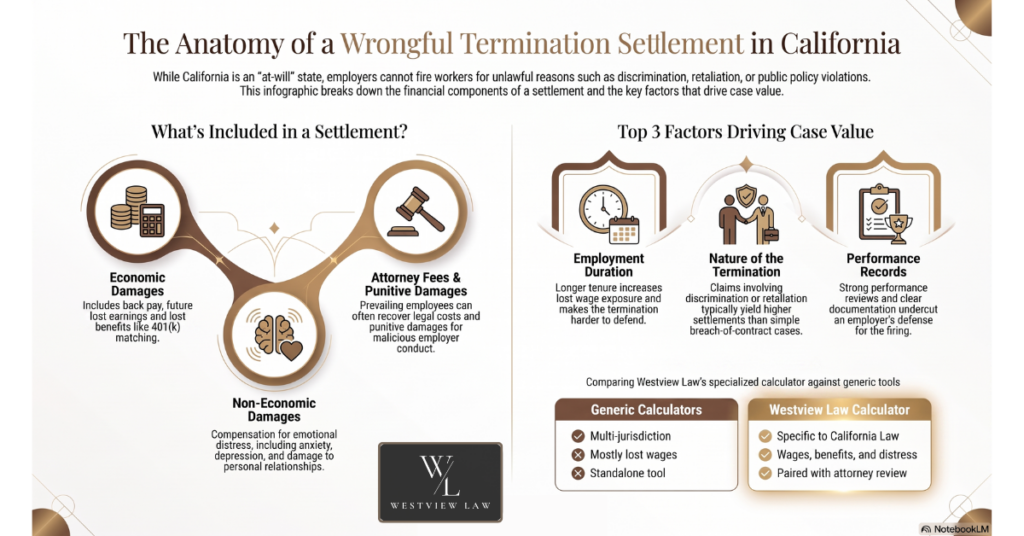
Wrongful termination occurs when an employer fires an employee for an illegal reason, discrimination, retaliation, refusing to break the law, or in violation of an employment contract or public policy. California is an at-will state, which means employers can usually fire workers for any reason or no reason at all, but they cannot fire for an unlawful reason. The difference is everything, and it is the basis for a legal claim in many wrongful termination cases.
Common examples include termination based on race, sex, age, disability, pregnancy, religion, or national origin under FEHA. They also include firing in retaliation for reporting harassment, wage theft, or safety violations under Labor Code sections 1102.5 and 6310, termination for taking protected medical or family leave under CFRA or FMLA, and discharge for refusing to participate in illegal conduct, which California courts recognize as the Tameny tort of wrongful discharge in violation of public policy. Each carries different remedies, but the legal protections often overlap in a single case, and the employer's actions may ultimately support a wrongful termination lawsuit.
What Is the Importance of Addressing Wrongful Termination?
The emotional and financial impacts hit quickly. A wrongfully terminated employee loses a paycheck, health insurance, retirement contributions, and access to the routines that organize daily life. Many people describe a wave of self-doubt that follows; the loss isn't just income, it's identity. In discrimination and retaliation cases, workers may also find themselves dealing with agencies such as the Equal Employment Opportunity Commission.
Medical bills can pile up while you're between insurance plans. COBRA premiums eat into savings, and a gap on a resume can create pressure to accept the first offer instead of the right one. Spouses and kids feel it too. The household budget collapses in weeks if there's no severance, and that pressure pushes people into decisions such as accepting a token severance, signing a release, or walking away from a real claim that they later regret.
The long-term career consequences are real too. A termination on your record affects future income, professional reputation, and references. Some workers spend years rebuilding what an unlawful firing took away, and in industries where reputation travels (law, finance, healthcare, tech), the damage can outlast the actual lost wages by a decade.
"The point of pursuing a wrongful termination claim isn't only the money," says Paul Marks, an attorney at Westview Law. "It's about restoring what was wrongly taken, holding the employer accountable, and making it harder for the same conduct to happen to the next worker." California's legal protections exist precisely because the legislature recognized that wrongful termination occurs often enough to need a real remedy, and an experienced attorney can help enforce those protections.
How Is a Wrongful Termination Settlement Calculated?
A wrongful termination settlement adds up several distinct categories of compensation, and each is calculated differently under California law. Understanding the components is the first step to understanding how wrongful termination compensation is calculated in a particular case and why two cases that look similar on the surface can settle for very different amounts.
Lost wages are usually the foundation. This includes back pay (wages and bonuses lost from termination through settlement or court judgment) and, in many California cases, front pay (future earnings lost until you're reasonably expected to find comparable work). Lost benefits include health insurance premiums you paid out of pocket, lost retirement contributions, lost stock options or RSUs, and the value of other employer-paid benefits. These losses generally make up the economic damages portion of wrongful termination compensation.
California employees also have a duty to mitigate their damages. This means making reasonable efforts to find comparable employment after a wrongful termination. Any income earned from a new job or other employment opportunities during the claim period is generally deducted from lost wage damages, which can reduce the final settlement amount. The extent of the reduction depends on factors such as when new employment was secured and how closely it matches the employee's previous position and compensation.
For mid-career professionals, lost benefits can sometimes exceed lost salary over a multi-year period. Equity vesting, employer 401(k) matching contributions, and high-end health coverage add up faster than most people expect. Documenting every category at the calculator stage matters because the categories you forget to claim are the categories you don't recover.
Emotional distress damages compensate for psychological harm, including anxiety, depression, sleep loss, and damage to personal relationships. California allows emotional distress compensation in wrongful termination cases without requiring a separate diagnosis, though medical records and treatment make the claim stronger. The value depends on the severity, duration, and how well it's documented. These losses are commonly categorized as non-economic damages and can represent a substantial portion of wrongful termination damages.
Legal fees and costs come into play in two ways. First, in cases brought under statutes like the Fair Employment and Housing Act, the prevailing employee can recover attorney fees and court costs from the employer, a major leverage point that often makes the case economically viable to bring. Second, when calculating what an employee nets from a settlement, contingency fee arrangements typically deduct a percentage of the recovery plus legal expenses. The gross settlement and the net to the employee are different numbers.
What Is the Role of a Settlement Calculator?
A wrongful termination calculator simplifies complex calculations by walking through the components and producing a range estimate. Westview Law's tool asks for the inputs that drive value, including salary, tenure, benefits, the nature of the termination, and the type of unlawful conduct, then returns an estimate based on how California settlements typically calculate in similar cases, including factors that influence the average wrongful termination settlement.
The calculator also uses economic damages as a starting point. In many cases, economic losses are initially estimated based on an employee's total annual compensation and the period of lost earnings. The final calculation may then be adjusted to account for lost benefits, future earnings, mitigation of damages, and other case-specific factors that affect settlement value.
It's not a substitute for legal advice, but it gives you a realistic starting point before you decide whether to file a wrongful termination claim, whether the potential recovery is a few thousand dollars or substantially more, and before you commit significant financial resources to pursuing the case.
Settlement values can vary widely depending on the facts of the case. The U.S. Equal Employment Opportunity Commission (EEOC) reports recovering hundreds of millions of dollars annually for workers through mediation, conciliation, settlements, and litigation, but it does not publish a standard settlement value for wrongful termination claims. Claims involving substantial lost wages, strong evidence of discrimination or retaliation, significant emotional distress, or exposure to punitive damages may resolve for considerably more.
What Factors Are Considered in a Wrongful Termination Settlement Calculator?

Several key factors shape what a wrongful termination case is worth in California. The calculator weighs each one to produce a range, and your case may sit above or below that range depending on the specifics. Here are the three factors that move settlements the most, including issues related to California proving wrongful termination.
1. Employment Duration
Tenure matters because it drives the lost wages calculation. A worker who spent twelve years at a company has built up more in back pay exposure, retirement contributions, accrued vacation, and seniority-based benefits than a worker fired after six months.
Longer employment also tends to make the termination harder to defend. An employer who praised your performance for a decade and then fired you a month after you reported harassment will have a harder time explaining the timing. Tenure feeds into front pay calculations and future earnings too, since longer-tenured workers usually take more time to find equivalent compensation in the job market.
2. Nature of Termination
Why you were fired drives the value as much as anything else. A termination based on race or sex discrimination triggers FEHA's full remedy set, including emotional distress damages and uncapped punitive damages when the employer's conduct meets the malice or oppression standard. Depending on the facts, a plaintiff may recover compensatory or punitive damages. A retaliation case under Labor Code 1102.5 carries its own civil penalty and reinstatement rights.
A breach-of-contract termination, where you were fired in violation of an express or implied employment contract, focuses more on contract damages than tort damages. Discrimination, retaliation, harassment, and public-policy claims often produce higher settlements than pure contract claims because of the broader damages available.
3. Employee Performance and Records
Your performance reviews, disciplinary record, attendance, and the documentation around your termination shape the case in both directions. Strong performance reviews followed by an abrupt termination are powerful evidence. They undercut the employer's "performance" defense and support the inference that the real reason was unlawful. Pay stubs, emails, witness statements from coworkers, and formal complaints you filed through HR all build the record and help explain the employer's actions.
On the other side, a documented history of warnings the employer can point to may complicate the case, though it rarely defeats it when the underlying reason was discriminatory or retaliatory. Documentation is the difference between a strong claim and a hard one.
Benefits of Using Westview Law’s Wrongful Termination Settlement Calculator
Westview Law's wrongful termination settlement calculator gives California employees a clearer picture of what their claim may be worth. The estimate is based on California employment laws and considers factors such as lost wages, lost benefits, future income losses, emotional distress, and other wrongful termination damages that may apply. This helps workers approach their next steps with realistic expectations rather than relying on an employer's initial offer and better understand their potential wrongful termination compensation.
The calculator also helps users understand what can influence the value of a case. Details such as the reason for the termination, the employer's conduct, available evidence, and the strength of supporting documents can all make a difference. Seeing these factors firsthand helps employees better understand how wrongful termination claims are evaluated.
While the calculator provides a useful starting point, every case has unique details that a tool cannot fully assess. After receiving an estimate, employees can speak with Westview Law's legal team to discuss their situation in more depth. The attorneys review the facts, identify potential legal issues, and explain the options available under California law.
Westview Law assists employees with a wide range of workplace matters, including wrongful termination claims, retaliation cases, whistleblower complaints, FEHA and EEOC filings, severance agreement reviews, and wage disputes. The calculator offers a free way to begin evaluating a claim, and the firm's consultation is available at no cost. The table below highlights some of the key differences between generic online calculators and Westview Law's wrongful termination settlement calculator.
| Factor | Generic Online Settlement Calculators | Westview Law's Settlement Calculator |
|---|---|---|
| Legal Focus | Often designed for a broad audience and multiple jurisdictions. | Built specifically around California employment law. |
| Damage Categories | May focus primarily on lost wages. | Considers lost wages, benefits, emotional distress, and other potential damages. |
| Case Context | Provides a general estimate with limited legal insight. | Designed to reflect factors commonly involved in California wrongful termination claims. |
| Attorney Support | Usually a standalone tool. | Paired with a free consultation from an experienced employment attorney. |
| Next Steps | Leaves users to interpret the results on their own. | Helps users understand their options and make informed decisions about pursuing a claim. |
Competitive Advantage of Westview Law

Westview Law focuses on California employment law, including wrongful termination, discrimination, retaliation, and workplace harassment claims. This experience is valuable because employment cases often involve strict filing deadlines and legal procedures that can affect the outcome. The firm's attorneys understand how California and federal employment laws work together and use that knowledge to guide clients through the process.
The firm's experience with wrongful termination cases also helps during settlement negotiations. Westview Law evaluates claims based on real-world case results and the damages that may be available under the law, including lost income, emotional distress, attorney fees, legal fees incurred, and, in some cases, punitive damages. This approach helps position clients for settlements that reflect the full value of their claims under California law.
Westview Law supports clients through every stage of a wrongful termination case. The firm assists with investigations, evidence collection, administrative complaints, settlement discussions, mediation, and litigation when necessary. For wrongful termination matters, Westview Law works on a contingency fee basis, allowing employees to pursue their claims without paying attorney fees upfront.
After being fired shortly after reporting discrimination at work, Maria was unsure whether pursuing a claim made financial sense. She used Westview Law's wrongful termination settlement calculator to get a general estimate of what her case might be worth based on her lost wages and other damages. The results gave her a clearer picture of her options and encouraged her to speak with a Westview Law attorney. After reviewing the facts, the legal team helped her build a strong case and negotiate a favorable settlement that provided compensation and peace of mind.
Ready to Understand How Much Your Wrongful Termination Settlement Might Be Worth?
If you've been wrongfully terminated, understanding what your case might be worth is the first step toward getting it. Westview Law's wrongful termination settlement calculator gives you a free, fast, California-specific estimate based on the factors that actually drive recoveries. The calculator is a starting point; the conversation with an experienced employment attorney is what turns that estimate into a real claim.
Don't rely solely on what your former employer tells you. Don't sign a severance agreement without legal review. Don't let the statute of limitations on your wrongful termination claim run out. California has tight deadlines on FEHA charges and other employment claims, and the clock starts the day you're fired.
Think your employer crossed the line? Don't guess what your wrongful termination claim might be worth. Westview Law helps California employees assess their legal options, calculate potential damages, and understand the factors that can affect settlement value. Start with our wrongful termination settlement calculator, then contact our team for a free case review and tailored legal guidance.
Frequently Asked Questions
Questions about wrongful termination settlements are common, especially when employees are trying to understand what their claim may be worth. This FAQ section answers some of the questions we hear most often about settlement calculations, damages, and wrongful termination claims in California.
How Does a Wrongful Termination Settlement Calculator Work?
A wrongful termination settlement calculator uses details like your salary, benefits, length of employment, and reason for termination to estimate the potential value of your case under California law. Westview Law’s tool also connects you with an experienced employment lawyer who can review your situation and provide a more accurate assessment.
What Factors Are Considered in a Wrongful Termination Settlement Calculator?
Several factors can affect a wrongful termination settlement, including your salary and benefits, length of employment, reason for termination, and the strength of the evidence supporting your claim. Other considerations include emotional distress, lost future earnings, attorney fees, punitive damages, and how long it may take to find comparable employment.
Is Using a Wrongful Termination Settlement Calculator Accurate?
A wrongful termination calculator can provide a realistic settlement estimate based on common case factors, but it cannot account for every detail. Use the estimate as a starting point and speak with an experienced employment attorney for guidance tailored to your specific situation.
Can I Use a Wrongful Termination Settlement Calculator for Any State or Country?
Westview Law’s calculator is designed for California employment law, which provides remedies and protections that may differ from those in other states. If your claim arose outside California, the calculator can still help you understand the factors that affect case value, but the estimate should be evaluated under the laws that apply in your jurisdiction.
How Can Westview Law Assist Me With My Wrongful Termination Case?
Westview Law offers free consultations, a California-specific settlement estimate through its calculator, and legal representation on a contingency fee basis. The firm assists with every stage of a wrongful termination claim, including agency filings, settlement negotiations, mediation, and trial, while working to pursue compensation that reflects the full impact of the termination.
Disclaimer: This article is for general informational purposes only and is not legal advice. Reading it does not create an attorney-client relationship with Westview Law. Wrongful termination claims are highly fact-specific, and the outcome of any case depends on facts not addressed here. Calculator estimates are illustrative and do not guarantee any particular result. For advice tailored to your situation, contact a licensed California employment attorney.