


Filing a wrongful termination claim in California starts with reviewing your employment records, gathering evidence, and speaking with an employment lawyer. Employees may also need to file a complaint with the appropriate state or federal agency before filing a lawsuit. Understanding the proper steps early can help protect your rights and strengthen your case.
Wrongful termination claims can be complex, especially when strict filing deadlines and legal procedures are involved. At Westview Law, we help California employees understand their rights, gather evidence, and pursue claims involving unlawful termination, discrimination, and retaliation. Our legal team works closely with clients to build strong cases and guide them through every stage of the process. If you believe you were wrongfully fired, contact us today to discuss your legal options and protect your future.
In this blog, we will explain the key steps involved in filing a wrongful termination claim in California, including gathering evidence, filing with the proper agency, and preparing for mediation or court.
Understanding Wrongful Termination Laws in California
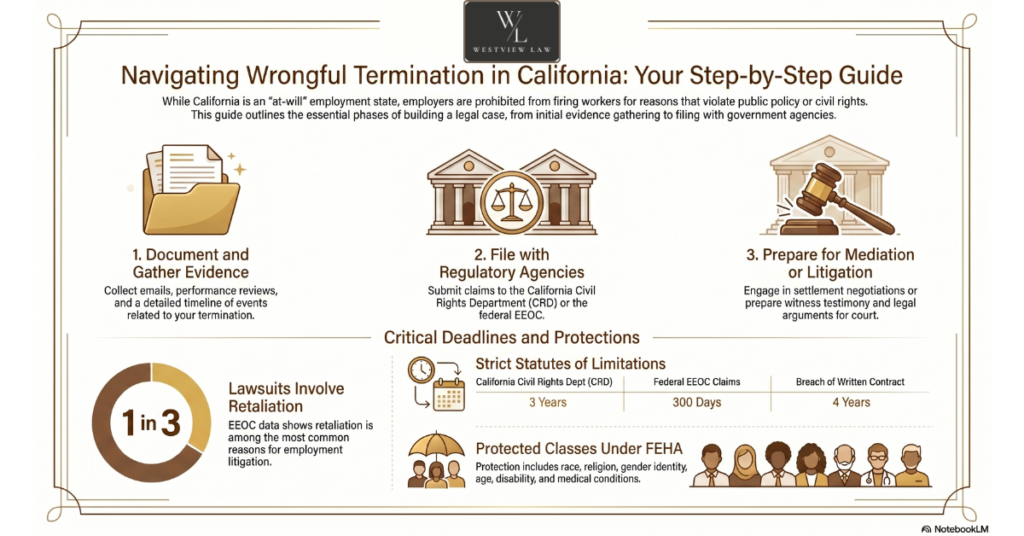
California follows an at-will employment system where employers can generally end employment at any time and for many reasons. Employees can also leave their jobs at any time. However, at-will employment does not give employers the right to fire workers for illegal reasons, including conduct that may lead to wrongful termination in California or California wrongful termination claims.
There are important exceptions to at-will employment rules. Employment contracts and workplace agreements may place limits on when or how an employee can be terminated. In some cases, even verbal promises or employer actions may create implied contracts. These situations can affect an employer's ability to end employment freely.
California law also protects employees from terminations that violate public policy and civil rights laws. An employer cannot legally fire someone for reporting unlawful activity, refusing to participate in illegal conduct, or exercising protected workplace rights. Understanding these protections can help employees recognize when a termination may raise legal concerns.
Protected Classes Under California Law
California law protects employees from unlawful discrimination based on certain personal characteristics known as protected classes under the Fair Employment and Housing Act (FEHA). These protections can include race, color, religion, sex, gender identity, sexual orientation, age, disability, national origin, marital status, pregnancy, medical condition, and other protected categories. California has expanded protections over time to address changing workplace issues, including sexual harassment, and provide broader rights for employees.
Understanding these protections is important because they help employees recognize unfair treatment in the workplace. Knowing your rights can help you identify when actions cross legal boundaries. It can also help you take steps to protect yourself if you believe discrimination or wrongful treatment has occurred.
How to Prove Retaliation or Discrimination
Proving retaliation or discrimination often requires showing a few key facts to prove wrongful termination or support an alleged wrongful termination claim. In retaliation cases, an employee may need to show that they took part in a protected activity, such as reporting misconduct, raising workplace safety concerns, or filing a complaint, and later faced an adverse action. In discrimination cases, the issue is whether the employee was treated unfairly because of a protected characteristic or another discriminatory act. Timing and workplace actions can sometimes help reveal important patterns.
Evidence can play a major role in supporting a claim. Relevant examples include emails, text messages, performance reviews, workplace complaints, and witness statements. Keeping records can help create a clear timeline of events. Motive can also matter because it may help show why an employer made a decision to terminate employment.
What Are the Steps to File a Wrongful Termination Claim in California?

Being wrongfully terminated can leave you uncertain about your rights and next steps. California employees may have legal protections if they were fired because of discrimination, retaliation, whistleblowing, or other unlawful reasons, and understanding the process can help you protect your claim. Below are the key steps involved in filing a wrongful termination claim in California and possibly pursuing a wrongful termination lawsuit to recover compensation.
Step 1: Review Your Employment Contract
Carefully review your employment contract, employee handbook, or severance agreement to understand your workplace rights, job duties, job security, and termination terms. These documents may contain policies, arbitration clauses, or procedures that could affect your claim.
Step 2: Gather Evidence
Collect important evidence such as emails, performance reviews, disciplinary records, pay stubs, termination letters, personnel files, and a detailed timeline of events related to your termination. Organizing these records can help support an employee-based claim and make the legal process easier to navigate.
Step 3: Consult with an Employment Lawyer
An employment lawyer can evaluate your case, explain your legal options, and help you avoid mistakes that could weaken your claim. California wrongful termination lawyers, including a founding partner, may offer a free consultation and help with gathering evidence, filing claims, and pursuing compensation.
Step 4: Filing the Claim
Wrongful termination claims may be filed with the Equal Employment Opportunity Commission (EEOC) or the California Civil Rights Department (CRD), depending on the type of violation involved. In some situations, a wage claim may involve the labor commissioner, the labor commissioner's office, or the California Department of Industrial Relations, depending on which agency has authority over the issue.
Step 5: Preparing for Mediation or Court
Many wrongful termination cases go through mediation before reaching court, giving both sides a chance to negotiate a settlement. If the case proceeds to litigation, your attorney will prepare evidence, witness testimony, legal arguments, and any required right-to-sue notice documents to support your claim.
Filing Options and What to Expect at Each Stage
Understanding your options at each stage of a wrongful termination claim can help you make more informed decisions and avoid unnecessary delays. The table below breaks down the key steps in the process and highlights the trade-offs involved so you can better understand what each path may mean for your case.
| Option/Step | When It’s Used | Pros | Cons/Trade-offs |
|---|---|---|---|
| Internal document review (contract, handbook, policies) | Early stage after termination | Helps identify rights and violations quickly | Limited if employer policies are vague or incomplete |
| Filing with EEOC or California Civil Rights Department (CRD) | Discrimination, harassment, retaliation claims | Required before many lawsuits; builds official record | Adds time before you can go to court |
| Direct lawsuit (after agency process or in eligible cases) | Strong evidence or unresolved agency claims | Potential for higher compensation and full legal remedies | Longer process, more complex, higher burden of proof |
| Mediation / settlement negotiations | Any stage after filing a claim | Faster resolution, lower stress, avoids trial | May result in lower payout than court award |
| Relying on evidence alone vs. attorney support | Throughout the process | DIY approach saves initial cost | Higher risk of missed deadlines or weaker claim strategy |
What Are the Time Limits for Filing a Wrongful Termination Claim in California?

Time limits are important when filing a wrongful termination claim in California. These deadlines are called statutes of limitations. Different claims may have different filing requirements, and California varies depending on the situation. Acting quickly can help protect your legal rights.
Some wrongful termination claims may require filing a complaint with a government agency before taking legal action. Claims involving discrimination or retaliation may involve agencies such as the Equal Employment Opportunity Commission or the California Civil Rights Department.
In California, employees generally have three years from the date of the alleged discrimination or retaliation to file a complaint with the California Civil Rights Department. Federal EEOC claims are often subject to a 300-day filing deadline. After receiving a right-to-sue notice, employees may have additional deadlines to file a lawsuit in court.
Other wrongful termination claims may follow different timelines. For example, breach of written contract claims in California are generally subject to a four-year statute of limitations, while some claims involving oral agreements may have a two-year deadline. Certain whistleblower or public policy claims may also have shorter filing periods depending on the law involved.
Missing a filing deadline can affect your ability to pursue a claim. In many cases, courts may dismiss a case if it is not filed on time. There may be limited exceptions in certain situations, but relying on them can be risky. Keeping records and seeking legal guidance early can help you avoid missing important deadlines.
What Are the Common Reasons for Wrongful Termination Claims?
Wrongful termination claims often happen when an employee believes they were fired for an illegal reason. One common reason is discrimination. This can include situations where an employer fires someone because of age, race, gender, religion, disability, pregnancy, or another protected characteristic. Signs of discrimination may include unfair treatment, offensive comments, being denied a reasonable accommodation, or being treated differently from other employees in similar situations.
Retaliation is another common reason for wrongful termination claims and one of the most frequently cited. In fact, recent EEOC data shows that retaliation was alleged in roughly one-third of employment discrimination lawsuits filed in fiscal year 2025, highlighting how often employees report being punished after speaking up or asserting their rights. Employees may receive protection when they report harassment, discrimination, or unsafe work conditions; file a workers' compensation claim; or request medical leave.
Whistleblowers also have legal protections under certain laws. Signs of retaliation may include sudden disciplinary actions, poor performance reviews without explanation, or termination shortly after making a complaint.
Wrongful termination claims can also involve breaches of employment contracts or company policies. An employer may violate a written agreement or fail to follow its own workplace rules before terminating employees. Employees who believe a contract or policy was ignored should review their records and save important documents. Keeping evidence can help if legal concerns arise later.
After working at a mid-sized logistics company in California, Daniel raised safety concerns about faulty equipment. He was soon after terminated under the claim of performance issues, despite a strong track record of positive reviews. Feeling uncertain, he gathered emails, performance evaluations, and messages showing a clear shift in treatment after his complaint and consulted an attorney at Westview Law for advice.
His lawyer helped him recognize a potential retaliation claim, guided him through filing with the California Civil Rights Department, and prepared the case for mediation. With strong documentation and legal support, the case was resolved through a favorable settlement that provided Daniel with compensation and closure.
Ready to File a Wrongful Termination Claim in California?

Filing a wrongful termination claim in California involves several important steps. This blog explains how to review your employment records, gather evidence, file with the proper agency, and prepare for mediation or court. It also covers why filing deadlines matter, how strong documentation can help support your case, and how lost wages may affect your claim.
Wrongful termination cases can feel overwhelming, especially after losing a job unexpectedly or while searching for a new job. Speaking with an employment attorney can help you better understand your rights, avoid mistakes, and determine the best path forward. If you believe your firing was illegal, getting legal guidance early may help protect your claim and improve your chances of a successful outcome.
Have you been fired for reasons that felt unfair or illegal? Westview Law helps California employees navigate wrongful termination claims involving retaliation, discrimination, harassment complaints, and other workplace violations. Our team understands how quickly evidence and filing deadlines can affect a case, which is why early legal guidance matters. Schedule a consultation with us to learn how you can protect your rights and pursue the compensation you may deserve.
Frequently Asked Questions
This FAQ section answers common questions about how to file a wrongful termination claim in California. It explains important steps in the process, filing requirements, and what employees should know when protecting their legal rights.
What Are the Steps to File a Wrongful Termination Claim in California?
Filing a wrongful termination claim usually starts with collecting important evidence. Save emails, text messages, performance reviews, and records related to your termination. You may also need to file a complaint with a government agency before taking legal action. Each step is important because it helps support your case and protect your rights.
Is There a Time Limit to File a Wrongful Termination Claim in California?
Yes, there are deadlines for filing a wrongful termination claim in California. The time limit depends on the type of claim and the laws involved. Waiting too long could affect your ability to take legal action. Acting quickly can help protect your rights and avoid missing important deadlines.
How Does Westview Law Determine if a Termination Was Wrongful?
Westview Law will conduct a thorough review of the circumstances surrounding your termination, including any relevant employment agreements, policies, and evidence of discrimination or retaliation. They will assess whether your termination violated any state or federal laws protecting employees.
What Are the Potential Outcomes of a Wrongful Termination Claim With Westview Law?
A: If successful, a wrongful termination claim with Westview Law may result in financial compensation, reinstatement to your position, or other remedies as determined by the court or agency handling the case. The specific outcome will depend on the facts of your case and applicable laws.
Can Westview Law Assist With Negotiations or Settlements in a Wrongful Termination Claim?
Yes, Westview Law can represent you in negotiations with your employer or their legal representatives to seek a settlement agreement. Your attorney will work to achieve a favorable resolution that addresses your legal rights and interests.
Disclaimer: The information provided on this blog is for general informational purposes only and does not constitute legal advice. Reading this content does not create an attorney-client relationship. Laws and regulations vary by jurisdiction and may change over time, so you should consult a qualified employment attorney directly for advice regarding your specific situation. Past examples, case studies, or hypothetical scenarios are illustrative only and do not guarantee similar results.