


A wrongful termination lawsuit arises when you are fired for illegal reasons, not just unfair ones. Common legal grounds include discrimination based on protected traits, retaliation for reporting wrongdoing, or a violation of an employment contract. To succeed, you usually need to show that the employer ended your job in a way that violated the law or your agreement.
At Westview Law, our team has years of experience handling wrongful termination matters and protecting employee rights. An experienced wrongful termination lawyer can review the facts of your case and explain possible next steps. We stay current on employment laws so we can provide clear, reliable guidance tailored to your situation. Contact us today to discuss your case and take the first step toward securing the outcome you deserve.
In this blog, we will break down what a wrongful termination lawsuit is, the legal grounds behind it, and the steps you can take to protect your rights.
What Is a Wrongful Termination Lawsuit?
A wrongful termination lawsuit is a legal claim made by an employee who believes they were fired illegally. It happens when an employer ends someone’s job for reasons that violate the law, public policy, or an employment agreement.
In many cases, wrongful termination occurs when an employer violates clear workplace protections or promises made to the employee. While many jobs follow at-will employment rules, that does not provide employers with unlimited power. Understanding what at-will employment means can help workers know when a firing may still be illegal.
Several actions can lead to a wrongful termination case. Unlawful firing may happen when someone is dismissed for refusing illegal requests or reporting misconduct. A breach of contract can occur if an employer ignores the terms of a written or verbal job agreement.
In some situations, termination for an unlawful reason may involve discrimination based on race, religion, disability, or another protected class. Data shows that in 2023 alone, the EEOC received more than 81,000 workplace discrimination charges, reflecting how frequently employees raise concerns about unlawful treatment on the job.
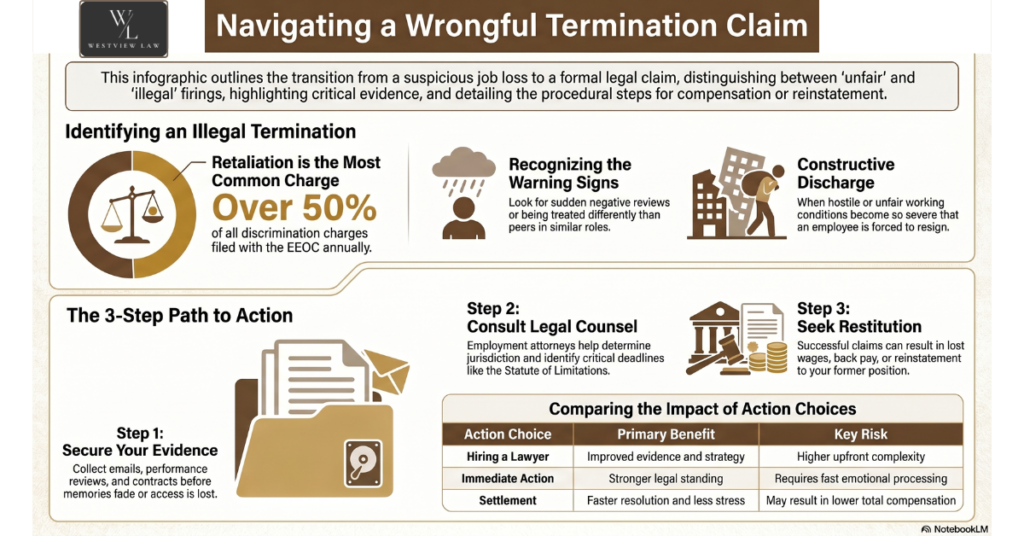
Wrongful termination can also include constructive discharge. This happens when working conditions become so hostile or unfair that a reasonable employee feels forced to resign. There are also exceptions to at-will employment that protect workers from unfair treatment. If a firing breaks these rules, a lawsuit may help recover lost wages or other damages.
How Do You Know if You Were Wrongfully Terminated?
Sometimes it is difficult to tell whether a firing was just unfair or actually illegal. Wrongful termination usually involves certain warning signs that point to discrimination, retaliation, or another violation of your rights. By paying attention to these warning signs, you can determine if your situation is more serious than a typical job loss. Termination based on sexualorientation or other protected traits may also violate workplace laws.
There are a few common signs that may suggest wrongful termination. These include being fired shortly after reporting misconduct, facing sudden negative performance reviews without warning, or being treated differently from coworkers in similar roles. According to the U.S. Equal Employment Opportunity Commission, retaliation consistently accounts for just over half of all discrimination charges filed each year, showing how often employees face consequences after reporting wrongdoing or asserting their rights.
Another warning sign is when your employer fails to provide a clear and legitimate explanation for your termination. If any of these situations feel familiar, it may be worth taking a closer look at your case.
Wrongful termination may also appear in real-world situations involving sexual harassment, racial discrimination, or bias based on national origin. An employee may be fired shortly after announcing a pregnancy or requesting leave. Another common scenario is whistleblower retaliation, such as being let go after reporting harassment or safety violations. Sudden firings without explanation, especially after raising complaints, can also point to possible legal violations that may support a claim.
How Do You File a Wrongful Termination Lawsuit?
Filing a wrongful termination lawsuit can feel overwhelming at first, but the process becomes clearer once you break it down into simple steps. Here’s a straightforward guide to help you understand how to move forward.
Step 1: Gather Evidence
Start by collecting any records that support your claim. This can include emails, termination letters, performance reviews, witness information, and other relevant documents. If available, copies of the employee handbook may also help show company rules or procedures.
Step 2: Consult a Lawyer
Speak with a wrongful termination lawyer who understands employment disputes. An experienced employment attorney can review your situation, explain your rights, and help you avoid mistakes early in the process. Strong legal counsel often improves the direction of a case.
Step 3: Determine Jurisdiction and File a Complaint
Your lawyer can help identify the correct place to file your claim. In some situations, a complaint may first be filed with the Equal Employment Opportunity Commission before going to court. Once the required steps are completed, formal legal action can begin against the employer.
What Evidence Is Needed for a Wrongful Termination Case?

A wrongful termination case often depends on the evidence you can show. It is not enough to feel the firing was unfair. You need records that help prove the reason for your termination was illegal. Strong documentation can make your claim clearer and more credible.
Some of the most helpful records include your employment contract, if one exists. This may show job terms, promises, or rules the employer agreed to follow. Copies of the employee handbook and written company policies can also be important when they outline procedures the employer failed to follow.
Performance reviews may help show a strong work history or sudden unfair criticism. Emails, texts, letters, and other communications may reveal bias, retaliation, or questionable employer actions. Records of warnings or disciplinary actions may also help show inconsistent treatment.
Statute of Limitations for Wrongful Termination Claims
If you believe you were wrongfully terminated, timing is very important. Filing deadlines depend on where you submit your claim. For example, complaints with the Equal Employment Opportunity Commission (EEOC) or state agencies usually have strict time limits that can be as short as a few months from the date of termination. Different claims may involve federal law, state agency rules, or deadlines connected to leave protections under the Medical Leave Act.
Acting quickly also helps protect your evidence and strengthens your claim. Over time, emails can be deleted, memories fade, and witnesses may become harder to reach. That is why it is important to speak with an employment attorney as soon as possible. They can help you understand the exact deadlines for your situation and guide you through the next steps.
What Are Possible Outcomes of a Wrongful Termination Lawsuit?
A wrongful termination lawsuit can end in several different ways. The result often depends on the facts of the case and the strength of the evidence. Some claims are resolved through a wrongful termination settlement before reaching trial. Others move forward until a judge or jury gives a court ruling.
If the employee wins, financial compensation is one possible outcome. This may include lost wages, missed benefits, back pay, and money for emotional distress in some cases. The court may also award damages to cover losses caused by the unlawful firing. A settlement can provide similar compensation without a full trial.
Another possible result is reinstatement to the former job. This means the employee is allowed to return to the position they lost. In some cases, courts may award front pay when reinstatement is impractical. In serious cases, punitive damages may also be awarded to punish especially harmful employer behavior. These outcomes are meant to provide fairness and discourage future misconduct.
What Common Mistakes Do Employees Make After Being Fired?
Being fired can be overwhelming, making it easy to act impulsively without careful consideration. However, certain mistakes can seriously weaken a potential wrongful termination claim. Knowing what to avoid can help you protect your rights and understand your legal rights.
1. Posting on Social Media
Many employees share frustration online right after being fired. Your former employer can use these posts against you, potentially damaging your credibility.
2. Not Documenting Evidence
We regularly remind clients, "One of the biggest factors in wrongful termination cases is documentation." Some people forget to save emails, messages, or important documents. Without this evidence, it becomes much harder to prove what actually happened.
3. Waiting Too Long to Act
Delaying action can cause you to miss important legal deadlines. It can also lead to lost evidence and weaker witness statements over time. Seeking professional advice early can help you avoid costly mistakes.
What to Know Before Moving Forward With a Wrongful Termination Case
After a wrongful termination, it is not always clear which path to take or what each option really means for your case. Some choices can lead to faster results, while others may strengthen your long-term outcome. Understanding these trade-offs can help you make more informed decisions. The table below breaks down the key options and what to consider with each one.
| Option / Situation | What It Means | Pros | Trade-offs / Risks |
|---|---|---|---|
| At-Will Employment vs. Wrongful Termination | Most jobs can end anytime unless illegal | Employers have flexibility | Employees still have strong protections against discrimination, retaliation, or contract breaches |
| Filing Alone vs. Hiring a Lawyer | Handling case yourself vs. getting legal help | Saves money upfront if self-represented | Lawyers improve evidence, strategy, and settlement outcomes |
| Early Action vs. Delayed Action | Acting quickly vs. waiting after termination | Stronger evidence and better legal standing | Delays can lead to missed deadlines and lost proof |
| Settlement vs. Going to Court | Resolving early vs. full trial | Faster resolution and less stress in settlements | Court cases may result in higher compensation but take longer |
| Strong Evidence vs. Weak Documentation | Keeping records vs. limited proof | Clear emails, contracts, and witness statements strengthen claims | Weak documentation makes cases harder to prove |
Do You Need a Lawyer for a Wrongful Termination Case?

In many wrongful termination cases, having a lawyer is crucial. It is especially helpful to speak with an experienced employment lawyer if your case involves discrimination, retaliation, or a contract dispute. An employment lawyer can help you understand your rights, gather strong evidence, and avoid mistakes that could weaken your claim. These cases can become complex quickly, so legal support often makes a big difference.
“We see a large number of cases where employees are let go shortly after speaking up about workplace issues. In many situations, the timing tells an important part of the story," - Paul Marks, attorney at Westview Law.
In simpler situations, you may not always need a lawyer, such as when the issue is small or can be resolved directly with your employer. However, even then, a consultation can still help you understand your options. Most wrongful termination attorneys work on a contingency fee basis, which means you only pay if they win your case. This makes legal help more accessible and reduces the financial risk of taking action.
For example, one employee in California was fired shortly after reporting ongoing safety violations at work and was told it was due to “performance issues,” despite having strong recent reviews. Concerned that the termination may have been retaliation, they reached out to an employment lawyer at Westview Law who reviewed the timeline, gathered key emails, and compared performance records.
With this evidence, it became much clearer that the firing was linked to the complaint rather than job performance. The employer ultimately chose to settle the matter before trial, and the employee received compensation for lost wages and related damages.
Ready to File a Wrongful Termination Lawsuit?
A wrongful termination lawsuit can help you hold an employer accountable for illegal firing. Not every termination is unlawful, but some clearly violate the law. Knowing your rights and recognizing the signs early can make a big difference. Taking action starts with understanding your situation.
If you think you have a case, do not wait too long to explore your options. Speaking with an employment attorney can give you clarity and direction. The right guidance can make the process less stressful and improve your chances of a fair outcome. Reaching out is a simple step that can have a real impact.
Do you believe you were fired for an unfair or illegal reason? At Westview Law, we focus on wrongful termination cases and bring a strong understanding of employment law to every client we help. Our expert wrongful termination attorneys in California take the time to listen, explain your options clearly, and build a strategy that fits your situation. Contact us today to get the answers you need with a free consultation.
Frequently Asked Questions
If you have questions about a wrongful termination lawsuit, you are not alone. These common FAQs can help you better understand your rights and possible next steps.
What Are the Steps for Filing a Wrongful Termination Lawsuit?
Start by gathering documents such as contracts, emails, and performance records. Then speak with an employment lawyer or file a claim with the proper agency before starting a lawsuit.
How Much Compensation Can I Expect From a Wrongful Termination Lawsuit?
Compensation depends on your lost wages, benefits, and how the termination affected you. Some cases may also include damages or settlement payments.
Can I Sue for Wrongful Termination if I Was Fired Unfairly?
Being unfairly dismissed does not always mean the firing was illegal. You may have a case if the termination involved discrimination, retaliation, or a contract violation.
What Evidence Is Needed to Prove Wrongful Termination?
Helpful evidence includes emails, reviews, witness statements, and company policies. Any records showing discriminatory treatment or helping with proving discrimination can strengthen your claim.
How Long Does a Wrongful Termination Lawsuit Take to Resolve?
Some cases settle in a few months, while others can take a year or longer. The timeline depends on the complexity of the case and whether it goes to trial.
Disclaimer: The information provided on this blog is for general informational purposes only and does not constitute legal advice. Reading this content does not create an attorney-client relationship. Laws and regulations vary by jurisdiction and may change over time, so you should consult a qualified employment attorney directly for advice regarding your specific situation. Past examples, case studies, or hypothetical scenarios are illustrative only and do not guarantee similar results.