


Short answer: Yes, but not because you took the leave. The FMLA and California's CFRA require your employer to restore you to the same job or an equivalent one when you return. Your employer can still let you go for a reason that would have ended your job anyway, such as a real layoff. Firing you for using the leave is unlawful.
Losing your job after taking medical leave is stressful, and it feels unfair when you believed your position was protected under the FMLA. Sometimes employers legally can fire an employee who has taken FMLA leave. Firing someone because they used protected leave, though, can violate federal law. If you've been fired after using FMLA leave, then document what happened and keep track of important documents; you should talk to an employment lawyer as well regarding your rights and legal options.
At Westview Law, our team understands how stressful it can feel to lose your job after taking protected medical leave. We help employees understand their rights under the FMLA and evaluate whether a termination may have been unlawful. If you believe you were fired after FMLA leave, contact us today for a confidential case review and guidance on your next steps.
In this blog, we will explain when it may be illegal to be fired after FMLA leave, the signs of possible retaliation, and the steps employees can take to protect their rights and explore legal options.
Understanding the Family and Medical Leave Act (FMLA)
The Family and Medical Leave Act (FMLA) is a federal law that grants eligible workers protected time off from work for certain reasons related to family and personal health. That includes your own serious health condition, the birth or adoption of a child, and caring for a spouse, child, or parent with a serious health condition. Eligible employees get up to 12 workweeks of unpaid, job-protected leave in a 12-month period, or up to 26 workweeks to care for a covered servicemember with a serious injury or illness.
Not every worker qualifies. To be eligible you must work for an employer that is covered by labor laws; you need to have worked there for at least 12 months and during that time you should have put in at least 1,250 hours in the 12 months before your planned leave period. Your worksite also has to have 50 or more employees within 75 miles. Private employers are covered once they have 50 or more employees for at least 20 workweeks in the current or previous year, and public agencies and schools are covered regardless of size.
Two protections matter most when a job ends after leave. The first is reinstatement: when approved leave ends, you are generally entitled to return to the same job or an equivalent one. Secondly, you need protection from interference and getting punished too. Your employer should not deny or discourage the use of time off you are legally entitled to and they shouldn't punish you for taking such leave.
How California's CFRA Adds Protection Beyond FMLA
Many workers in California have an additional layer of protection thanks to something called Government Code section 12945.2 that is built on top of California Family Rights Act (CFRA). CFRA reaches out to much smaller businesses. It applies to employers with five or more employees, while the FMLA requires 50 employees within 75 miles of the worksite. The eligibility test is otherwise similar: more than 12 months of service and at least 1,250 hours in the 12 months before leave. CFRA offers at most 12 weeks of protected leave related to employment in any 12 month period.
CFRA considers more family members as well. In addition to being able to take leave for children, parents, or spouses, this also allows you to use your time off to look after grandparents, grandchildren, siblings, or domestic partners. Since January 1, 2023, it also covers a "designated person," meaning someone related by blood or whose relationship with you is the equivalent of family. Under California's Pregnancy Disability Leave law pregnancy disabilities are treated differently from those covered by CFRA. The California Civil Rights Department's family care and medical leave guide lays out the FMLA and CFRA rules side by side.
If your employer retaliated against you for using CFRA leave, or interfered with your right to take it, that claim goes through the California Civil Rights Department (CRD), and you generally have three years to file.
What Are the Common Misconceptions About FMLA
Many people believe FMLA leave gives them complete job protection in every situation. It does not. FMLA protects eligible employees from being let go if they take protected leave time, but it doesn't prevent firing if the company has legitimate reasons to terminate someone. Employers can still take action for policy violations, documented performance issues, or layoffs that have nothing to do with taking leave.
Another common mistake is assuming FMLA leave works like every other kind of time off. FMLA is a specific federal law and generally the leave it gives is unpaid. Paid time off, short-term disability benefits, company leave policies, and state laws like CFRA each have their own rules. Some run at the same time as FMLA leave, and some don't, so it pays to know which ones apply to you.
What Are the Legal Grounds for Termination During FMLA Leave?
Leaving Taking FMLA does not protect an employee from being fired in every circumstance. Employers may still have legal reasons for terminating someone's employment while they are on leave. The question is the decision connected with the leave? Or did taking the leave count against the employee at all. Employers cannot terminate someone for using FMLA rights or take an adverse action because of protected leave.
Performance issues that have nothing to do with leave could be a good reason for termination. For example, an employer may rely on documented issues that were present before the leave began. Employers may also take action against real misconduct or violations of policies that have nothing to do with the leave specifically.
Changes in business also affect those who are on leave. Restructuring, department closures, and workforce reductions can lawfully reach someone who happens to be out on FMLA leave. If the employee would have lost the job anyway, the termination may be lawful. Details for each situation determine what happens.
Examples of Court Cases Involving FMLA Termination
FMLA cases usually turn on one of two questions: did the employer interfere with the employee's FMLA rights, or did it retaliate against the employee for using them? Courts scrutinize timing carefully along with stated reasons given by employers and the documentation trail including emails, attendance records, performance evaluations, and workplace communications. The Two U.S. Supreme Court decisions show how the law has evolved.
In Ragsdale v. Wolverine World Wide, Inc., 535 U.S. 81 (2002), Tracy Ragsdale received 30 weeks of leave under her employer's more generous policy. The company never designated that time for FMLA leave. When she could not return, she was fired. A Department of Labor regulation at the time said that leave an employer failed to designate didn't count against the employee's 12 weeks, which would have entitled her to 12 more. The Court struck this regulation down on a 5 to 4 vote. To recover for an employer's notice failure, an employee has to show the failure actually harmed them.
In Nevada Department of Human Resources v. Hibbs, 538 U.S. 721 (2003), William Hibbs left work to take care for his wife after an accident and neck surgery and later he was fired by the state. Was he able to sue his state employer at all? The Court held that state employees can recover money damages in federal court when a state violates the FMLA's family-care provision.
Neither case shows a clear victory for the employee on the part of "fired after leave". Ragsdale lost, and Hibbs was about whether a state could be sued, not the merits. What they show is that the outcome of an FMLA claim depends on the exact right involved and what the employee can prove. Records you keep from the start often decide what you can prove.
When Termination Is Lawful vs When It May Violate FMLA Rights
Not every termination after FMLA leave is illegal, but the reason behind the decision and the timing can make a significant difference in how the law applies. Employers may have valid business or performance-related grounds for ending employment, but they cannot base a decision on an employee's use of protected leave. The comparison that breaks down important factors that can help clarify where termination may fall.
| Factor | Lawful Termination After FMLA Leave | Possible FMLA Retaliation or Violation |
|---|---|---|
| Reason for termination | Performance issues, misconduct, or restructuring unrelated to leave | Fired because of FMLA use or timing tied to leave |
| Timing | Decision made before leave or part of broader layoffs | Sudden termination shortly after returning from leave |
| Documentation | Clear records of performance issues or business changes | Lack of documentation or vague justification |
| Treatment of employee | Consistent with how other employees are treated | Different or harsher treatment after FMLA leave |
| Layoffs/restructuring | Part of company-wide or department-wide reduction | Employee singled out while others in similar roles remain |
| Evidence pattern | Performance reviews, warnings, policy violations | Emails, comments, or timing suggesting leave-related bias |
| Legal risk for employer | Lower if reasons are well-documented and unrelated to leave | Higher if there is evidence of retaliation or interference |
What Are Your Rights if You Get Fired After FMLA Leave?
The Family and Medical Leave Act FMLA gives eligible workers important legal protections in the workplace. The FMLA allows qualified workers to take protected time off for reasons related to health or family without risking job loss as a result. During the leave, your employer must keep your group health insurance at the same terms as if you were still actively employed.
We regularly tell our clients "FMLA leave is not a privilege an employer can punish employees for using." one of the most important FMLA rights is reinstatement. In most cases, you have the right to return to the same job or an equivalent position after approved leave ends. An equivalent position should have essentially the same or nearly identical pay, benefits, job duties and working conditions. There are narrow exceptions, such as for certain highly paid "key employees."
You are also protected against retaliation for using FMLA leave. Employers cannot discipline, demote, or fire someone for taking protected leave. Federal regulations go further and bar employers from using FMLA leave as a "negative factor" in decisions like promotions or discipline. If your treatment changed for the worse after you used FMLA leave, that change may be the start of a claim.
Steps to Take If You Believe You Were Wrongfully Terminated
Losing your job unexpectedly is overwhelming, especially when the termination seems unfair or unlawful. In those first couple of weeks things that you do matter for your rights, the evidence that is available, and also the strength of what might be called a wrongful termination claim. This set of steps covers what you should do and what red flags to be on the lookout for.
Step 1: Collect and Keep Important Employment Documents
Gather copies of your employment contract, employee handbook, performance reviews, disciplinary notices, termination paperwork, and HR communications. These records may show whether your boss followed its own HR procedures and company policies before terminating you.
Step 2: Write Down a Detailed Timeline of Events
Create a timeline of important meetings, complaints, disciplinary actions, and conversations leading up to your termination. Remember to note down the day you asked for leave, the day that approval was given, and the day you returned from leave. Details slip away easily so you should write them down as soon as you can remember them clearly.
Step 3: Preserve Evidence of Discrimination or Retaliation
Save emails, text messages, complaints to HR, and other communications that may support claims of discrimination, harassment, or retaliation involving a medical condition. Strong evidence of unfair treatment or suspicious timing makes a case for wrongful termination claim.
Step 4: Avoid Deleting Emails or Digital Records
Keep copies of any work communication and documents related to your employment or termination if this is legal for you to keep. If your employer later says you were let go for poor performance, earlier positive reviews and messages are often how that explanation gets tested.
Step 5: Identify Potential Witnesses
Name some coworkers, supervisors or people from HR that saw or heard things related to relevant events. A witness who heard a manager complain about your leave can back up your account in a way your own notes can't.
Step 6: Review the Company Policies and Agreements
Carefully read through your handbook any severance agreements and workplace policies to understand how things work at work. Don't sign a severance agreement until you know what rights it asks you to give up. Sometimes failure by an employer to follow their own rules can be used as part of a case called wrongful termination case.
Step 7: Limit Public Discussions About Your Case
Avoid posting details about your termination on social media or discussing it publicly. Public statements might be misunderstood or turned against you later if there is a legal disagreement.
Step 8: Speak With an Employment Attorney
An employment attorney can review your situation and tell you whether your termination may violate state or federal law. Getting in touch with a lawyer early on helps preserve evidence and also avoids missing important deadlines.
Can You Be Fired After Taking FMLA Leave?
Yes but not because of leave. FMLA leave is pretty common. A 2018 Department of Labor survey found that 15 percent of U.S. employees reported taking leave for an FMLA-qualifying reason in the previous 12 months. With that many people using it, disputes about what happens when they come back are a predictable result.
The core test is whether you would have lost your job if you had never taken leave. Under federal regulations, you have no greater right to reinstatement than you would have had if you had kept working the whole time. If your whole department was gone when you were on leave, then that leave didn't affect the result. But the employer needs to show proof of this too. When an employer says you would have been laid off anyway, the regulations put the burden on the employer to show it.
This is where most decisions are made. An employer that discovers performance problems only after an employee returns from leave, or that picks the one person who was on leave for a "restructuring," invites hard questions. If the explanation shows up only after the leave, or doesn't match how other employees were treated, it deserves a closer look.
How to Handle Being Fired After FMLA Leave
You have basically two main ways to file a federal FMLA claim. The first is a complaint with the U.S. Department of Labor's Wage and Hour Division, which investigates FMLA violations at no cost to you. The second is to file a private lawsuit directly rather than going to the Department of Labor first. A lawsuit lets you seek lost wages and benefits, and, depending on the facts, liquidated damages, reinstatement, and attorney's fees.
Deadlines apply either way. Under 29 U.S.C. § 2617(c), an FMLA lawsuit generally must be filed within two years of the last violation, or within three years if the violation was willful. In California a claim under a CFRA claim in California goes to the Civil Rights Department, usually within three years of the last harmful act occurs. If your employer punished you for taking leave, our California workplace retaliation lawyers can tell you which claims fit your facts and which deadline applies.
For example, imagine an employee on approved FMLA leave returning and being fired just two weeks later; for "performance concerns." Before the leave, her reviews were good and nobody had raised a problem. She keeps old reviews of her work, gets approvals for leaves, and writes emails praising her performance; she then arranges this into a timeline. Those records allow an attorney to compare what the employer explained with what had actually happened and what had been done before she left.
Were You Fired After Taking an FMLA Leave?
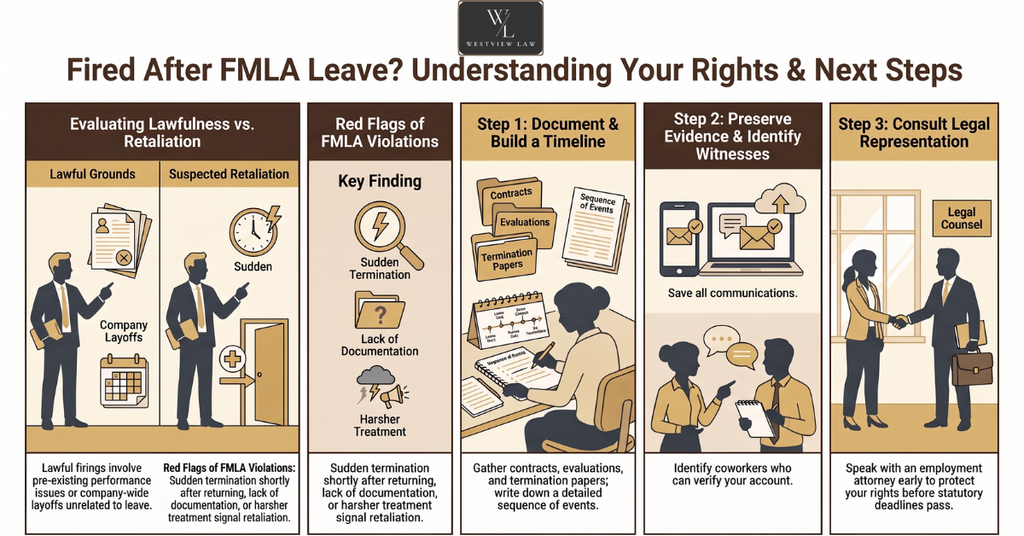
Getting fired when on FMLA leave can really confuse, frustrate, and leave employees uncertain about their rights. Employers are allowed to fire employees under certain circumstances but they cannot retaliate against someone just because they have used protected leave under Family and Medical Leave Act law or take any negative action based on such leave use. Keeping track of communications, recording any changes in treatment, and understanding your legal rights were important things to do if you think that your rights have been violated.
If you think that your termination might be illegal, speaking with an employment attorney may help you understand what options you have and how to move forward next. Resources such as the Wage and Hour Division of the U.S. Department of Labor, local legal aid organizations, and state labor agencies may also provide guidance and support. Taking action promptly helps preserve evidence, protects your rights and makes things clearer for moving forward after a tough situation.
Were you let go very soon after coming back from taking FMLA leave and wondering if that was against your rights? At Westview Law, we help our staff understand if their termination may involve retaliation that is illegal or interfere with rights for protected leave time. Our team of employment lawyers in California carefully reviews employee records, actions by employers and timelines to spot possible violations of federal labor law. Come talk to Contact us today and learn about any legal options may be available to you.
Frequently Asked Questions
This section of frequently asked questions contains answers to common questions about getting fired while on FMLA leave. It explains employee rights and important legal protections so that you can better understand your choices.
Can an Employer Fire an Employee After They Return From FMLA Leave?
Yes, an employer is able to terminate an employee under certain circumstances during FMLA leave. They can't just fire people because they take protected leave. The employer must have a legal reason for the decision.
What Should I Do if I Believe I Was Wrongfully Terminated After Taking FMLA Leave?
Keep emails, messages, performance reviews and any documents about your leave or termination. Write down important details before they get lost as you remember them. Talking to an employment lawyer may also help you understand what your options are.
Are There Any Steps I Should Take to Protect My Rights Before, During, or After Taking FMLA Leave?
Keep copies of medical documents, notes of your requests and correspondence at work. Follow procedure at work and keep track of important conversations. Keeping things organized helps safeguard your rights.
How Can Westview Law Help Me if I Was Fired After FMLA Leave?
Westview Law can review the details of your situation and explain your legal choices. They can also help determine if your rights may have been violated.
What Are Some Common Reasons Employers Give for Firing Employees After FMLA Leave?
Employers may point to performance problems, attendance issues, changes in company structure or policy violations. In some cases, there might be valid reasons may be legitimate. Details matter in each case.
Disclaimer: The information on this blog is for general informational purposes only and should not be construed as legal advice. Reading this content does not establish any attorney-client relationship. Laws and regulations vary by jurisdiction and may change over time, so you should consult a qualified employment attorney directly for advice regarding your specific situation. Examples from the past, case studies or hypothetical examples are illustrative only and do not result in anything alike.