


To qualify for leave under the Family Medical Leave Act, you must have worked for your employer for at least 12 months, logged at least 1,250 hours during the past 12 months, and work at a location where your employer has 50 or more employees within a 75-mile radius. The FMLA is a federal law passed in 1993 that gives eligible employees up to 12 weeks of unpaid, job-protected leave for serious health and family reasons. Understanding the qualifications matters because missing one threshold can mean the difference between protected leave and a denied request.
Westview Law represents California employees in FMLA, CFRA, and broader employment law disputes, from interference claims to wrongful termination after protected leave. If you're unsure whether you qualify or believe your rights have been violated, you can schedule a free consultation with our employment team to talk through your situation.
In this guide, we will walk you through the actual requirements of FMLA qualifications, the application process, the benefits the law provides, and where workers most often encounter difficulties.
Understanding FMLA Eligibility Requirements
The Family and Medical Leave Act, codified at 29 U.S.C. § 2601 et seq., was signed into law in 1993 and is enforced by the U.S. Department of Labor's Wage and Hour Division. Congress designed the Medical Leave Act to help workers balance the demands of the workplace with serious family responsibilities and personal health crises without losing their jobs. Family and medical leave is a common workplace need. According to the U.S. Department of Labor's FMLA Employee Survey, approximately 15% of employees reported taking leave during the previous year.
Under the FMLA, eligible employees can take up to 12 workweeks of unpaid, job-protected leave in a 12-month period for the birth or placement of a child (including a foster child or adopted or foster child), to care for an immediate family member with a serious health condition, or to address the employee's own serious illness. The law also covers prenatal care and recovery from expected birth, planned medical treatment, and inpatient care. The protections are limited but meaningful: your job, your seniority, and your group health insurance stay intact while you're out.
Three thresholds decide FMLA eligibility, and all three must be met. First, you must have worked for the same employer for at least 12 months. Those months don't have to be consecutive because break-in-service rules generally count prior employment if the gap is under seven years, with exceptions for military service obligations.
Second, you must have actually worked 1,250 hours during the 12 months immediately before your leave starts. This is hours worked, not hours paid: vacation time, paid sick leave, holidays, and any prior unpaid leave don't count toward the 1,250. Third, your employer must be a covered employer, meaning a private-sector employer with 50 or more employees within a 75-mile radius of your worksite, or a public agency or school of any size.
Part-time and seasonal workers can qualify if they hit the hours and tenure thresholds, though seasonal employees often fall short on the 1,250-hour count. Public agencies, local education agencies, and private elementary and secondary schools are covered regardless of employee count, but teachers have special rules about instructional time and end-of-term leave. Most federal employees fall under separate FMLA regulations administered by the Office of Personnel Management, not the DOL framework.
The FMLA also covers military families through two distinct provisions: qualifying exigency leave (up to 12 weeks for issues arising from a family member's active duty in the armed forces or uniformed services employment) and military caregiver leave (up to 26 weeks to care for a covered servicemember with a serious injury or illness). These categories have their own definitions of who qualifies, so military family situations almost always warrant a closer review.
How to Determine Your Eligibility at Westview Law
Start with your employment history. Pull together your hire date, any breaks in service, and your job title or department changes to confirm you've been with the same employer for 12 months. Next, calculate hours worked over the past 12 months using time records or pay stubs. The 1,250-hour count means actual time on the clock, so subtract paid sick leave, vacation time, and any other paid time off.
Finally, verify your employer is a covered employer: count employees at your worksite plus every other location within 75 miles. For employees who have all three boxes checked, the next step is confirming the reason for leave fits one of the FMLA-qualifying categories.
The biggest misconception is that the 12 months of service must be consecutive; they don't. A worker who left a covered employer two years ago and came back can usually stack the prior tenure toward the 12-month requirement.
Another common mistake is assuming paid time off counts toward the 1,250-hour rule; it doesn't, which can disqualify employees who took extended leave the year prior. Finally, employees often misread "covered employer." A company with 200 employees nationwide but only 12 at your worksite (with no other locations within 75 miles) is not a covered employer under the FMLA, though California's CFRA may still apply.
How to Apply for FMLA
Preparing for the application process matters because the FMLA puts most of the paperwork burden on the employee and the employee's health care provider. Getting documentation right upfront usually means fewer disputes about eligibility, designation, or recertification down the line.
Step 1: Gather Necessary Documentation
Pull together employment records, pay stubs covering the past 12 months, a calendar of hours worked if your hours vary, and any prior leave records. If the reason involves a family member, document the relationship.
Step 2: Get Medical Certifications and Proof of Eligibility
You or the family member's healthcare provider should complete the WH-380-E (employee's own serious health condition) or WH-380-F (family member's serious health condition) from the DOL. For military family leave, the WH-384 and WH-385 forms apply.
Step 3: Notify Your Employer
Give at least 30 days' notice when the need is foreseeable (planned medical treatment, expected birth, scheduled surgery). When the need isn't foreseeable, notify as soon as practicable, typically within one or two business days.
Step 4: Use Proper Channels and Timing for Notification
Follow your employer's usual call-in procedures and submit your request in writing where possible. Verbal notice can satisfy the FMLA, but a paper trail protects you if a dispute comes later.
What Is the FMLA Application Process?
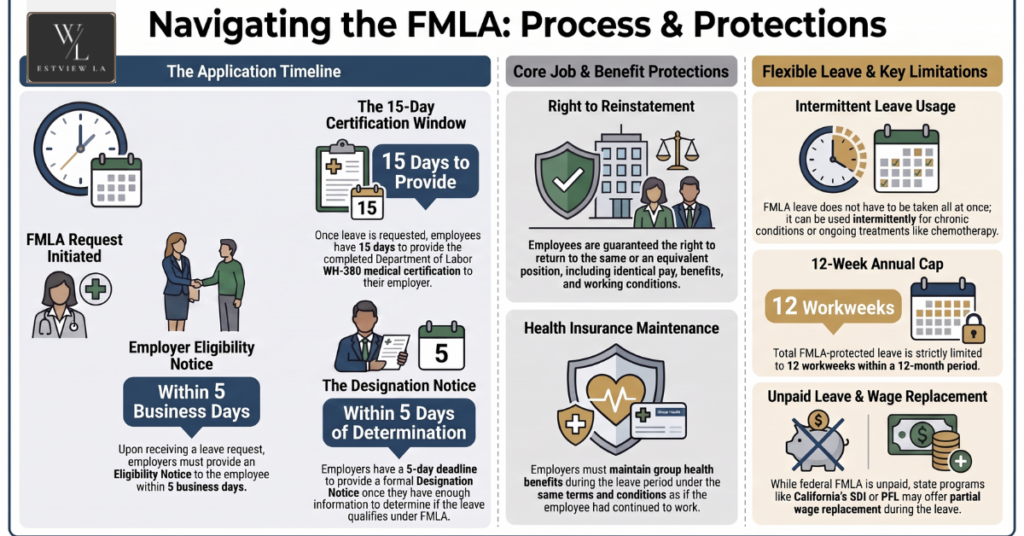
You'll fill out your employer's internal FMLA paperwork and provide the completed DOL WH-380 certification within 15 calendar days of the employer's request. The employer then has 5 business days to provide an eligibility notice (confirming whether you meet the thresholds) and another 5 business days after receiving certification to issue a designation notice telling you whether the leave is FMLA-protected and how it will be counted against your 12-week entitlement.
What to Expect After Applying for FMLA
Once your leave is designated, your employer must maintain your group health benefits on the same terms as if you were still working. You continue paying your share of the premium, and the employer pays its share.
You're entitled to return to the same job or an equivalent position with the same pay, benefits, and working conditions. If you need FMLA leave intermittently (for chemotherapy, physical therapy, or flare-ups of a chronic condition), you and your employer will coordinate scheduling to minimize disruption, but the employer can't deny medically necessary intermittent leave.
What Are the Benefits of FMLA Benefits?
The headline FMLA benefit is job protection. When you return from FMLA leave within the 12-week cap, your employer must restore you to the same job or an equivalent position. This means the same pay, the same benefits, the same shift, the same worksite (or a geographically proximate one), and substantially similar duties. "Equivalent" is a real legal standard, not a suggestion: a demotion dressed up as a lateral move is FMLA interference.
The second core protection is health insurance continuation. Your employer must maintain your group health insurance on the same terms as if you'd never left, including any family coverage. You're still responsible for your share of the premium, and if you don't return after leave (outside of circumstances beyond your control), the employer can sometimes recover the premiums it paid on your behalf. These FMLA protections apply equally to employees taking parental leave, caring for a family member, or recovering from their own serious illness.
FMLA leave is unpaid, which is the single biggest practical limitation. Many employees substitute paid sick leave, vacation time, or other paid time off to run concurrently with FMLA leave; the FMLA permits such arrangements, and many employers require it. Some states (California included, through SDI and PFL) provide partial wage replacement that runs alongside federal FMLA, but the federal law itself doesn't guarantee a paycheck.
The 12-week cap is firm. An employee's FMLA leave entitlement resets based on whichever 12-month measurement method the employer uses (calendar year, anniversary, rolling forward, or rolling back). Military caregiver leave is the exception, capped at 26 weeks in a single 12-month period. Intermittent leave and reduced-schedule leave are allowed for the employee's own serious health condition or to care for a family member when medically necessary, but for bonding leave after birth or placement, intermittent scheduling requires employer agreement.
How Can Westview Law Assist With Your FMLA?

Most FMLA disputes fall into three buckets: interference (an employer denies, delays, or discourages protected leave), retaliation (adverse action after the employee returns), and denial (the employer disputes eligibility or designation). Each requires a different evidentiary approach, and FMLA claims have strict notice and statute-of-limitations rules, generally two years from the violation and three for willful conduct.
"Most of the FMLA cases that come through our door start with a paperwork problem," says Taylor Markey, a Westview Law attorney. If your employer denied leave, cut your hours after return, or terminated you during or shortly after a qualifying absence, our employment team can review the timeline, the paperwork, and the employer's notices to identify where the FMLA was violated.
Michael had worked for the same California employer for more than three years and easily met the 1,250-hour requirement when he needed time off for surgery. He submitted the required medical certification, but his employer delayed approving his leave and later cut his hours when he returned. Concerned that his FMLA rights had been violated, Michael contacted Westview Law for a free consultation.
The legal team reviewed his employment records, leave paperwork, and communications with management. They identified evidence of FMLA interference and retaliation and stepped in on his behalf. After negotiations, Michael's hours were restored, he received compensation for lost wages, and his employment record was corrected, allowing him to move forward with confidence.
Ready to Protect Your FMLA Rights?
The Family and Medical Leave Act gives eligible employees real, enforceable protections such as 12 weeks of job-protected leave, continued group health coverage, and the right to return to the same job. However, those protections only kick in if you meet the three thresholds (12 months of service, 1,250 hours, covered employer), follow the notice and certification rules, and document your request properly. Knowing the eligibility criteria, the application process, and the FMLA benefits you're entitled to is the first line of defense against interference and retaliation.
If your employer denied your FMLA leave, miscounted your hours, refused to designate qualifying time, or took adverse action after you returned, you may have a claim under federal law and in California, often under CFRA as well. Don't wait to consult an attorney. FMLA claims carry tight deadlines, and the longer you wait, the harder it gets to reconstruct the record.
Unsure whether you qualify for FMLA leave or whether your employer handled your request lawfully? Westview Law represents California employees in FMLA, CFRA, retaliation, and wrongful termination matters, helping workers understand their rights and evaluate potential claims. Our employment team in California carefully reviews employment records, leave documentation, and employer actions to identify possible violations and protect your interests. Contact us today for a free consultation to discuss your situation and learn what legal options may be available to you.
Frequently Asked Questions
Employees often have questions about who qualifies for FMLA leave, how much leave they can take, and what situations the law covers. Below are answers to some of the most common questions about Family Medical Leave Act qualifications and how FMLA works.
What Are the Eligibility Requirements for the Family and Medical Leave Act?
You need 12 months of employment with the same employer (not necessarily consecutive), at least 1,250 hours worked in the past 12 months, and an employer with 50 or more employees within 75 miles of your worksite. All three must be met.
How Many Hours Do I Need to Work to Qualify for FMLA?
You must have worked at least 1,250 hours during the 12 months immediately preceding your leave. This is actual hours worked, paid leave, vacation time, and unpaid leave don't count toward the 1,250-hour threshold.
Can I Take FMLA Leave for Mental Health Reasons?
Yes. A serious mental health condition that requires inpatient care or ongoing treatment by a healthcare provider qualifies as a serious health condition under the FMLA. The same certification and notice rules apply as for any physical or mental condition.
What Is the Family Medical Leave Act (FMLA)?
The FMLA is a federal law enacted in 1993 that provides eligible employees up to 12 weeks of unpaid, job-protected leave per year for qualifying family and medical reasons. The DOL's Wage and Hour Division enforces it.
Who Qualifies for FMLA Leave?
Employees who've worked 12 months and 1,250 hours for a covered employer qualify. Covered employers include private sector employers with 50+ employees within 75 miles, plus all public agencies and local education agencies regardless of size.
What Are the Reasons for Which FMLA Leave Can Be Taken?
Qualifying reasons include the employee's own serious health condition, caring for a family member with a serious illness, birth or placement of a child (including foster care or adoption), qualifying exigency leave for military families, and military caregiver leave.
How Much FMLA Leave Can an Employee Take?
Eligible employees can take up to 12 work weeks of leave in a 12-month period for most qualifying reasons. Military caregiver leave allows up to 26 workweeks in a single 12-month period to care for a covered servicemember with a serious injury
How Does an Employee Request FMLA Leave?
Give your employer at least 30 days' notice when the need is foreseeable or as soon as practicable when it isn't. Follow your employer's usual call-in procedures, request the certification forms, and submit your request in writing where possible.
Disclaimer: This article is for general informational purposes only and does not constitute legal advice. Reading this content or contacting Westview Law does not create an attorney-client relationship. FMLA regulations change; consult a qualified employment attorney about your specific situation.