


Yes, you can be fired while on FMLA leave if the reason is unrelated to your leave. The Family and Medical Leave Act (FMLA) provides eligible employees with up to 12 weeks of unpaid, job-protected leave for qualifying medical and family reasons. However, it does not protect employees from layoffs, misconduct, poor performance, or other legitimate reasons for termination.
Westview Law represents employees, not employers. Founder David M. Safvati was named a Super Lawyers Southern California Rising Star from 2022 through 2024 and recognized in Best of the Bar’s Top 100 Verdicts in California for 2024, and Of Counsel Taylor Markey spent years as an Assistant Regional Attorney at the U.S. Equal Employment Opportunity Commission, where she led systemic discrimination litigation. The firm’s name was built inside courtrooms rather than around them. If you were fired while on FMLA leave and something about the timing feels wrong, contact us for a free case review.
This article walks through what FMLA actually protects, when an employer can legally terminate you anyway, and what to do if you think your termination crossed the line.
Understanding FMLA Rights and Protections
The Family and Medical Leave Act is federal law, passed in 1993. Its purpose is straightforward: let people deal with a serious health condition or a family crisis without losing their job. It covers your own serious illness, the birth or placement of a child, caring for a spouse, child, or parent with a serious health condition, and certain situations tied to a family member’s military deployment.
Not everyone qualifies. To be among the eligible employees, you need to have worked for your employer for at least 12 months, logged at least 1,250 hours in the 12 months before your leave request, and work at a site where the employer has at least 50 employees within 75 miles. Meet all three, and you are entitled to 12 workweeks of unpaid leave in a 12-month period, or up to 26 weeks if you are caring for a covered servicemember.
California adds a second layer through the California Family Rights Act, which reaches employers with as few as five employees. Plenty of workers who fall outside the FMLA are still covered under state law.
The protections themselves come in three parts. Your job is protected, meaning you must be restored to the same or a virtually identical position when you return. Your group health insurance continues on the same terms as if you had kept working. And your employer cannot interfere with your leave, retaliate against you for taking it, or use it against you in a termination decision.
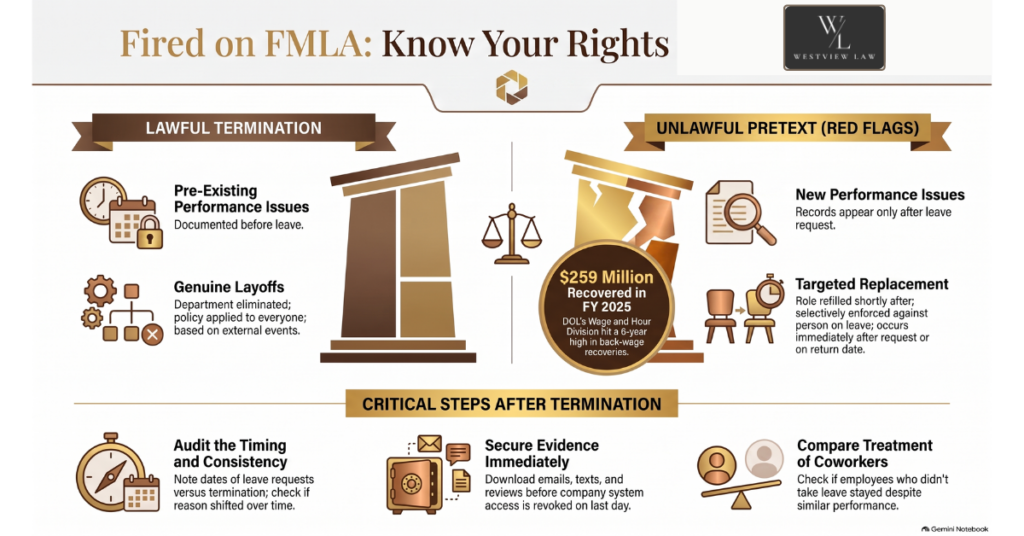
That third protection is the one people underestimate. The Department of Labor’s Wage and Hour Division, which enforces FMLA, recovered more than $259 million in back wages for nearly 177,000 workers in fiscal year 2025, the agency’s highest recovery since 2019.
Employment law is not a niche concern, and neither is enforcement. Westview Law works in this area every day, and the pattern the firm sees most often is not an employer who denies leave outright. It is an employer who approves the leave, then quietly builds a file.
What Are the Common Reasons for Termination During FMLA Leave?

Here is the rule that governs all of it. Federal regulations state that an employee on leave has no greater right to reinstatement than if they had been continuously employed. In plain terms: FMLA freezes your job in place, but it does not upgrade it. If something would have happened to your position anyway, it can still happen while you are out. There are three legitimate reasons employers rely on most.
1. Performance-Related Issues
An employer may lawfully terminate an employee during FMLA leave for documented performance problems that existed before the leave began. However, if performance concerns only appear after the employee requests or takes FMLA leave, and there is no prior record of those issues, the timing may raise questions about whether the termination was truly unrelated to the leave.
2. Company Restructuring or Layoffs
Employees on FMLA leave can still be affected by legitimate layoffs or company restructurings if their position would have been eliminated regardless of their leave. The employer must be able to show that the decision was unrelated to the employees' FMLA leave, especially if the role was later refilled or recreated.
3. Violation of Company Policies
An employer may terminate an employee on FMLA leave for violating workplace policies, such as falsifying medical documentation or engaging in serious misconduct. To support the decision, the employer should apply its policies consistently, as treating employees differently for similar violations may suggest the termination was motivated by something other than the policy violation. According to Sara Salinas, an attorney at Westview Law, "Policies have to be enforced consistently, so if you're the only employee treated differently, that's an important question to ask."
Lawful vs. Potentially Unlawful Reasons for Firing an Employee on FMLA
Not every termination during FMLA leave violates the law. The table below compares situations that are generally considered lawful with warning signs that may indicate an employer unlawfully used FMLA leave as the real reason for the termination.
| Situation | Generally Lawful | Potentially Unlawful | Why It Matters |
|---|---|---|---|
| Performance issues | Performance problems were documented before the employee requested FMLA leave. | Negative reviews or discipline appear only after the leave request with no prior record. | Employers must show the decision was unrelated to protected leave. |
| Layoffs or restructuring | The position was genuinely eliminated as part of a company-wide reduction affecting multiple employees. | The employee was laid off during leave, but the same or a nearly identical position is quickly refilled. | Replacing the role may suggest the layoff was a pretext. |
| Policy violations | The employee violated a workplace policy that is consistently enforced against everyone. | The employer selectively enforces policies only against employees who took FMLA leave. | Unequal treatment can support a retaliation claim. |
| Timing of termination | The employer can point to documented reasons that existed before the leave. | The firing occurs immediately after a leave request or return from leave with little or no supporting evidence. | Suspicious timing alone is not enough, but it can strengthen other evidence. |
| Employer documentation | Performance records, investigation files, and decision-making documents existed before the leave. | Documentation is created only after the employee requested or took leave. | Late-created records may raise questions about the employer's true motive. |
| Treatment of coworkers | Employees who committed similar misconduct received similar discipline. | Employees who did not take FMLA leave were treated more favorably under similar circumstances. | Comparing similarly situated employees is often key evidence in FMLA cases. |
Legal Steps if Wrongfully Terminated on FMLA
If you believe you were fired because you took FMLA leave or exercised your rights under the law, it is important to act quickly. At Westview Law, these are the steps we recommend clients take to protect their rights and put themselves in the strongest position if legal action becomes necessary.
Step 1: Look Hard at the Timing
Termination that lands days after a leave request, or on the morning you were due back, is not proof of anything on its own, but timing is real evidence, and courts treat it that way. Write down the exact dates of your leave request, your approved leave, and every conversation that followed.
Step 2: Test the Reason You Were Given
Ask whether the stated reason existed before you asked for leave and whether it was ever raised with you at the time. A reason that appears only after your leave request or shifts between the termination meeting and the paperwork is a warning sign worth taking seriously.
Step 3: Compare Yourself to Other People
Look at how your employer treated similarly situated employees who did not take leave. If someone else had the same performance record or broke the same policy and stayed, that gap is one of the strongest signs of retaliation there is.
Step 4: Collect Your Documentation Now
Gather your leave paperwork, medical certification, performance reviews, emails, texts, your handbook, and anything showing what you were told and when. Do it quickly, because access to company systems usually disappears the day you are terminated.
Step 5: Put Your Own Account in Writing
Write a dated summary of what happened while it is fresh, like who said what, in which meeting, and what reason you were actually given. Memory fades and details matter, particularly when the case turns on a single conversation.
Step 6: Talk to an Employment Lawyer
These cases are fact-specific, and the difference between a lawful termination and an unlawful one often comes down to evidence you would not think to preserve. Getting legal counsel early is the single most useful thing you can do, and most employment lawyers will review your situation at no cost.
Step 7: Consider a Complaint With the Department of Labor
You can file a complaint with the Wage and Hour Division, which investigates FMLA violations, and in California you may also have claims through the Civil Rights Department. An attorney can tell you which route fits your facts, because filing in the wrong place can waste time you do not have.
Step 8: Act Quickly
Deadlines apply to every one of these claims, and they are shorter than most people expect. Waiting to see whether your employer reconsiders is how good cases get lost.
What Compensation Can You Recover in an FMLA Case?
Employees who win an FMLA retaliation or interference claim may be able to recover lost wages, lost benefits, and other financial losses caused by the violation. Depending on the circumstances, a court may also order reinstatement to the employee's former position, award liquidated damages, and require the employer to pay reasonable attorney's fees and costs.
If your case also involves violations of California law, you may have access to additional remedies beyond those available under the federal FMLA. The value of any claim depends on the specific facts, including the harm suffered and the evidence available, so it is important to have an experienced employment attorney evaluate your situation before estimating potential compensation.
How Can an Attorney Help if You’re Fired While on FMLA?
"A legitimate layoff can happen during FMLA leave, but employers still have to prove the decision had nothing to do with your leave," says Simon Moshkovich, founding partner at Westview Law. Most people arrive at a lawyer’s office with a strong instinct and thin proof. They know the timing was wrong. What they usually do not have is the comparison evidence, the internal documents, or the paper trail showing when their employer’s story changed. An attorney’s first job is to turn that instinct into something a court can work with.
The second job is figuring out which claims you actually have. FMLA is often only part of the picture. If your leave was tied to a disability, the Americans with Disabilities Act and California’s own protections may apply, including the duty to explore reasonable accommodations before termination. Retaliation, disability discrimination, and wrongful termination claims frequently travel together, and missing one narrows your legal options unnecessarily.
Consider a representative situation. A warehouse supervisor takes approved FMLA leave for surgery. Her reviews had been strong for three years. Two weeks before she is due back, HR calls to say her position has been eliminated in a restructuring. She contacts Westview Law, and the firm’s review surfaces two things she could not have found alone: the company posted a nearly identical role six weeks later, and two colleagues with weaker performance records kept their jobs through the same restructuring. That is the difference between a feeling and a case.
Have You Been Fired While on FMLA?
You can be legally terminated while on protected leave, but only for reasons that would have applied if you had never taken leave at all. Your employer carries the burden of proving that. The FMLA protections around job restoration, health insurance, and freedom from retaliation are real, and they do not switch off because you are out of the office.
If the reason you were given appeared out of nowhere, changed over time, or does not match how your colleagues were treated, that is worth having someone look at. Westview Law's experienced employment attorneys represent employees across California and review these cases at no cost. Contact us for a free case review and do it sooner rather than later, because the deadlines move faster than most people realize.
Frequently Asked Questions
The FMLA provides important legal protections for eligible employees who need qualifying leave. Here are answers to common questions about your rights if you are fired while on FMLA leave.
What Are My Rights if I Am Fired While on FMLA Leave?
You may have recourse if your termination was related to your FMLA absence, and you could be reinstated or recover other damages. An employer must show specific reasons for the termination that are unrelated to your protected leave.
Can an Employer Terminate an Employee on FMLA?
Yes, but only for legitimate other reasons, such as documented performance issues or misconduct. An employer cannot force you out of your job because you exercised your FMLA rights.
What Should I Do if I Suspect Wrongful Termination?
Gather your documentation immediately, write down what you were told and when, and speak to an employment lawyer. Access to work email and files usually ends on your last day, so acting fast matters.
Can You Be Fired While on FMLA Leave?
Yes, in specific circumstances. A genuine layoff, misconduct, or documented performance problems that existed before your leave can all support a lawful termination.
Are There Any Circumstances Where I Can Be Fired While on FMLA Leave?
The common ones are company restructuring, poor performance recorded before your leave, and violations of policies your employer enforces consistently. What none of these can be is a cover story invented after your leave request.
Can My Employer Retaliate Against Me for Taking FMLA Leave?
No, retaliation for taking FMLA leave is prohibited, and that covers more than termination. Demotions, schedule changes, disciplinary actions, and sudden negative reviews can all count.
What Steps Should I Take if I Believe I Was Wrongfully Terminated While on FMLA Leave?
Preserve everything, note the timeline, compare how similarly situated employees were treated, and get legal counsel. You can also file a complaint with the Department of Labor’s Wage and Hour Division.
How Can I Ensure My Rights Are Protected While on FMLA Leave?
Submit your leave request in writing, keep copies of every certification and approval, and save anything your employer sends you. If your duties or reviews change after you request leave, write down what happened and when.
Disclaimer: This article is general information about the Family and Medical Leave Act and California employment law. It is not legal advice, and reading it does not create an attorney-client relationship. Every case is fact-specific, and deadlines apply. Speak with a licensed attorney about your own circumstances before relying on anything here. Past results do not guarantee future outcomes. Attorney Advertising. Westview Law PC, 1880 Century Park East, Suite 1100, Los Angeles, California.