


In most cases, no, a California employer cannot lawfully fire you simply for being sick or for using sick leave you are legally entitled to. State law gives workers some of the strongest job protections in the country, from paid sick days under the Healthy Workplaces, Healthy Families Act to job-protected medical leave under the California Family Rights Act (CFRA) and the Fair Employment and Housing Act (FEHA). The catch is that California is an at-will state, so the answer depends heavily on the facts.
Getting fired for being sick often isn't just unfair in California, it can be illegal. Westview Law represents employees who were pushed out for taking medical leave, disclosing a disability, or using protected sick days. Our team includes Taylor Markey, a former Assistant Regional Attorney at the U.S. EEOC, and we're trial lawyers who built our name inside the courtroom. Contact us today for a confidential case review.
In this guide, we will explain when California law protects employees from being fired for taking sick leave, the exceptions employers may rely on, and the steps you can take if you believe your termination was unlawful.
Understanding Employer Policies on Sick Leave

A sick leave policy is the set of rules an employer uses to manage time off for your own illness or when caring for a family member's illness. It spells out how much paid sick leave you earn, how you accrue it, when you can use it, and what you have to do to request it. Think of it as the company's operating manual for missing work due to a health condition.
Most policies cover a handful of core elements: the amount of paid sick time available, how it builds up (front-loaded all at once or accrued by hours worked), notice requirements, and any documentation the employer may ask for. Good policies also explain how sick leave interacts with other paid leave and with longer medical leave.
Policies vary widely from one employer to the next. A small business might offer the state minimum and little else, while a large company may provide generous paid leave, continued health insurance benefits, short-term disability coordination, and formal accommodation procedures. Union contracts and local ordinances can add another layer on top.
What no California employer can do is drop below the legal floor. State and federal laws set minimums that a company policy can improve on but never undercut, and employers cannot violate federal laws or California law through workplace policies. So even if your handbook is silent or stingy, your underlying legal rights still apply.
What Is the Importance of Reviewing Your Employer’s Sick Leave Policy?
Reading your policy before you need it is one of the simplest ways to protect your job. Start with the employee handbook, usually found in your onboarding paperwork, an HR portal, or an intranet page. Your offer letter and any employment contracts may also reference leave terms, and California requires most employers to post paid sick leave information and note available sick time on your wage statements.
As you read, focus on the aspects that decide real disputes: how much notice you must give, whether a doctor's note is required and when, how sick days differ from vacation or personal days, and how the company treats absences once your paid leave runs out. Pay attention to any point system for attendance, because that is often where trouble starts.
If something reads as vague, ask. A short email to HR asking how to properly report an absence or what documentation is acceptable creates a written record and shows good faith. Keep the reply. Clear questions now prevent "you didn't follow policy" arguments later.
Understanding your policy also helps you spot when an employer is overreaching. If the handbook demands more than the law allows, for example, a doctor's note for a single sick day when your paid sick leave has no such trigger, you will know to push back or seek legal advice rather than assume the company is right.
What Are Common Employer Expectations for Sick Days?
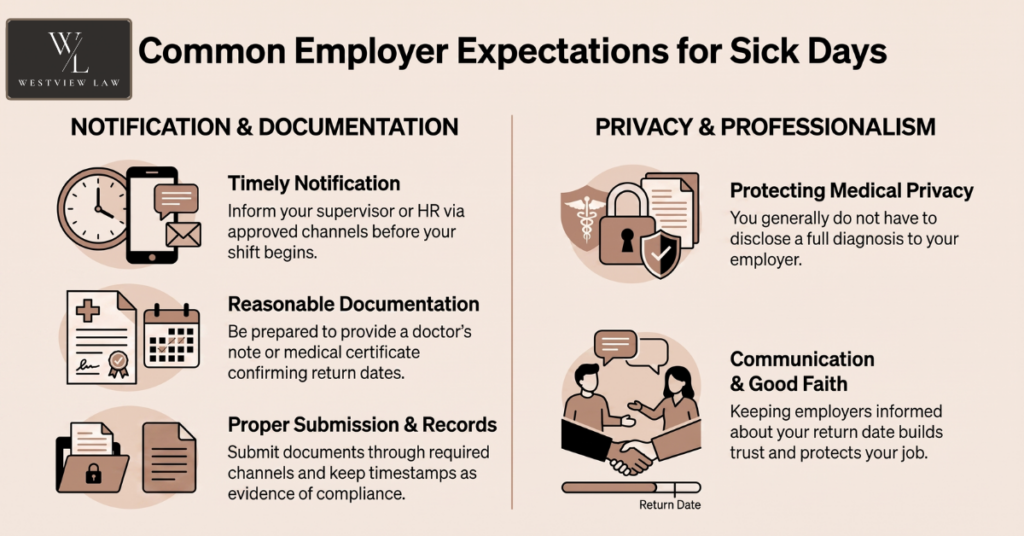
When you call in sick, most employers expect timely notice through an approved channel: a call, text, or message to a specific supervisor or HR line before your shift or within a set window. Follow the method your policy names. Notifying the wrong person or going silent is one of the easiest ways to hand an employer a legitimate, non-retaliatory reason to discipline you.
Documentation is where many disputes begin. Employers often ask for proof to confirm an absence was genuinely medical, especially for longer stretches away from work. Reasonable documentation requests are lawful, but California limits how far a company can go, particularly for short absences covered by paid sick leave. Knowing the difference keeps you from oversharing private medical information.
Acceptable documentation usually means a doctor's note confirming you were seen and cleared, or a medical certificate describing work restrictions or the expected length of leave. For extended time off under FMLA or CFRA, a formal medical certification form is standard. You generally do not have to hand over your full diagnosis or records. The point is to verify the need, not to expose your health history.
How you submit matters too. Send documentation through the channel your policy requires, keep copies of everything, and note the date you sent it. If you email a doctor's note, that timestamp becomes useful evidence if the employer later claims it never arrived.
Underneath all of this is communication and trust, helping employees feel they are treated fairly throughout the leave process. Employers are far more reasonable with workers who keep them reasonably informed, and courts and agencies look favorably on employees who acted in good faith. You do not owe your boss your medical chart, but a clear, prompt "I'm sick, here's when I expect to be back" protects both your job and your credibility if a conflict lands in front of a judge.
What Are the Legal Protections for Employees?
Two federal protections form the baseline for employees who need medical leave. The Family and Medical Leave Act (FMLA) gives eligible employees up to 12 weeks of unpaid, job-protected FMLA leave for a serious health condition. However, this is only for employers with 50 or more workers within 75 miles and only for employees with 12 months of service and at least 1,250 hours. As of 2026, mandatory paid sick leave laws have been enacted in 22 U.S. jurisdictions, including 21 states and Washington, D.C.
According to the U.S. Bureau of Labor Statistics, 79% of private industry workers had access to paid sick leave in 2024, though coverage remains lower among lower-paid occupations. The Americans with Disabilities Act (ADA) separately requires covered employers to provide reasonable accommodations for a physical or mental impairment that substantially limits major life activities, unless doing so causes undue hardship.
California goes further on nearly every front, which is why so many wrongful termination cases here turn on state law. The Healthy Workplaces, Healthy Families Act requires most employers to offer paid sick leave, and as of January 1, 2024, SB 616 raised the minimum to 40 hours or 5 days per year (Labor Code §246).
CFRA provides 12 weeks of job-protected leave at employers with just 5 or more employees, far broader than FMLA (Gov. Code §12945.2). And FEHA requires reasonable accommodations and an interactive process at employers with 5 or more workers (Gov. Code §12940). The table below shows how the state and federal laws compare on the points that matter most to a worker who is out sick.
| Workplace Protection | Federal Law | California Law |
|---|---|---|
| Paid sick leave | No federal law requires employers to provide paid sick leave. | Most employees are entitled to at least 40 hours (5 days) of paid sick leave each year under SB 616. |
| Job-protected medical leave | The Family and Medical Leave Act (FMLA) provides up to 12 weeks of unpaid, job-protected leave for eligible employees working for employers with 50 or more employees. | The California Family Rights Act (CFRA) provides up to 12 weeks of unpaid, job-protected leave and applies to employers with 5 or more employees. |
| Disability accommodations | The Americans with Disabilities Act (ADA) requires reasonable accommodations and generally applies to employers with 15 or more employees. | The Fair Employment and Housing Act (FEHA) also requires reasonable accommodations but applies to employers with 5 or more employees. |
| Protection from retaliation | Employers cannot retaliate against employees for exercising protected leave rights under applicable federal laws. | Employers are prohibited from retaliating against employees for using paid sick leave under California Labor Code § 246.5. |
Can You Be Fired for Being Sick?
Yes, in some situations, being sick is not a blanket shield. Because California is an at-will state, an employer can fire you for any lawful reason or no reason at all, as long as the real reason isn't an illegal one. Absences that fall outside any protected category, poor job performance unrelated to your illness, or a genuine, evenhanded attendance policy can all support a lawful termination. If you exhaust your FMLA and CFRA leave and still cannot return or be accommodated, an employer may, in some cases, lawfully end the relationship.
The line is drawn at motive. It is illegal to fire someone because they used paid sick leave, requested reasonable accommodations, took protected medical leave, or reported an unsafe condition. Employers know this, so they rarely say it out loud. Instead, a termination gets dressed up as a restructuring or a sudden performance concern. When the employer's stated reason doesn't match the timeline or the paper trail, that gap is often the heart of a wrongful termination claim.
A doctor's note helps, though it isn't magic. It documents that your absence was medically necessary, ties your time off to a legitimate health condition, and makes it harder for an employer to claim you simply skipped work. Combined with your own records of what you reported and when, it builds the story that your absence was protected, not a fireable offense.
If you believe you were wrongfully terminated for being sick, you may have legal options and may also qualify for unemployment benefits depending on the circumstances. For discrimination, retaliation, or failure to accommodate under FEHA, you file with the California Civil Rights Department (CRD, formerly the DFEH), which can issue a right-to-sue notice. For paid sick leave violations and retaliation under the Labor Code, you can file with the California Labor Commissioner. An experienced employment lawyer can tell you which path fits and what your case may be worth, including lost wages and, in some cases, emotional distress damages.
Are There Special Considerations for Chronic Illnesses in California?

Chronic and serious illnesses get extra protection because they often meet the legal definition of a disability. For an illness to qualify as a serious health condition under the FMLA, it must cause a period of incapacity exceeding three consecutive calendar days and include ongoing medical treatment. The CDC reports that 6 in 10 U.S. adults live with at least one chronic disease, while 4 in 10 have two or more, making workplace accommodations an issue affecting millions of workers.
Under FEHA, a physical or mental impairment that limits a major life activity qualifies, and California's standard is more generous than the ADA's because it does not require the limitation to be substantial. That means conditions like diabetes, cancer, lupus, severe anxiety, or long COVID can trigger a duty to accommodate even when flare-ups are intermittent.
Once your employer knows about the condition, it must engage in a good-faith interactive process to find reasonable accommodations such as a modified schedule, intermittent leave, remote work, or time off for treatment, unless the change would cause genuine undue hardship (Gov. Code §12940(m)–(n)). The failure to even hold that conversation is its own violation under California law, separate from any failure to actually accommodate.
Communicating and documenting a chronic illness takes some care. You do not have to announce a diagnosis to the whole office, but you should put an accommodation request in writing to HR or your manager, keep a copy, and provide a supporting medical certificate describing your work restrictions. Written accommodation requests create the record that proves your employer was on notice.
Support is available beyond your workplace. The Civil Rights Department publishes guidance on disability rights, the federal Job Accommodation Network offers free accommodation ideas, and an employment law attorney can step in early if your employer stalls or refuses. Getting advice before a conflict escalates often keeps your job security intact.
What Should You Do if You Are Fired for Being Sick?
A sudden termination after taking sick leave can leave you feeling overwhelmed, worried about losing income, and unsure of what to do next. If you believe your illness or medical leave played a role in your dismissal, taking the right steps early can help protect your rights and strengthen any future legal claim.
Step 1: Ask for the Reason You Were Fired
Request a written explanation or termination letter if one is available. Knowing your employer's stated reason can help determine whether the firing may have violated California employment law, the California Family Rights Act (CFRA), the Family and Medical Leave Act (FMLA), or other workplace protections.
Step 2: Save Important Evidence
Keep copies of emails, text messages, doctor's notes, performance reviews, attendance records, and any other documents related to your illness or termination. These records can help show whether your employer fired you because of your medical condition or for taking protected sick leave.
Step 3: Write Down What Happened
Create a timeline while all the details are still fresh in your mind. Include when you became sick, notified your employer, took leave, returned to work, and when you were terminated.
Step 4: Check Whether Your Leave Was Protected
Review whether you were using paid sick leave or qualified for leave under the CFRA or FMLA. You may also have rights under the Fair Employment and Housing Act (FEHA) if your illness qualifies as a disability and you requested a reasonable accommodation.
Step 5: Do Not Sign Severance or Release Agreements Right Away
Some employers ask terminated employees to sign legal documents in exchange for a severance package or severance pay. Read every agreement carefully because signing a release may limit your ability to pursue a wrongful termination or retaliation claim.
Step 6: File a Complaint if Appropriate
Depending on your situation, you may be able to file a complaint with the California Civil Rights Department (CRD), the U.S. Equal Employment Opportunity Commission (EEOC), or the California Labor Commissioner's Office. Each agency handles different types of employment law violations and has filing deadlines you should not miss.
Step 7: Speak With an Employment Lawyer
This is where Westview Law can help. Our California employment lawyers review your records, tell you whether your termination was likely illegal, and handle the filings with the Civil Rights Department or Labor Commissioner. If pursuing legal action makes sense, we can seek remedies such as reinstatement, lost wages, and other damages, and we would rather hear from you early than after a deadline has passed.
How Can a Lawyer Help if You’re Fired for Being Sick?
Being fired for being sick can leave you feeling shocked and unsure of what to do next. While California is an at-will employment state, employers cannot fire workers for reasons that violate state or federal law. If your illness qualifies for protected leave or a disability accommodation, your employer may have legal obligations they cannot ignore.
An employment lawyer can review your situation, explain your rights, gather evidence, and determine whether your termination was unlawful. They can also communicate with your employer, negotiate a settlement, help you understand potential legal costs, or file a legal claim if necessary.
Take Maria's story as an example. She worked for a healthcare company for five years and had always received positive performance reviews. After being diagnosed with a serious medical condition, she took approved medical leave to recover. A week after returning, she was told her position had been eliminated. Soon after, she learned the company had hired someone else to perform the same job. Maria contacted Westview Law for help. The legal team reviewed her records, gathered emails, and uncovered evidence suggesting her termination was tied to her medical leave. They negotiated with her employer and secured a favorable settlement that compensated her for lost wages and other damages.
Every situation is different, but you do not have to figure it out on your own. A lawyer can identify whether your employer violated laws protecting workers who are sick, need medical leave, or require reasonable accommodations. They can also help you understand the strength of your case before you decide what to do next.
As Paul Marks, an attorney at Westview Law, puts it, "The word 'at-will' gets thrown around to make people think they have no case, and very often, they do." Let an experienced employment lawyer look at the facts before you walk away from what you're owed.
Balancing Employer Needs and Employee Rights
Employers have legitimate needs, coverage, deadlines, and predictability, and the law does not ask them to ignore business reality. What it asks is that they meet those needs without trampling your right to be sick. Most workable arrangements come from acknowledging both sides rather than treating leave as a fight.
Practical negotiation goes a long way. If you have a health condition that affects your job duties, explain which essential functions employees perform and which tasks you can continue to perform with an accommodation. Offering options such as a temporary schedule change, cross-training a colleague, or intermittent leave makes it far easier for an employer to say yes and much harder to justify a refusal later.
Open, transparent communication is the thread that holds it together. Employees who keep their employer reasonably informed, and employers who respond in good faith, rarely end up in litigation. When one side goes quiet or acts in bad faith, that breakdown becomes the evidence, and it usually cuts against whoever stopped talking.
Have You Been Fired for Being Sick in California?
If you take one thing from this, let it be that being sick is not a lawful reason to lose your job in California. Between paid sick leave, CFRA, FEHA, and the federal FMLA and ADA, state and federal laws protect employees who miss work for a genuine health condition or a family member's illness, and they prohibit retaliation for using those rights. At-will employment gives employers latitude, but it does not license firing you for an illegal reason.
Stay informed about your rights, keep good records, and don't assume an employer's version of events is the legal one. If you believe you were wrongfully terminated for being sick, consult an employment attorney for a confidential review.
Were you fired right after calling in sick? That timing can point to an illegal termination, and it's exactly what our employment attorneys in California dig into. Westview Law includes Taylor Markey, a former U.S. EEOC Assistant Regional Attorney, and we're trial lawyers who aren't afraid to take your case all the way. Contact us today for a free confidential review.
Frequently Asked Questions
If you're worried about losing your job because you were sick, it's normal to have questions about your rights. These frequently asked questions explain when an employer can and cannot fire someone for being sick under California law.
Can I Get Fired for Being Sick if I Have a Doctor’s Note?
Generally, no, if your absence is legally protected. A doctor's note helps show your leave was medically necessary and can support your claim if you're fired.
Can I Get Fired for Being Sick if I Have a Chronic Illness?
A chronic illness may qualify as a disability under California law. If it does, your employer may have to provide reasonable accommodations instead of terminating you.
Can I Get Fired for Taking Too Many Sick Days?
It depends on whether your absences are legally protected. Employers generally cannot discipline you for using protected sick leave, but unprotected absences may result in disciplinary action.
How Should I Notify My Employer if I Am Too Sick to Work?
Notify your employer using the method required by your workplace policy. Keep a copy of your message or other proof that you reported your absence.
What Should I Do if I Believe I Was Wrongfully Terminated for Being Sick?
Collect your doctor's notes, emails, and other records related to your termination. Speak with an employment attorney as soon as possible to understand your rights and filing deadlines.
Disclaimer: This article is provided for general informational purposes only and does not constitute legal advice. Reading it or contacting Westview Law does not create an attorney-client relationship. Employment laws change and apply differently to each situation, and the facts of your case matter. For advice about your specific circumstances, consult a qualified California employment attorney. If you have questions about a possible wrongful termination or a violation of your sick leave rights, contact Westview Law directly.