


Short answer: Sometimes. If your restrictions come from a disability, California law requires a timely, good-faith talk about options first: changed duties, a new schedule, leave, or an open job you qualify for. Your employer can generally let you go over the restrictions only if no option would let you do the essential duties without undue hardship.
A doctor's note that says "no lifting over 20 pounds" or "four-hour shifts only" can make any employee nervous about their job. Yes, you can be fired if work restrictions keep you from performing the essential functions of your job, even with a reasonable accommodation. But in California, your employer must first engage in a good-faith interactive process with you and consider accommodations before it can lawfully make that decision. Skipping that step would be in violation of state law anyway.
Westview Law represents California employees in disputes over medical restrictions, denied accommodations, and wrongful termination claims. We know what state law requires of employers before they let someone go over a restriction, and we know which records tend to matter when they don't follow those rules. If you are not sure where you stand, schedule a free consultation and we can go over your situation with you.
Below, we cover when a firing over work restrictions is legal, how reasonable accommodations and the interactive process work under California and federal law, and what you can do if you think your employer crossed the line.
Understanding Work Restrictions and Employment Rights

Limits that doctors set on what kinds of jobs you can do safely are called work restrictions. Common ones include lifting limits, no prolonged standing, reduced hours, no repetitive motion, or no driving. Usually they follow after an injury, surgery for recovery, chronic illness conditions, disabilities, or pregnancy. Some last just a few weeks. Others are permanent.
Actually, the restriction itself is not what law aims to protect. What the law protects is the condition behind it, and your right to ask for help working around it.
At the federal level, Americans with Disabilities Act (ADA) prevents discrimination against people with disabilities by employers who have 15 or more workers. The Family and Medical Leave Act (FMLA) allows eligible employees to take up to twelve weeks of protected leave for serious health reasons.
California law goes further than other places. The Fair Employment and Housing Act (FEHA) covers employers with as few as 5 people. It defines disability more broadly than the ADA, too: a condition only has to "limit" a major life activity, not "substantially limit" it. FEHA considers two failures as distinct violations. One is failing to provide a reasonable accommodation (Gov. Code §12940(m)). The other is failing to engage in a timely, good-faith interactive process (Gov. Code §12940(n)). California Family Rights Act (CFRA) also includes 12 additional weeks of protected sick leave for employees at companies that have five or more workers.
If your restrictions came from a workplace injury, California Labor Code §132a also bars employers from firing or punishing you because you were hurt on the job or filed a workers' compensation claim.
According to EEOC enforcement data, disability is one of the most frequently cited grounds in discrimination charges filed each year, along with retaliation. Restrictions leading to firings are actually quite common among these cases.
Employers have responsibilities as well. They have to provide reasonable accommodations unless doing so would cause an undue hardship, and they can't treat you worse because of a disability or because you asked for help. According to California law, if an employer guesses wrong, they are on the hook for it.
Common Work Restrictions That Could Lead to Being Fired
Some limitations are pretty easy for an employer to handle. A standing desk or a stool costs little. Others collide with the core of a job, and that's where disputes start.
Lifting limits are the classic example. A warehouse worker with a back injury and a 15-pound limit may not be able to move inventory. A nurse who can't lift patients faces the same problem. Reduced hours restrictions conflict with jobs that rely on around 12-hour shifts or mandatory overtime. Limits on driving, travel or repetitive motions would take away regular work for technicians or people working on assembly lines.
Having just a restriction doesn't give an employer legal grounds for firing you. Problems usually begin in just a few situations. An employer offers light duty for a set period and then says the temporary work has run out. It decides a permanent restriction means you can never return to your old role, without looking at other open positions. Or it starts writing you up for attendance or productivity soon after the restriction appears.
Employers usually frame the termination one of three ways: you can't do the essential functions of the job, the accommodation you need would be too costly or disruptive, or the decision had nothing to do with your restriction at all. Whether any of those holds up depends on the facts, and on whether the employer did the legally required work before deciding.
Can an Employer Legally Fire Me for Having Work Restrictions?

In California most employment relationships are "at will," which means that employers can end the relationship for any lawful reason or no reason at all. The key thing here is to be lawful. Employment at will doesn't allow firing people just because they have a disability, ask for some kind of reasonable adjustment or file a workers compensation claim.
A termination is more likely to be lawful when the employer can show three things. You can't perform the essential functions of the position even with an accommodation. It looked at reasonable accommodations, including reassignment to a vacant position you're qualified for. And it went through the interactive process with you in good faith. An employer can also act for legitimate business reasons that have nothing to do with your restriction, such as a documented layoff that would have included you regardless.
A termination raises legal concerns when the timing lines up with a restriction or an accommodation request, when the employer never discussed alternatives with you, or when the stated reason shifts over time. Firing someone because they asked for an accommodation is also retaliation under FEHA, which is a separate claim from discrimination.
Keep a paper trail from day one. Keep all the doctor notes, every accommodation request, emails with HR and your boss and your own dated notes after each conversation. Courts look at what was actually said and done, and written records carry more weight than memory.
What Constitutes a Reasonable Accommodation?
A reasonable accommodation is any change to the job, the schedule, or the workplace that lets a qualified employee with a disability or medical condition do the essential parts of their work. There's no fixed list. Choosing right accommodations depends on restrictions and jobs.
Common examples include modified schedules, extra breaks, ergonomic or assistive equipment, shifting non-essential tasks to coworkers, temporary light duty, remote work where the job allows it, and reassignment to a vacant role. In California, an unpaid leave of absence that is taken for treatment or recovery purposes counts as a reasonable accommodation along with any leave under CFRA that you are entitled to.
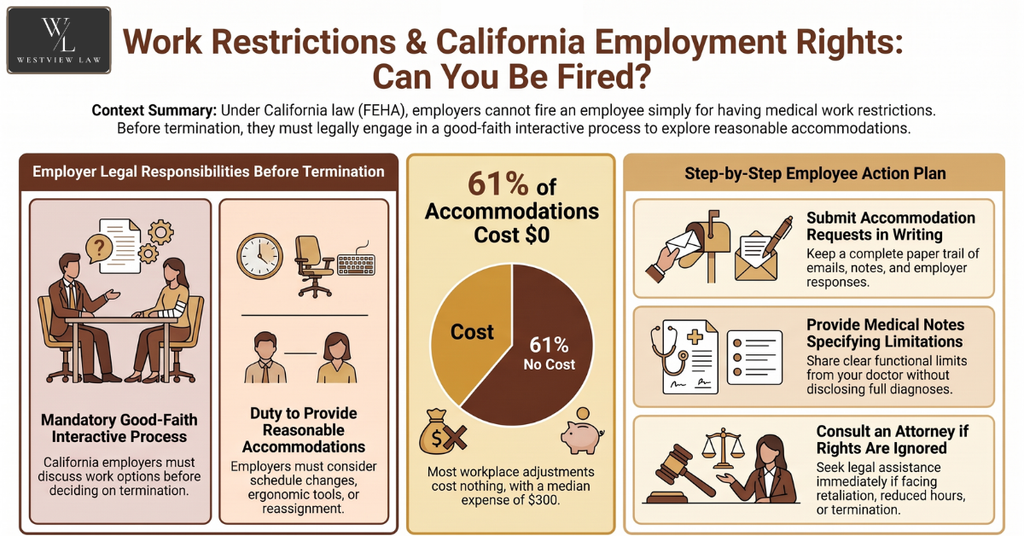
Accommodations generally cost less than people expect them to cost their employers. A Job Accommodation Network (JAN) survey funded by the U.S. Department of Labor found that 61% of employers who reported costs said the accommodation cost nothing at all. Among those that did have a one-time expense, the median was $300.
An employer can refuse an accommodation that would cause an undue hardship, meaning significant difficulty or expense given the company's size, finances, and operations. That's a pretty high bar for most mid-sized and larger companies. Employers don't have to give you exactly what kind of accommodation you requested. It can pick another one as long as it functions properly.
How Employers Evaluate Work Restrictions vs Employee Rights
Employers weigh business needs, and the law requires them to weigh your rights alongside those needs. Below is a table that shows what various typical situations look like from both sides and the question most often used to decide if an employer acted legally.
| Situation | Employer Position | Employee Protection | Key Question |
|---|---|---|---|
| Employee can't perform essential job duties | May consider termination | Employer must first assess accommodations and vacant positions under FEHA and the ADA | Is the duty truly essential, or just a task the employee usually handles? |
| Employee requests an accommodation | May claim cost or operational difficulty | Employer must engage in the interactive process; refusal requires real undue hardship | Is the hardship documented, or just assumed? |
| Temporary medical restriction | May treat it as an inability to work full duty | May qualify for temporary light duty, a finite leave, or CFRA/FMLA leave | How long will the restriction last, and what does the medical note say? |
| Performance issues after a restriction | May cite productivity or attendance | Discipline can't be based on the condition itself or the accommodation request | Did the performance issues start before the restriction? |
| Termination decision | May rely on at-will employment | Can't fire because of a disability, an accommodation request, or a workers' comp claim | Did the employer follow the process and document its reasons? |
What Is the Process of Requesting Accommodations?
You don't need fancy words or anything formal to ask for an accommodation. Informing your boss that you need a change at work due to a health condition is sufficient for them to be obligated. These steps make the request less likely to be ignored and also make it easier to show proof later.
Step 1: Identify Your Need for an Accommodation
Pinpoint which tasks are restricted and what allows you to continue doing your job. "I can't lift more than 20 pounds, so I need help with deliveries over that weight" seems more useful than "I have a back problem."
Step 2: Check Your Workplace Policy and Rights
Look in your employee handbook for an accommodation or leave policy and the person who handles requests. Following company procedures removes one easy way of justifying delays.
Step 3: Submit a Formal Request to Your Employer
Put the request in writing to your supervisor or HR, even if you've already mentioned it in person. An email works. Keep it short and focused on what you can do with the right support.
Step 4: Provide Supporting Documentation if Required
Your employer may ask for a doctor's note that verifies the limitation and how long it will last. It is generally entitled to information about your functional limits, not your full diagnosis or medical history.
Step 5: Engage in the Interactive Process
Meet with your employer, answer reasonable questions, and consider the options it offers. Suggest alternatives if its first offer doesn't work. Under California law, both sides should act in good faith. Having evidence that you have cooperated is useful for you if things go south down the line.
Step 6: Follow Up and Confirm the Agreed-Upon Accommodation
After you agree on a place to stay, send an email confirming that. If it stops working, or your restrictions change, raise it promptly and in writing so the process can start again.
Legal Recourse for Being Fired Due to Work Restrictions

Not every firing after a restriction is illegal. But if your employer skipped the interactive process, refused a workable accommodation, or let you go soon after you asked for one, you may have claims under FEHA, the ADA, CFRA or FMLA, or Labor Code §132a.
It's good to talk to an employment lawyer right away. A lawyer can look at the timeline and figure out which claims apply; they also make sure that you do not miss any deadlines. In this case deadlines are very strict.
Most claims under FEHA in California begin with filing a complaint with California Civil Rights Department (CRD). You generally have three years from the date of the discriminatory act to file. You can also file a charge with the EEOC for federal claims, usually within 300 days in California. The two agencies receive complaints. Many of the employees want a right to sue notice immediately so they can go to court directly. A §132a claim tied to a workers' comp injury goes to the Workers' Compensation Appeals Board instead.
Remedies depend on the claim. They can include back pay, future lost earnings, reinstatement, emotional distress damages, and attorney's fees. In some cases, punitive damages are available too. FEHA doesn't cap emotional distress or punitive damages the way federal law does, which is one reason many California employees bring their claims under state law.
How to Protect Yourself From Being Fired Due to Work Restrictions
Usually, the strongest position among employees goes to those who communicate effectively and keep good records. Tell your employer about your restrictions as soon as you have them. Ask for what you need. in writing. If your employer says there's no work you can do, ask whether any vacant positions might fit your restrictions, and ask that in writing too.
Build your file along the way. Keep copies of doctors' notes, work reports, requests for accommodation, and every response that you receive. After the meeting send an email that quickly summarizes what was discussed. If your employer disagrees with your summary, it now has to say so in writing.
Don't wait to get advice after you get that termination letter. If your requests are being ignored, your hours or duties are cut after a restriction, or you're suddenly being written up, a lawyer can help you respond before things escalate. Early advice also helps keep evidence that would otherwise vanish when you're no longer on payroll.
Westview Law handles disputes about housing accommodations, disability discrimination, and wrongful termination for workers in California. If something about your employer's response doesn't sit right, that's a good time to call.
Hypothetical example, for illustration only: A warehouse employee hurts their shoulder and gets a 15-pound lifting restriction. The employer says there's no light work available and starts to terminate employment. An employment lawyer looks at the job ad, medical records and emails that relate to this request. The attorney finds that the employer never discussed modified duties or open positions. When an attorney brings up employer responsibilities for interacting with employees, the employer then opens up and agrees to assign duties on an interim basis that are modified from the usual assignments. Real cases depend on their specific facts and results differ.
Ready to Navigate Being Fired for Work Restrictions?
Work restrictions don't make you untouchable, but they don't make you easy to fire either. If your restrictions prevent you from doing the essential functions of your job, your employer can consider termination, but only after it has looked at reasonable accommodations and worked through the interactive process with you in good faith. In California, failing to do that is a violation on its own.
If your employer let you go, or is threatening to, get your records together and have someone review them before you sign anything or accept a severance offer. Talking briefly can tell you if an employer has followed the rules.
Wondering if your boss can legally fire you because of restrictions on your work? Westview Law represents California workers for disputes about accommodations, disability discrimination, and terminations and we understand what employers need to do before making those calls. Contact us today to have your situation and learn about what options may be available for you.
Frequently Asked Questions
Here are the most frequent questions that California workers ask when a medical restriction begins to impact their job. Each answer is general information. Your own facts shape your choices.
Can I Be Fired for Work Restrictions Due to a Medical Condition?
Only in limited situations. An employer can legally terminate your employment if you cannot perform essential job duties even after making reasonable accommodations and that employer has initiated interaction with you first. Firing someone because of that person's medical condition or because they requested an accommodation violates both FEHA and ADA.
What Should I Do if My Employer Is Threatening to Fire Me Due to Work Restrictions?
Put your accommodation request in writing if you haven't already, send your employer a current doctor's note describing your limits, and ask to meet about options, including vacant positions. Make sure to keep copies of everything. If threats persist, talk to an employment lawyer before resigning or signing any documents.
Can My Employer Fire Me if I Have a Temporary Work Restriction?
It depends on how bad the condition is and how long it lasts. Short term minor things like a cold may not be covered. But many temporary restrictions after surgery, an injury, or pregnancy do qualify under FEHA, CFRA, or California's pregnancy disability leave law. A finite period of leave or light duty is often a reasonable accommodation for them.
Are There Any Laws That Protect Me From Being Fired for Work Restrictions?
Yes. FEHA in California protects employees who work for firms that have 5 or more workers from discrimination because of disability, failure to provide reasonable accommodations, and retaliation. The ADA covers employers with 15 or more. CFRA and FMLA both provide for medical leave. If your restriction comes from an injury sustained at work, injury, Labor Code §132a forbids your employer from punishing you for it.
What Steps Can I Take if I Have Been Fired Due to Work Restrictions?
Collect your medical notes, accommodation request forms, emails and termination paperwork and speak with an employment lawyer about whether you have a claim. Most FEHA claims require a complaint with the California Civil Rights Department, generally within three years. Federal claims go to the EEOC usually within 300 days.
Please note that the content here on the blog serves only as general information and is not legal advice; it's just meant to be informational. Reading through this content does not establish any attorney-client relationship. Laws and regulations vary by jurisdiction and may change over time, so you should consult a qualified employment attorney directly for advice regarding your specific situation. Examples, case studies, and hypothetical scenarios are illustrative only. Past results do not guarantee future outcomes.