


There is no fixed amount you can sue your employer for when they make false promises, because what you recover is measured by what the broken promise actually cost you. That usually means the gap between the pay you were promised and the pay you received, money you spent relocating, and the value of the job you gave up, with punitive damages possible where an employer knowingly lied. If the false promise moved you from one place to another for work, California Labor Code section 970 can double those damages outright.
Westview Law handles employment matters for workers from its office at 1880 Century Park East in Los Angeles. Taylor Markey once prosecuted discrimination cases for the federal government at the EEOC, and founder David Safvati clerked for a Superior Court judge before becoming a Fellow of the American Board of Trial Advocates. That's the kind of experience most firms can't match. If you're curious to find out what your case is worth, contact us today for a free case evaluation.
This article explains the compensation an employee can recover when suing an employer for breach of contract, including unpaid wages, emotional distress, and punitive damages.
What Counts as a False Promise?

Not every broken promise at work is a legal claim. The ones that matter are specific, and you acted on them. These are the common examples we see, and most of them start as ordinary recruiting tactics aimed at a prospective employee who is weighing a different job.
Inflated salary offers are the most frequent. A recruiter dangles six figures and big bonuses, so you take the new job expecting more money, then the offer letter lands at a lower base with a bonus nobody can explain. Fake promotion or raise talk runs a close second, where someone is told the next promotion is already decided, and it never comes, or the raise is always one quarter away.
A misrepresented job title or duties show up when the role described in the interview is not the job. Someone hired to lead a team arrives to find no team, or a salaried position quietly becomes a contractor role without the benefits discussed.
Relocation lies are their own category, and California treats them seriously. Exaggerated benefits round out the list, and it includes promised vacation time that does not exist, health coverage that starts far later than described, extra shifts that never materialize, or working conditions nothing like the ones described.
The clearest version is the two-job-offer problem. You hold one offer and a competing offer from a new employer, and you turn one down based on what the hiring manager told you about pay, job security, or your next promotion. Then the promise evaporates. You gave up something measurable, and that lost opportunity is often what separates ordinary frustration from a claim worth bringing. What your employer promised, and whether those misleading statements can be pinned to a date and a person, is usually the whole case.
The Legal Theories Behind These Claims
Your situation can support more than one legal claim at the same time, and which of these potential legal claims apply changes what you can recover. Four come up most often, and they sit at the boundary between contract law and fraud.
Fraudulent inducement of employment applies when the employer intentionally misrepresented something, meaning they knew the statement was false when they made it. The California Supreme Court addressed the issue directly in Lazar v. Superior Court (1996) 12 Cal.4th 631, where an executive left a secure New York job after an employer misrepresented the company's financial health and the security of the position.
The court held he could recover the costs of uprooting his family, his relocation expenses, and the income and security he gave up, on top of ordinary contract damages. Negligent misrepresentation covers the softer version, where the employer had no reasonable grounds for believing what they said, even if they honestly believed it. Under Civil Code section 1710, asserting something as fact without reasonable grounds is still deceit.
Promissory estoppel matters when there is no contract at all. If an employer made a clear promise, you reasonably relied on it, and you were injured by that reliance, the promise can be enforced without the usual consideration that a contract requires.
Breach of contract is the fourth route, and it works when the promise appeared in an employment contract or a clear verbal agreement. Labor Code section 2922 presumes at-will employment in California, but that presumption is rebuttable, and evidence that both sides understood particular terms of the employment relationship can overcome it.
California Labor Code § 970
Section 970 is the provision most articles skip, and it is the strongest one for anyone who moved. It bars an employer from using knowingly false representations to persuade someone to change their location for work, whether that move is within California or into or out of the state.
The false information has to concern one of four things: the kind, character, or existence of the work, how long the work will last or what it pays, the sanitary or housing conditions around the work, or whether a strike or lockout is underway.
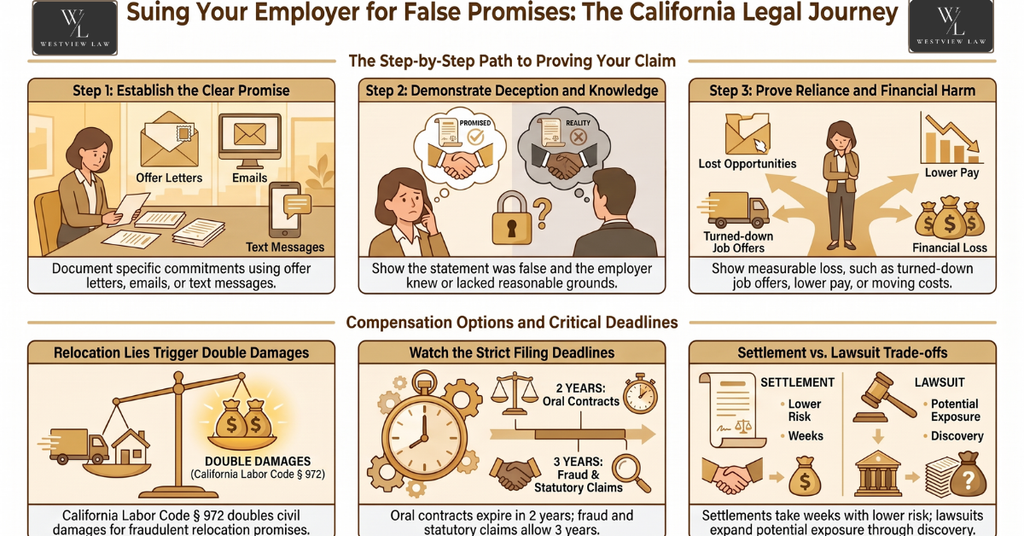
The remedy is what makes it valuable. Labor Code section 972 makes an employer who violates section 970 liable in a civil action for double damages, and that civil case can be brought without first establishing any criminal liability.
Note the limit carefully. Section 970 requires an actual change of location. A false promise about your job title that did not involve a move falls outside this section, so you would need to rely on the other theories instead.
Can Emotional Distress Be Claimed for False Promises?

Sometimes, and the answer depends entirely on which claim you bring. When an employee relies on an employer's false promises, the consequences reach past the paycheck into real mental suffering, anxiety, and stress. The law recognizes that unevenly.
On a straight breach of contract claim, the answer is no. California draws a firm line here, and the remedy for breach of an employment agreement, including the implied covenant of good faith and fair dealing, is solely contractual. That rules out both emotional distress and punitive damages.
Where the employer's conduct was intentional, the picture changes, because fraud is a tort rather than a contract claim and tort damages are broader. Intentional wrongdoing can also support a separate claim for intentional infliction of emotional distress, which has its own demanding standard. This area is genuinely unsettled, so treat any blanket promise that emotional distress damages are available with suspicion, and ask an employment lawyer about your specific facts.
If you do pursue it, the evidence matters more than the adjectives. Documentation from a medical professional or therapist describing anxiety, depression, or other stress-related conditions carries the most weight. Personal journals, emails, and text messages showing the impact over time help, as do witness statements from colleagues, friends, or family who watched it happen.
How to Prove Your Employer Made a False Promise
Proving one of these claims comes down to four elements, and each one needs its own evidence. Work through them in order.
Step 1. Show a Clear Promise Was Made
Vague optimism about your future is not enough, so identify the specific commitment about pay, title, duration, or conditions. Offer letters, recruiting emails, and text messages from the hiring manager are the strongest proof here.
Step 2. Show the Statement Was False
Compare what you were told against what actually existed, using pay records, org charts, or the job you were actually given. A gap between the promise and reality is the heart of the claim.
Step 3. Show the Employer Knew or Should Have Known
For a fraud claim, you need to show the employer knew the statement was untrue when they made it, which internal emails and recorded conversations sometimes reveal. For negligent misrepresentation, it is enough that nobody had reasonable grounds to believe it.
Step 4. Show You Relied on It and Were Harmed
Prove what you gave up, whether that was a competing job offer, your current position, or the cost of a move. Witness statements from people you discussed the decision with at the time help establish that the promise drove your choice.
How Much Compensation Can You Get?
Compensation is built from categories, not from a lookup table. Lost wages are usually the largest piece, measured as the difference between the compensation you were promised and what you actually received, along with unpaid wages and benefits you never got. Relocation expenses are recoverable where a move was involved, and Lazar confirms that the costs of uprooting a household belong in that calculation.
Emotional distress damages may be available where the employer intentionally deceived you, though not on a contract claim alone, and the financial loss you can document will always anchor the number. You can ask for punitive damages, but the law sets a high bar.
Nationally, punitive damages only show up in a small slice of cases. Plaintiffs who won their case received punitive damages just 5 percent of the time, and even when they were awarded, the typical amount landed at $64,000, with only 13 percent topping a million dollars, based on the Bureau of Justice Statistics' punitive damages report.
Under Civil Code section 3294, you need strong, convincing proof that the other side acted cruelly, deceived you, or meant to harm you. And if you're suing a company, you also have to prove that someone in charge, like an officer or director, knew about it or backed it after the fact. The double damages available under Labor Code section 972 for a relocation case are the one true multiplier in this area, and they are statutory rather than discretionary.
You will find dollar ranges for these cases quoted confidently online. Treat them carefully. No government agency, court system, or research body publishes settlement data for employer false promise claims, so those figures are not drawn from any dataset that can be checked.
What you can potentially sue for, and what you actually recover damages for, depends on your documentation, what you lost, whether a relocation triggers section 972, and whether other employment issues, such as wage theft or discrimination, ride along with the same case.
What Is the Timeline to Sue Your Employer for Failed Promises in California?

Deadlines here are unusually specific, and they differ by claim, which is why filing one theory late does not necessarily sink the others. A fraud claim runs three years, and the clock does not start until you discover the facts constituting the fraud rather than when the lie was told.
A written contract gives you four years. An oral contract gives you only two, which is the shortest window and the one that catches people out. Claims founded on a statute, including wage claims, run three years. Because a single set of facts can support several claims with different clocks, the practical deadline is the earliest one that applies to you.
Settlement vs. Filing a Lawsuit
Most of these disputes resolve before trial, so the realistic question becomes how strong a position you bring to the negotiation. Settlement value tracks a handful of concrete factors rather than the strength of your feelings about what happened. The comparison below lays out the trade-offs between resolving early and filing.
| Factor | Settling | Filing a lawsuit |
| Speed | Weeks to months | Often a year or more |
| Cost and risk | Lower, more predictable | Higher, with no certain result |
| Documentation needed | Enough to show exposure | Full evidentiary proof at each element |
| Employer's exposure | Limited to what you can show now | Expands through discovery |
| Privacy | Terms usually confidential | Filings are public record |
| Other claims attached | Adds moderate pressure | Discrimination or wage claims raise the stakes |
What to Do If You Think You Have a Case
Start by saving everything in writing. Offer letters, recruiting emails, text messages, and any document describing the promise should be collected and stored somewhere outside your work accounts, because access disappears quickly.
Verbal promises need the same treatment, so write down what was said, who said it, and the date, while your memory is accurate. A contemporaneous note is much more useful later.
Then talk to an employment attorney before you quit, sign a severance agreement, or accept a revised offer. Those documents routinely waive claims, and the informed decisions available to you narrow considerably once you sign one. A short conversation about your legal options early is worth more than a long one after the fact.
Ready to Claim Compensation for False Promises?
If your employer made false promises that harmed you, moving quickly protects your options. Documenting the promises, gathering your evidence, and understanding your legal rights puts you in a position to pursue the compensation you may be entitled to recover.
A false promises lawsuit can rest on breach of contract, negligent misrepresentation, fraudulent inducement, or promissory estoppel, and each carries different proof requirements and different deadlines. Because specific laws set their own specific guidelines for these legal issues, an experienced employment attorney can assess your case, explain your employee rights, identify which claims fit your facts, and pursue every remedy California law makes available before you take legal action.
Wondering who's actually in your corner when you take on an employer? Westview Law fights employment cases with real firepower. Taylor Markey prosecuted discrimination cases for the EEOC, and founder David Safvati clerked for a Superior Court judge before earning a spot as a Fellow of the American Board of Trial Advocates, a level of experience most firms simply don't have. Contact us today for a free case evaluation and find out what your false promises case could be worth.
Frequently Asked Questions
Employees who were promised something specific to take a job and then didn't get it often assume they have no case without a written contract. That's rarely true in California. Here are the questions we hear most.
How Much Can I Sue My Employer for False Promises in California?
There's no fixed amount because recovery depends on your actual losses from the false pretenses, including unpaid wages, lost opportunities, and punitive damages if you can prove fraud. If the promise induced a move, Labor Code section 972 doubles the damages.
Can I Sue Without a Written Contract?
Yes, promissory estoppel lets you enforce a clear promise you reasonably relied on, even without a formal contract. Oral agreements count too, though they carry a shorter two-year deadline.
Is Lying About Pay Illegal in California?
It can be. A knowing lie about compensation that convinces someone to relocate violates Labor Code section 970 and triggers double damages under section 972. Even without a move, a knowing lie about pay can still support a fraudulent inducement claim.
Do I Need a Lawyer?
Not legally, but these claims depend heavily on which legal theory you use and how well you document your reliance on the promise. An employment lawyer can spot the strongest angle for your facts, and most cases like this are handled on contingency, so a first conversation costs nothing.
Disclaimer: This article is for informational purposes only and does not constitute legal advice. Reading it or contacting Westview Law does not create an attorney-client relationship. Every case turns on its facts, and no particular outcome is implied. If you need advice about your situation, consult a licensed California attorney.