




Severance pay is money an employer offers an employee at the end of the employment relationship, usually when a job ends through a layoff, a restructuring, or another involuntary termination. It typically comes as lump sum payments or a series of payments, and it often arrives alongside a written agreement asking the employee to give something up in return. Understanding your California rights and obligations before you accept matters, because once you sign, the terms are hard to undo.
Westview Law is a California employment litigation firm that represents employees across the state. We handle discrimination, harassment, retaliation, wrongful termination, wage and hour, and severance and separation matters. Our team is trial-tested, and it includes Taylor Markey, a former U.S. EEOC Assistant Regional Attorney. If a severance offer has landed on your desk and you want a clear read on what you are being asked to sign, contact us today for a consultation.
In this post, we will explain what severance pay is in California, the laws that touch it, how packages are typically calculated and taxed, and how to negotiate a stronger deal.
What Are the Severance Pay Basics in California?
Severance pay refers to a payment an employer makes to a departing employee that goes beyond the wages already earned. Employers offer it for a mix of reasons: to soften the blow and provide financial support for a job loss, to maintain goodwill, to make a transition smoother, and, very often, to buy peace in the form of a signed release of legal claims. A severance offer is a business decision, not a legal reflex.
A typical severance package includes a cash payment to help employees transition, but it can carry more. Some employers add continued health insurance coverage, other extended benefits, or information about COBRA continuation, outplacement services to help with the job search, a neutral reference, or the timing of a final departure date that lets benefits run a little longer. The details vary widely from one company policy or employment agreement to the next.
Is Severance Pay Required by Law in California?
No. Neither federal law nor California severance pay laws mandate severance pay or otherwise require a private employer to pay severance. The federal Fair Labor Standards Act does not mandate severance pay, and California has no statute that does either. Severance is a matter of a contract or company policy or a voluntary offer, and it becomes enforceable only when the employer has promised it somewhere binding, such as an employment contract, a company policy or employee handbook, an ERISA severance plan, or a collective bargaining agreement.
Most other states work the same way and generally do not require severance pay. No state forces private employers to provide severance pay, although many voluntarily offer severance packages, so an employee's right to it almost always traces back to a specific promise the employer made. If your handbook or offer letter spells out a severance formula, that language is where your leverage starts.
What Are the Severance Pay Laws and Regulations in California?
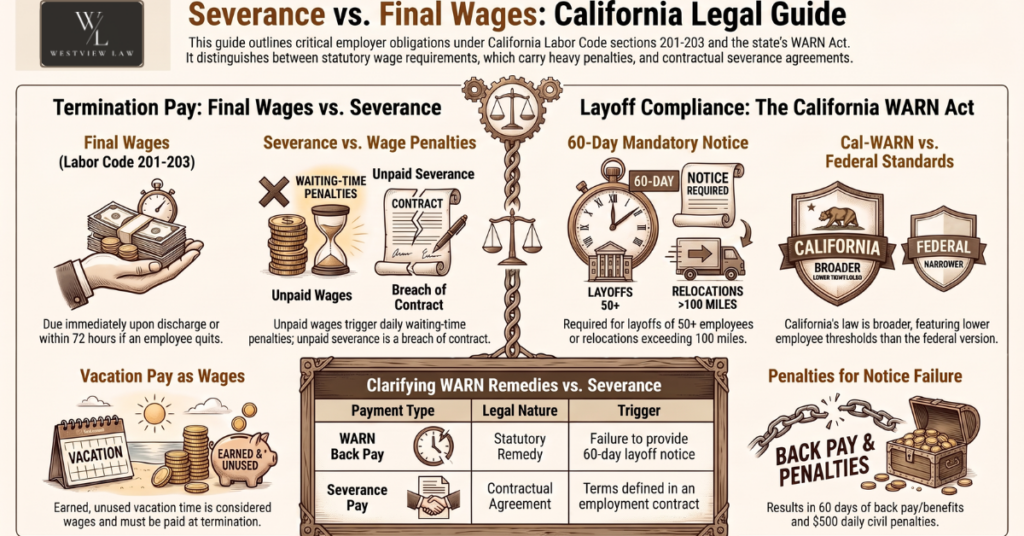
California law draws a sharp line between severance and final wages, and it helps to keep the two separate. Under Labor Code sections 201 through 203, earned wages, including accrued unused vacation time, which California treats as earned wages, must be paid promptly at termination.
If you are fired, your final paycheck is due immediately, and if you quit without notice, it is due within 72 hours. A willful failure to pay can trigger a waiting-time penalty of up to 30 days of wages under section 203.
Severance is different. It is not "wages due" under these final paycheck laws, so section 203 penalties do not attach to unpaid severance. If a promised severance goes unpaid, that is a breach-of-contract problem, not a waiting-time penalty problem.
The California WARN Act, found at Labor Code sections 1400 through 1408, is the other statute worth knowing. It applies to a covered establishment that employs, or employed in the prior 12 months, 75 or more people, part-time workers included.
When an employer orders a mass layoff of 50 or more employees in a 30-day period, a relocation of 100 or more miles, or a shutdown of operations, it must provide advance notice by giving 60 days of written notice. That notice goes to the affected employees and to the California EDD, the local workforce development board, and the local elected official.
If an employer skips that notice, the remedy is back pay plus the value of benefits for up to 60 days, along with a civil penalty of up to $500 per day. The federal WARN Act runs parallel but is narrower, and it covers employers with 100 or more employees. It defines a mass layoff as 50 to 499 affected workers who make up at least a third of the site's workforce. Cal-WARN is broader, with lower thresholds and no 33% test.
Here is the piece people miss. WARN back pay is a statutory remedy for the failure to give advance notice of a mass layoff. It is not contractual severance. Some employers offer pay instead of notice to cover the 60-day gap, but that payment answers a retraining notification and notice obligation, not a promise to pay severance benefits.
What Are Employee Rights and Employer Obligations Regarding Severance Pay in California?
If severance was promised, you have a right to enforce that promise, and you have rights around any release you are asked to sign. California's SB 331, the Silenced No More Act (Government Code section 12964.5), bars separation agreements from using confidentiality agreements or non-disparagement provisions that would stop you from disclosing unlawful workplace conduct such as harassment, discrimination, or retaliation.
These protections matter because workplace disputes are far from rare. According to the U.S. Equal Employment Opportunity Commission, 88,531 discrimination charges were filed nationwide in fiscal year 2024, a more than 9% increase from the previous year. Employees should understand the rights they are preserving before signing any severance agreement.
These agreements must include the statutory carve-out language, though the settlement dollar amount can still be kept confidential. AB 749 makes certain "no-rehire" clauses in agreements settling an employment dispute void, and California also generally prohibits non-compete clauses, with limited exceptions.And if you are 40 or older, the federal Older Workers Benefit Protection Act sets rules for waiving age claims.
Some rights cannot be waived at all, including unemployment insurance, workers' compensation, unpaid-wage claims, the right to file or participate in an EEOC or California Civil Rights Department charge, or other legal action permitted by law.
How to Calculate Severance Pay in California
There is no legally mandated formula, minimum, or maximum for severance pay in California, and companies calculate severance using different methods. The amount of financial compensation comes from a contract, policy, or negotiation, and several factors shape it. Length of service is the big one, as a longer tenure usually means a larger payment.
Position and seniority matter too, since senior and executive roles often receive larger severance packages than junior employees. Company policy or an employee handbook can set an internal standard, and some employers choose to offer more generous severance packages than their policies require.
A common custom used to calculate severance pay runs like this. Start by figuring out your weekly pay. Then multiply that weekly figure by the number of weeks per year of service your employer's policy offers, often in the range of one to two weeks per year. Add any negotiated extras on top, such as a bonus payout, continued benefits, or a longer runway.
Consider a hypothetical, an illustrative employee named Dana, who earned $1,500 a week and worked eight years. At two weeks of pay per year of service, Dana's base severance would be 16 weeks of pay, or $24,000. If Dana negotiated an extra month of continued health coverage and a neutral reference, those additions would sit alongside the cash figure. Remember, this is industry custom, not a legal entitlement, and your employer is free to offer more, less, or nothing unless a binding promise says otherwise.
What Are the Tax Implications of Severance Pay in California?
Each severance payment is taxable, and the IRS treats severance as wages. It is subject to federal income-tax withholding, Social Security and Medicare (FICA), and FUTA, and it gets reported on a W-2. The Supreme Court confirmed in United States v. Quality Stores (2014) that severance counts as FICA wages.
Employees receiving severance pay should understand that, because severance is treated as a supplemental wage, employers commonly withhold federal income tax at the flat 22% supplemental rate, rising to 37% on supplemental wages above $1 million in a year. California state income tax applies too. If your package is large, spreading payments across tax years or talking to a tax professional before you sign can help you plan for the bill and understand any impact on retirement accounts or other financial planning decisions.
Negotiating Severance Pay in California
Do not sign immediately. Carefully review the severance terms before agreeing to anything. A severance agreement is a legal contract, and once your signature is on it, you have usually waived real rights. Read the release closely and understand exactly what you are giving up, which is typically your ability to sue over the employment or the termination.
Your leverage often comes from two places: any potential legal claims you may hold, such as wrongful termination, discrimination, or unpaid wages, and the strength of your tenure and track record. That leverage can be significant. In FY 2024, the EEOC recovered nearly $700 million for almost 21,000 workers through discrimination enforcement and settlements, showing the financial value employment claims can carry.
Negotiate beyond the dollar figure, too, especially if the agreement could affect your future employment opportunities. Extended health insurance coverage, a neutral reference, outplacement services, keeping vested equity, and the timing or characterization of the payment can all help create a fair severance package and may be worth as much as extra cash.
"Before you sign anything, read the release as carefully as you read the dollar amount," says David M. Safvati, founder and managing partner of Westview Law. Taking the time to understand the agreement now may help both parties avoid unnecessary legal disputes later.
If you were wrongfully terminated or believe the separation was retaliatory, that possibility changes the math. An employer weighing the cost and exposure of a lawsuit may improve an offer or agree to more severance pay to close the door on it. This is the moment to get advice, because an employment lawyer can tell you whether the release is asking you to waive valuable rights or your ability to pursue legal action.
What Should Employers Consider When Offering Severance Pay in California?

Employers have their own reasons to get the structure right, including ensuring the return of company property before the separation process is complete. The best practice is a clearly written release, a fair payment tied to a consistent policy, and an approach designed to support employees while remaining legally compliant. That means including the SB 331 carve-out so the agreement does not silence disclosure of unlawful conduct, leaving out any unlawful no-rehire clause, and following the OWBPA process for workers 40 and older.
For an age-claim waiver to hold up, the OWBPA requires that the employee get at least 21 days to consider the agreement. This includes 45 days in a group layoff, plus 7 days to revoke after signing, and written advice to consult an attorney. No release can bar an employee from filing or participating in an EEOC charge. An employer that ignores these pitfalls can end up with a release that does not actually protect it, which defeats the purpose of paying severance in the first place.
Severance Pay vs Final Wages
Before discussing California's severance laws in more detail, it helps to understand how severance pay differs from final wages. Many employees mistakenly assume the two are treated the same under state law, but they serve different purposes and follow different legal rules. The table below highlights the key differences.
| Severance Pay | Final Wages |
|---|---|
| Not required by California law | Required by California law |
| Based on contract, policy, or employer agreement | Includes earned wages and unused vacation |
| Usually exchanged for a release of claims | Cannot be withheld if already earned |
| No waiting-time penalties under Labor Code §203 | Late payment may trigger waiting-time penalties |
| Negotiable | Not negotiable |
How Can an Employment Attorney Help With Severance Pay in California?
An employment attorney can review your severance agreement before you sign and explain exactly what you're giving up. They can identify unfair release terms, confidentiality provisions, non-disparagement clauses, and other language that may affect your future rights. If your termination involved discrimination, retaliation, wrongful termination, or unpaid wages, an attorney can also determine whether your legal claims strengthen your negotiating position.
A lawyer can often negotiate more than just a larger payment. They may help secure continued health benefits, a better reference, extended deadlines, equity protections, or changes to restrictive terms. Before accepting any severance package in California, having an employment attorney review the agreement can help you make an informed decision and avoid giving up valuable rights without fair compensation.
Ready to Negotiate Your Severance Pay in California?
California severance rules are not always obvious, and the stakes are real. Whether severance is owed, what a release actually waives, how the payment is taxed, and how it interacts with unemployment benefits all turn on the specific facts of your package. A short conversation with an employment attorney before you sign can protect rights you did not know were on the line.
Westview Law PC represents employees across California, from Los Angeles and Orange County to San Diego, San Francisco, San Jose, Sacramento, and beyond. We are a trial-focused firm, and our severance pay attorneys in California are happy to review a severance offer before you commit to it. Contact us today to talk about your situation.
Frequently Asked Questions
Severance pay can be confusing, especially if you're unsure whether your employer has to provide it. These frequently asked questions explain how severance pay works in California and what you should know about your rights.
What Is Severance Pay in California?
Severance pay is money an employer gives a departing employee beyond wages already earned, usually as a lump sum or continued payments. It commonly comes with a written agreement asking the employee to release legal claims. It is a contractual or voluntary benefit, not a wage the law requires.
Is Severance Pay Required by Law in California?
No. Neither the federal Fair Labor Standards Act nor California law forces a private employer to provide severance pay. It becomes owed only when the employer promised it in a contract, policy, ERISA plan, or collective bargaining agreement.
Can an Employer Provide Severance Pay in Exchange for a Release of Claims in California?
Yes, and it is common. The catch is that the release cannot silence disclosure of unlawful conduct under SB 331, cannot include an unlawful no-rehire clause, and must follow OWBPA timing rules to waive age claims. Certain rights, like filing an EEOC or CRD charge, cannot be waived.
How Is Severance Pay Calculated in California?
There is no legal formula. A common custom is one to two weeks of pay per year of service, adjusted for seniority, company policy, or a collective bargaining agreement. The final number is set by the contract, policy, or negotiation, not by statute.
Is Severance Pay Required in California?
Generally, severance pay is not required in California, but there are exceptions where a payment becomes owed. A binding employment contract, a handbook policy, or a collective bargaining agreement can create the obligation, and a Cal-WARN violation can trigger back pay or "pay in lieu of notice" for missing the required advance notice of a mass layoff.
What Are the Laws Regarding Severance Pay in California?
No law mandates severance, but several rules shape it: Labor Code sections 201 to 203 govern final wages, the California WARN Act (sections 1400 to 1408) requires layoff notice, and SB 331, AB 749, and the OWBPA limit what a release can demand. Severance is also taxed as wages under IRS rules.
Disclaimer: This article is for general informational purposes only and is not legal advice. Reading it or contacting Westview Law PC does not create an attorney-client relationship. Laws, deadlines, and their interpretation change over time and vary by state, including within California, and every situation is different. For advice about your specific severance agreement or termination, consult a licensed attorney.