


FMLA leave can cover your own serious health condition, caring for a spouse, child, or parent, bonding with a new child, and certain military family needs. A serious health condition generally involves inpatient care or continuing treatment by a health care provider, including some chronic physical or mental health conditions. Knowing what qualifies can help you recognize when you may have protected leave and take the right steps to protect your FMLA rights.
Westview Law PC represents employees across California, and the firm’s name comes from what it does inside a courtroom rather than around one. Founder David Safvati was named to Super Lawyers’ Southern California Rising Stars from 2022 through 2024 and to Best of the Bar’s Top 100 Verdicts in California in 2024. The firm handles family and medical leave disputes, wrongful termination, discrimination, and wage claims from its Century City office. If your employer denied your leave request or punished you for taking it, contact us today for a free case review.
This guide covers what the Family and Medical Leave Act is, who qualifies, which medical conditions are covered, how mental health fits in, what your medical certification needs to say, and how to check your own situation.
What Is FMLA?

The Family and Medical Leave Act is a federal law giving eligible employees job-protected leave for specific family and medical reasons. It does two things at once. It provides unpaid time away when you or a close family member is seriously ill, and it protects your job and your health coverage while you are gone.
Congress signed it into law in February 1993, and it took effect that August. It was the first federal statute to guarantee leave of this kind, and it expanded in 2008 and 2010 when military family leave entitlements were added. The Department of Labor’s Wage and Hour Division enforces it for most workers, while the Office of Personnel Management handles much of the federal workforce.
The benefits are concrete. You get up to 12 workweeks of leave in a 12-month period, your group health coverage continues on the same terms, and you return to the same job or an equivalent one with the same pay, benefits, and essential functions. You can also take FMLA leave intermittently when the medical need calls for it, which matters for chronic health conditions that flare up rather than persist.
What Are the Basic Provisions of FMLA?
The core entitlement is 12 workweeks of unpaid FMLA leave in a 12-month period. It covers your own serious health condition, care for an employee’s spouse, son, daughter, or parent, the birth or placement of a newborn child or a child through adoption or foster care, and a qualifying exigency arising from a family member’s covered active duty. Military caregiver leave runs longer: 26 workweeks in a single 12-month period to care for a covered servicemember with a serious injury or illness.
Job protection gives the law its teeth. When your leave ends, your employer must return you to the same position or an equivalent one, and your group health benefits continue throughout at the same cost to you. Your employer cannot count FMLA absences against you under an attendance policy or treat your leave as a negative factor in promotion or discipline. Retaliation for requesting leave is unlawful in its own right.
FMLA leave is unpaid, though you or your employer may substitute paid leave such as accrued vacation or sick time. Many employees stack FMLA protection on top of a state program or short-term disability coverage. In California, the California Family Rights Act has applied to employers with just five or more employees since 2021, so a worker whose employer is too small for the FMLA may still have state leave rights.
What Are the Eligibility Criteria for FMLA?
FMLA eligibility is not universal. In a U.S. Department of Labor survey, 56% of employees were eligible for FMLA based on their employment tenure, hours worked, and worksite size. That makes it important to check both your employer’s coverage and your own eligibility before assuming you are protected.
The Family and Medical Leave Act (FMLA) applies to many private employers with 50 or more employees who worked during at least 20 calendar workweeks in the current or preceding year. The 50-employee count includes part-time employees and workers who are on leave. Federal, state, and local government agencies are covered regardless of their number of employees. Public and private elementary and secondary schools are also covered, even if they have fewer than 50 employees.
Even when an employer is covered by the FMLA, an individual employee may not qualify. You generally must have worked for the employer for at least 12 months and completed 1,250 hours of service during the 12 months before your leave begins. You must also work at a location where your employer has at least 50 employees within 75 miles. These requirements are separate, so meeting one does not automatically make you eligible for FMLA leave.
Your 12 months of employment do not have to be continuous. In most cases, earlier periods of employment count if the break in service was less than seven years. Certain breaks may also count when required by military service under USERRA. The 1,250-hour requirement is based on hours actually worked. Paid vacation, sick leave, and other time off generally do not count toward those hours.
Military families have additional FMLA protections. Eligible employees may take up to 26 workweeks of leave in a single 12-month period to care for a covered servicemember with a serious injury or illness.
Eligible employees can also use FMLA qualifying exigency leave for certain needs related to a family member's covered military deployment, such as making childcare arrangements, attending military events, or meeting with a counselor. The usual FMLA eligibility requirements still apply, but these military-related leave provisions provide additional types of protected leave.
What Are the Common Medical Conditions Covered by FMLA?

FMLA is commonly used for an employee's own health needs. In the 2018 Department of Labor's survey, 51% of qualifying leaves involved the employee's own illness, while another 25% involved the arrival of a new child.
The FMLA does not provide a specific list of illnesses that automatically qualify for leave. Instead, it covers certain serious health conditions that require inpatient care or continuing treatment from a health care provider.
For example, a condition may qualify if it causes more than three consecutive, full calendar days of incapacity and involves either at least two health care provider visits within 30 days or one visit followed by a continuing treatment plan. The diagnosis itself is not always what matters. The required treatment and period of incapacity matter too.
Chronic conditions can also qualify for FMLA leave. These include conditions such as asthma, diabetes, epilepsy, and migraines when they require treatment at least twice a year and continue over an extended period.
FMLA can also cover long-term conditions, including illnesses that may cause periods of incapacity even when treatment is not effective. Conditions that require multiple treatments may qualify as well. This can include chemotherapy, dialysis, physical therapy, or surgery and other restorative treatments.
Pregnancy and prenatal care are covered under the FMLA, including periods of incapacity caused by pregnancy and certain prenatal appointments. The usual three-day incapacity requirement does not apply to pregnancy-related incapacity.
FMLA also covers certain periods of inpatient care, which generally involve an overnight stay in a hospital, hospice, or residential medical facility. Eligible employees may also take FMLA leave to care for a spouse, child, or parent with a serious health condition, and the definition of “son or daughter” can include a child for whom the employee stands in the place of a parent.
Which FMLA Leave Situation Applies to You?
Different FMLA situations can qualify for different reasons, from your own serious health condition to caring for a family member or welcoming a new child. The amount and type of leave can also vary, especially for military-related leave. The table below compares the main FMLA leave situations so you can see how they differ and which may apply to your circumstances.
| FMLA situation | Who or what it covers | Typical leave available | What makes it different? |
|---|---|---|---|
| Your own serious health condition | Your illness, injury, chronic condition, treatment, or recovery | Up to 12 workweeks | May be taken continuously or intermittently when medically necessary |
| Caring for a family member | A spouse, child, or parent with a serious health condition | Up to 12 workweeks | The leave is used to provide care or arrange care for the family member. |
| Pregnancy and childbirth | Pregnancy-related incapacity, prenatal care, childbirth, and recovery | Up to 12 workweeks | Prenatal appointments and pregnancy-related incapacity can qualify even when the usual three-day incapacity test does not apply |
| Bonding with a new child | Birth, adoption, or foster placement of a younger child | Up to 12 workweeks | Leave is for bonding rather than treating a serious health condition |
| Military qualifying exigency | Certain needs related to a spouse, child, or parent on covered active duty | Up to 12 workweeks | Can cover situations such as childcare arrangements, military events, or counseling |
| Military caregiver leave | Caring for a covered servicemember with a serious injury or illness | Up to 26 workweeks in one 12-month period | Provides substantially more leave than the standard 12-week FMLA entitlement |
Does the FMLA Cover Mental Health Conditions?
Mental health conditions are covered on exactly the same terms as physical ones. The definition covers a “physical or mental condition,” so there is no separate, tougher standard for a psychiatric diagnosis. The question is identical: inpatient care, or continuing treatment by a health care provider?
Most mental health claims come through the continuing treatment route. Major depression that leaves an employee unable to work for more than three consecutive days, with two provider visits within 30 days or one visit plus a prescribed medication regimen, meets the test. Anxiety disorders and PTSD often qualify as chronic conditions where the employee attends counseling sessions at least twice a year and experiences episodic incapacity.
Intermittent leave matters more here than almost anywhere else. Someone managing PTSD may function well for months and then need several days after a triggering event or two hours every Thursday for therapy. Both are legitimate, and an employer cannot force you into one continuous block when your medical need is intermittent.
Employees are often reluctant to say anything, which is understandable. You do not have to hand over a diagnosis or a therapy transcript. You need to give enough information for your employer to know the leave may be FMLA-qualifying, and whatever medical information you do provide must be kept confidential and separate from your personnel file.
Why Are Documentation and Certification Important When Applying for FMLA Leave?

Documentation turns a request into protected leave. When you ask for time off for a serious health condition, your employer can require a medical certification from your health care provider and must give you at least 15 calendar days to return it. Miss that deadline without good reason, and the employer can delay or deny the leave, which is one of the most common ways employees lose protection they were entitled to.
The medical certification form asks your provider to confirm when the condition began, how long it should last, the treatment schedule, and whether you can perform the essential functions of your job or need to care for a family member. For intermittent leave, it should spell out expected frequency and duration. Vague answers cause more denials than unqualifying conditions do, so review the form with your provider before it goes back.
Your employer has options if it doubts the certification, but they are limited. It can seek clarification through its own health care provider, require a second opinion at its expense, and get a third, binding opinion if the first two conflict. It cannot demand medical detail beyond the form, and your direct supervisor cannot make that call. Keep a copy of everything you submit and note the date.
How to Determine if Your Condition Qualifies for FMLA
Not every illness or medical issue qualifies for FMLA leave. The key is whether your condition meets the FMLA’s definition of a serious health condition and requires the type of care or treatment the law covers. Here are the main factors to look at when determining whether your condition may qualify for protected leave.
Step 1: Confirm Your Employer Is Covered.
Count whether the company has 50 or more employees, or check whether it is a public agency or a school, since those are covered at any size. If you are in California and the employer is smaller, check the California Family Rights Act, which starts at five.
Step 2: Check Your Own Eligibility.
Add up your months of service and actual hours worked over the last 12 months, then confirm your worksite has 50 employees within 75 miles. Falling short on hours is the most common reason a strong request fails.
Step 3: Match Your Condition to the Definition.
Ask whether your situation involves inpatient care or continuing treatment, then identify which category fits: three-plus days of incapacity with treatment, pregnancy or prenatal care, a chronic condition, a long-term condition, or multiple treatments. Name the category rather than the diagnosis, because that is the language the law uses.
Step 4: Talk to Your Health Care Provider.
Describe what your job actually demands, physically and mentally, so they can speak to your essential functions. Ask directly whether they expect episodic absences, since that decides whether you request continuous or intermittent leave.
Step 5: Read Your Employer’s Policy.
Pull the handbook section on family and medical leave and note the call-in rules, the certification form used, and whether you must substitute paid leave. Employers can enforce their usual notice procedures, so following them protects you.
Step 6: Give Proper Notice.
Request leave 30 days ahead where the need is foreseeable, such as planned medical treatment, and as soon as practicable when it is not. Put it in writing even if a phone call is allowed.
Step 7: Work With HR and Keep Records.
HR handles the paperwork, tracks your entitlement, and issues the eligibility and rights notices, but it is not the final word on what the law says. Log every conversation with a date and save the certification, the notices, and any denial.
Step 8: Get Advice if the Answer Feels Wrong.
If your employer denies the request, treats the absences as a performance problem, or your job changes when you return, talk to an employment lawyer before signing anything. Westview Law PC reviews these cases at no cost.
Common FMLA Tips
Most FMLA problems start with paperwork, not medical facts. Return the certification inside the 15-day window, and if your provider needs longer, say so in writing before the deadline rather than after. Leave no blanks, and make sure the frequency and duration section is complete if you need intermittent leave, because an incomplete answer there is what employers seize on. Give notice as early as you reasonably can.
Be careful how you describe things at work. You do not need to disclose a diagnosis, but you do need to say enough that your employer knows the absence might be covered. “I have a medical issue and will need time off, and my doctor is completing paperwork” beats calling in sick with no context. Keep the conversation in writing where you can, and follow up any phone call with a short confirming email.
Watch what happens after you return. Retaliation rarely announces itself and usually looks like a sudden change in reviews, a shift in duties, or an attendance write-up counting FMLA days it should not. Save your pre-leave performance reviews so you have something to compare against.
Need Help Understanding Your FMLA Rights?
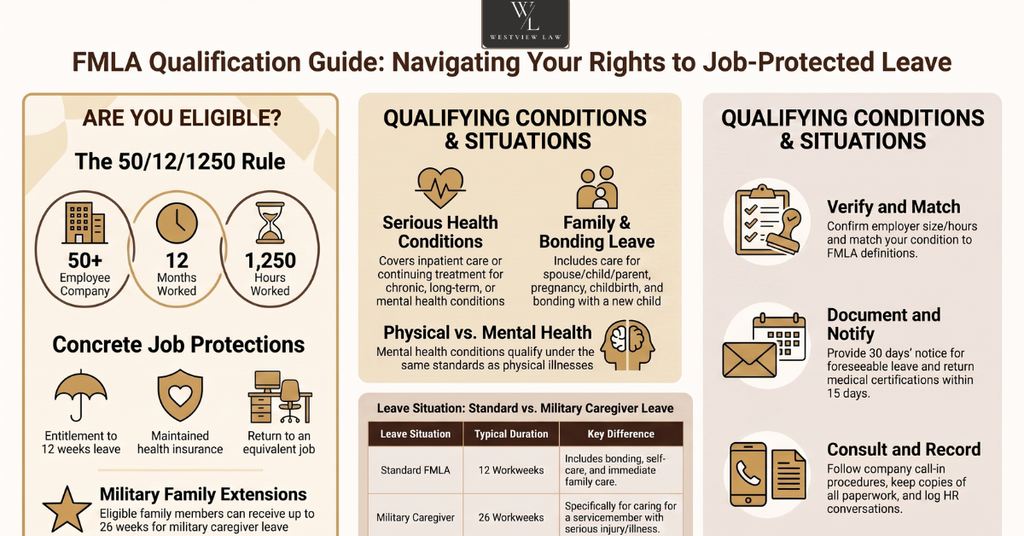
FMLA can protect eligible employees who need leave for a serious health condition, to care for certain family members, to bond with a new child, or to handle qualifying military-related needs. A condition generally qualifies when it involves inpatient care or continuing treatment, and mental health conditions can qualify under the same standards as physical conditions. Eligibility generally requires 12 months of employment, 1,250 hours worked, and a worksite with at least 50 employees within 75 miles. California employees may also have additional protections under state law.
If your leave was denied, cut short, or followed by discipline, that is worth a conversation with a lawyer rather than another round with HR. Deadlines run, evidence disappears when system access is cut off, and paperwork signed on the way out can limit what you can do later.
What conditions qualify for FMLA leave, and what should you do if your employer gets it wrong? Taylor Markey, Of Counsel at Westview Law PC, previously served as an Assistant Regional Attorney with the EEOC, handling complex systemic discrimination cases and federal enforcement matters. That experience gives her a practical understanding of how employers and agencies evaluate workplace claims, including disputes involving medical leave and retaliation. If your FMLA leave was denied, mishandled, or followed by discipline, bring your paperwork to Westview Law PC for a free case review.
Frequently Asked Questions
Employees often ask whether a health condition or family circumstance qualifies for FMLA leave. Eligible employees may receive unpaid leave for qualifying reasons, subject to the FMLA regulations and the employee's FMLA entitlement.
What Medical Conditions Qualify for FMLA Leave?
There is no official list, but a serious health condition can involve inpatient care or continuing treatment by an employee's health care provider. Conditions may qualify when employees need to receive medical treatment, attend periodic visits, or are unable to perform the essential functions of their employee's position.
Can Mental Health Conditions Qualify for FMLA Leave?
Yes, mental health conditions can qualify under the same standards as physical conditions. A mental or physical disability may qualify when it requires inpatient care or continuing treatment, subject to the employee's entitlement and applicable FMLA requirements.
Does Pregnancy Qualify for FMLA Leave?
Yes, pregnancy-related incapacity and prenatal care can qualify for FMLA leave, including when an employee needs to receive medical treatment. Eligible employees may also use their employee leave to bond with a newborn, subject to the applicable requirements.
Can Caring for a Family Member With a Serious Health Condition Qualify for FMLA Leave?
Eligible employees may take FMLA leave to care for a spouse, son or daughter, or parent with a serious health condition. The rules also cover certain military family member situations, while the employee's responsibilities and the employee's position receive the protections provided by the FMLA.
Do Military-Related Situations Qualify for FMLA Leave?
Yes, qualifying exigency leave can cover certain needs involving a spouse, child, or parent on covered active duty in the armed forces. Eligible employees may also receive up to 26 weeks of FMLA leave in a single 12-month period for military caregiver leave involving a covered servicemember or certain veterans.
Disclaimer: This article is provided for general informational purposes only and does not constitute legal advice. Reading it does not create an attorney-client relationship with Westview Law PC. Leave laws change, and every situation depends on its own facts, so you should consult a licensed California attorney about your specific circumstances. Prior results do not guarantee a similar outcome.