


Yes, a job can sometimes fire you while you're sick, because California is an at-will state and employers can end employment for many reasons. But they cannot fire you because you used a protected right, like taking paid sick leave, requesting FMLA or CFRA leave, or having a disability covered by the ADA or FEHA. When the illness itself is the reason, the firing may cross into illegal territory.
Westview Law represents California employees in wrongful termination, discrimination, and retaliation cases, and this is the kind of situation the firm handles every week. Our team includes Taylor Markey, a former Assistant Regional Attorney at the U.S. Equal Employment Opportunity Commission, so the firm knows how these cases look from the government's side of the table. Our trial lawyers built their name in the courtroom, not just at the settlement table. If you think you were pushed out over an illness, contact us today for a free consultation know where you stand.
This post walks through at-will employment, your federal and California legal protections, the steps to take if you were wrongfully terminated, and how an employment lawyer can help.
What Is At-Will Employment and What Are Its Implications for Sick Leave?
California runs on at-will employment. Under Labor Code section 2922, the law presumes that if there's no set term for your job, either you or your employer can end it at any time, for almost any reason or no reason at all. That's the default rule, and it catches a lot of people off guard.
Here's the big misconception. Many workers assume that showing up on time, doing good work, and following the rules guarantees job security. It doesn't. At-will means your employer generally doesn't need a good cause to let you go, and a strong performance record won't stop a lawful termination on its own.
So what does at-will mean for your sick days? On the surface, an employer has wide discretion over who stays and who goes. But that discretion has hard limits. At-will does not give an employer the right to fire you for a reason the law forbids, and using protected sick leave is one of those reasons.
The exceptions are where most sick-leave cases live. California recognizes a public-policy exception, so firing someone for a reason that violates a fundamental public policy can be wrongful termination. Courts also recognize an implied contract in some cases, where an employer's conduct, a handbook, or repeated assurances suggest you'd only be fired for cause. And a written employment contract or a union collective bargaining agreement can replace at-will status entirely with its own rules.
Then there are the statutory protections, which matter most here. State and federal laws also protect employees who report workplace safety concerns or exercise other protected legal rights. State and federal laws like California's Fair Employment and Housing Act (FEHA), the FMLA, the CFRA, and the Americans with Disabilities Act sit on top of at-will employment and override it.
Your employee handbook and company policies can add protections too, but they can't take away rights the law already gives you. So even in an at-will job, an employer who fires you for exercising these rights may be on the hook.
When Can an Employer Fire You for Being Sick?
While California is an at-will employment state, employers cannot fire workers for reasons prohibited by law. The table below shows when firing an employee for being sick is generally lawful and when legal protections may apply.
| Situation | Employer Can Legally Fire You? | Why |
|---|---|---|
| You're absent for a minor illness that isn't protected by law and you've exhausted available leave | Possibly | At-will employment generally allows termination unless another legal protection applies. |
| You're using California paid sick leave correctly | Generally No | California law prohibits retaliation for using protected paid sick leave. |
| You're on approved FMLA or CFRA leave | Generally No | These laws provide job-protected leave for qualifying medical and family reasons. |
| You have a qualifying disability and requested a reasonable accommodation | Generally No | The ADA and FEHA prohibit disability discrimination and require reasonable accommodations unless they create undue hardship. |
| You're fired because of poor performance unrelated to your illness | Yes | Employers may terminate employees for legitimate, documented business reasons unrelated to protected medical leave. |
| You violate company policies unrelated to your medical condition | Yes | Protected leave does not excuse misconduct or policy violations that would justify termination. |
| Your employer claims "performance issues" immediately after protected leave | It Depends | Suspicious timing may indicate retaliation, making the termination potentially unlawful if the employer's stated reason is a pretext. |
What Are the Legal Protections Under the Family and Medical Leave Act (FMLA)?
The Family and Medical Leave Act is a federal law that gives eligible employees time off for serious health issues without losing their jobs. Under the FMLA, a covered employer must provide up to 12 weeks of unpaid, job-protected leave in a 12-month period for a serious health condition, whether it's your own or a close family member's. When your leave ends, you're generally entitled to return to the same or an equivalent position.
Not everyone qualifies, though. To be eligible, you need to have worked for your employer for at least 12 months and at least 1,250 hours over the past year, and you must work at a location where the company employs 50 or more employees within 75 miles, according to the U.S. Department of Labor.
A serious health condition means an illness, injury, or condition that requires inpatient care or ongoing treatment by a health care provider. A bad cold usually won't count; surgery, cancer treatment, or a chronic condition that flares up often will.
This is where the job protection kicks in. If you qualify and take FMLA leave for a genuine serious health condition, your employer can't fire you simply for being out on that protected leave. Firing someone in retaliation for using an FMLA leave, or refusing to reinstate them afterward, is considered wrongful termination. The law is meant to let you focus on getting better without gambling your paycheck.
The FMLA has real gaps, and that's the catch. That's where California steps in with broader protections for eligible employees. It doesn't cover employers with fewer than 50 employees, and it doesn't help workers who haven't hit the hours or tenure thresholds.
That's where California steps in. The California Family Rights Act (CFRA) is the broader state parallel, and since 2021, it applies to employers with just 5 or more employees, with no 75-mile requirement. CFRA gives many California workers job-protected leave even when the federal FMLA doesn't reach their employer.
Americans with Disabilities Act (ADA) and Its Role in Protecting Sick Employees
The Americans with Disabilities Act is a federal civil rights law that protects workers with disabilities from discrimination. It applies to employers with 15 or more employees. Under the ADA, a disability is a physical or mental impairment that substantially limits a major life activity, which can include things like working, walking, concentrating, or caring for yourself. In California, FEHA is broader, covering employers with 5 or more employees and dropping the "substantial" limitation requirement, so more conditions and more workers are protected.
A lot of serious and chronic illnesses fall under these laws. Conditions like cancer, diabetes, epilepsy, multiple sclerosis, and diagnosed depression or anxiety can qualify when they limit a major life activity. If your illness qualifies, you're not just protected from being fired over it. You may also be entitled to help staying on the job.
That help usually comes as reasonable accommodations. These are practical changes that let employees perform the essential functions of their roles, such as a modified schedule, time off for treatment, remote work, or adjusted duties.
The process starts when you ask, and it triggers what's called the interactive process, a back-and-forth where you and your employer figure out what works. Employers must provide reasonable accommodations unless doing so causes an undue hardship, meaning significant difficulty or expense given the size and resources of the business.
The discrimination piece is the backbone of the law. An employer can't fire you, demote you, or treat you worse because of your disability or because you asked for an accommodation.
Say a warehouse worker with a back condition asks for a lifting restriction and gets terminated a week later instead. Or an employee returns from cancer treatment and is suddenly written up for made-up performance problems. Those are the patterns that point to employment discrimination, and disability claims remain one of the most common types the EEOC sees. The agency received 88,531 new charges of discrimination in fiscal year 2024, according to the U.S. Equal Employment Opportunity Commission.
Know Your Rights: Can a Job Fire You for Being Sick?
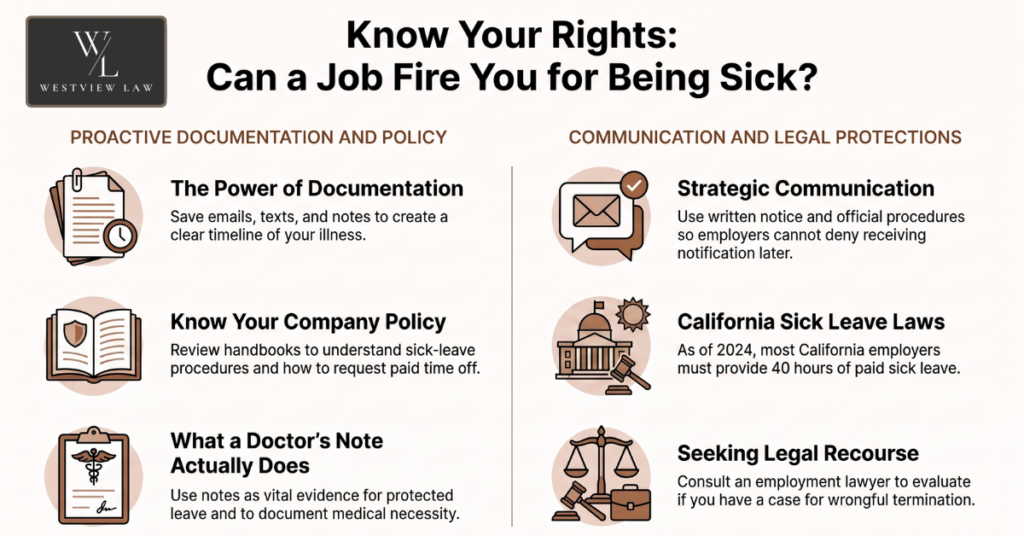
If you were let go while sick and it feels wrong, you may have legal recourse. The first move is documentation. Save your emails, texts, performance reviews, doctor's notes, and anything showing the timeline of your illness and the firing. Then talk to an employment lawyer, because whether your situation counts as wrongful termination depends on the specific facts, and a quick consultation can sort that out fast.
People put a lot of faith in a doctor's note, so it's worth being clear about what it does. A doctor's note documents that your absence was medically necessary, and it can support a claim for protected leave or an accommodation. It does not, by itself, make you immune from every firing. What it does is create a paper trail that shows your employer knew about your medical situation, which matters a lot if they later claim they had no idea.
Communication is where you can protect yourself and help ensure you are treated fairly throughout the leave process. Tell your employer you're out for medical reasons, follow the company's call-in procedures, and put the important parts in writing when you can.
You don't have to hand over your entire medical history, but giving enough notice that your absence is health-related helps trigger your legal protections. A vague or verbal-only notice is easier for an employer to later deny.
Company policy is the last piece to understand. Read your employee handbook and learn how the sick-leave policy actually works, including how much paid sick leave you have and how to request it.
If your employer is violating its own written policy or California's sick leave laws, that's worth raising, in writing, and escalating to HR or the labor authorities if needed. California requires most employers to provide at least 40 hours, or 5 days, of paid sick leave per year as of January 1, 2024, according to the California Department of Industrial Relations.
Steps to Take If You Believe You Were Wrongfully Terminated
Paid sick leave is common now, reaching about 80% of private industry workers in 2025, according to the U.S. Bureau of Labor Statistics, but having sick days and knowing your job is safe are two different things. If you think you were fired for being sick, what you do in the first few weeks matters. Acting early protects evidence and preserves deadlines, and it puts you in a stronger position whether you end up filing a complaint or hiring a lawyer. Here's a practical order to work through.
Step 1: Write Down the Timeline While It’s Fresh.
Note the dates you were sick, when you told your employer, and when you were fired. Memories fade fast, so get it on paper now.
Step 2: Gather Your Documentation.
Collect emails, texts, pay stubs, doctor's notes, performance reviews, and your employee handbook. These records show what your employer knew and when.
Step 3: Request Your Personnel File.
California employees have the right to inspect and get a copy of their personnel records under Labor Code section 1198.5. Ask in writing, and keep a copy of the request.
Step 4: File for Unemployment.
Apply for unemployment benefits through California's Employment Development Department while you look for work. Being fired doesn't automatically disqualify you, so don't skip this.
Step 5: File a Complaint With the Crd or the EEOC.
You can file with the California Civil Rights Department (CRD) or the federal EEOC, but watch the deadline, because these agencies have strict filing windows. Filing on time preserves your right to pursue the claim later.
Step 6: Consult an Employment Attorney.
A lawyer can review your facts, tell you if you have a case, and handle the agencies and paperwork. Most employment lawyers offer a free consultation, so the first conversation costs you nothing.
How Can an Attorney Help if You’re Fired for Being Sick?

A good employment lawyer does more than fill out forms. They can tell you quickly whether your firing was likely legal or whether it crosses into wrongful termination, which saves you from guessing. They know how to preserve evidence, meet agency deadlines, calculate lost wages, and deal with an employer's lawyers. And because most employment attorneys work on contingency, you usually don't pay legal costs upfront, which keeps the door open even when money is tight.
Consider a composite example, the kind of case we see, not a specific client. An employee with a chronic condition takes a week of protected sick leave with a doctor's note on file. Days after coming back, they're fired for performance, even though their reviews had always been solid. They bring the emails, the note, and the timeline to an employment lawyer, who spots the suspicious timing and the missing paper trail behind the sudden "performance" claims.
From there, the attorney can file the right agency complaint, gather records, and negotiate. In a case with facts like these, a favorable resolution might mean a settlement or, in some situations, reinstatement, depending on what the client wants and what the evidence supports. The point of the example is simple. When the firing lines up too neatly with protected leave, a lawyer can often turn that pattern into leverage. Every real case turns on its own facts, so this is an illustration, not a promise of any particular result.
Have You Been Fired for Being Sick in California?
At-will employment gives California employers a lot of latitude, but it isn't a free pass to fire someone for being sick. Federal and state laws, the FMLA, CFRA, the ADA, and FEHA, protect employees who use paid sick leave, take job-protected leave, or have a qualifying disability.
If your termination lines up with an illness, a doctor's note, or a leave request, that timing is worth a hard look. You don't have to figure this out alone. Every situation turns on its own facts, and the only way to know if you have a real claim is to have someone review the details.
Were you forced out of your job because of an illness or medical condition? Westview Law represents California employees in wrongful termination, discrimination, and retaliation cases and has the experience to hold employers accountable. Our team includes Taylor Markey, a former Assistant Regional Attorney with the U.S. Equal Employment Opportunity Commission, giving us valuable insight into how these claims are evaluated and defended. Contact us today for a free consultation and find out what legal options may be available to you.
Frequently Asked Questions
If you've missed work because of an illness, you may be worried about whether your employer can legally fire you. Here are answers to common questions about your rights if your employer fires you for being sick.
Are There Any Exceptions to the Law Protecting Employees From Being Fired for Being Sick in California?
Yes. An employer may fire an employee for legitimate reasons, such as poor job performance or an inability to perform job duties, as long as the decision is unrelated to protected paid leave, unpaid leave, or other federal protections.
Can My Employer Require a Doctor's Note When I Call In Sick in California?
Yes, in some situations. Private employers may request reasonable medical documentation when allowed by local laws and company policy, particularly for a serious illness or extended absence.
What Steps Should I Take to Protect Myself If I Suspect My Job Is Trying to Fire Me for Being Sick in California?
Keep copies of your doctor's notes, emails, and other records because they may support your legal options if you are considered wrongfully terminated. A qualified law firm can review all the details and explain whether pursuing legal action is appropriate.
Can a Job Fire You for Being Sick Even With a Doctor's Note?
Generally, no, if your absence is protected by law. A doctor's note helps show your leave was medically necessary and may support a wrongful termination claim if your employer fires you.
What Are My Rights If I Get Fired for Being Sick?
You may have legal options if your termination violated California law or federal protections. Depending on the facts, additional protections under state law may also apply, and you may be able to recover compensation, seek reinstatement, or file complaints with state labor departments.
Can I Be Terminated for Taking Too Much Sick Leave?
It depends on whether your leave is protected and whether you meet the criteria under state or federal law. Employers generally cannot fire employees for using protected leave to care for sick family members, a family member's illness, domestic violence, or another qualifying reason, but unprotected absences or too many sick days may lead to discipline.
Legal Disclaimer: This article is provided for general informational purposes only and is not legal advice. Reading it or contacting Westview Law does not create an attorney-client relationship. Employment laws change over time and apply differently depending on the specific facts of each situation. For advice about your own circumstances, consult a qualified California employment attorney, such as the team at Westview Law.