


A retaliation lawsuit is a legal claim brought by an employee who was punished for exercising a workplace right, such as for reporting harassment, filing a discrimination complaint, asking about unequal pay, or helping a coworker's case. When an employer strikes back with a firing, a demotion, cut hours, or a sudden bad review, the law gives that worker real options. You can file a charge with the Equal Employment Opportunity Commission (EEOC) or a complaint with California's Civil Rights Department (CRD) and often take the employer to court.
At Westview Law, our retaliation work is anchored by Of Counsel Taylor Markey, a former Assistant Regional Attorney at the U.S. EEOC who spent years enforcing the very anti-retaliation laws we now use to protect California workers. Founder David Safvati has been named to Super Lawyers Southern California Rising Stars (2022–2024) and recognized among California's Best of the Bar Top 100 Verdicts. Our firm built its reputation in the courtroom, so when an employer retaliates against you, we're prepared to prove your case before a jury, not just pursue a settlement. Contact us today for a confidential case review.
In this article, we will explain what counts as retaliation, the laws that protect you, how these cases are proven, which employers are covered, and the steps you can take next.
What Are Retaliation Lawsuits?
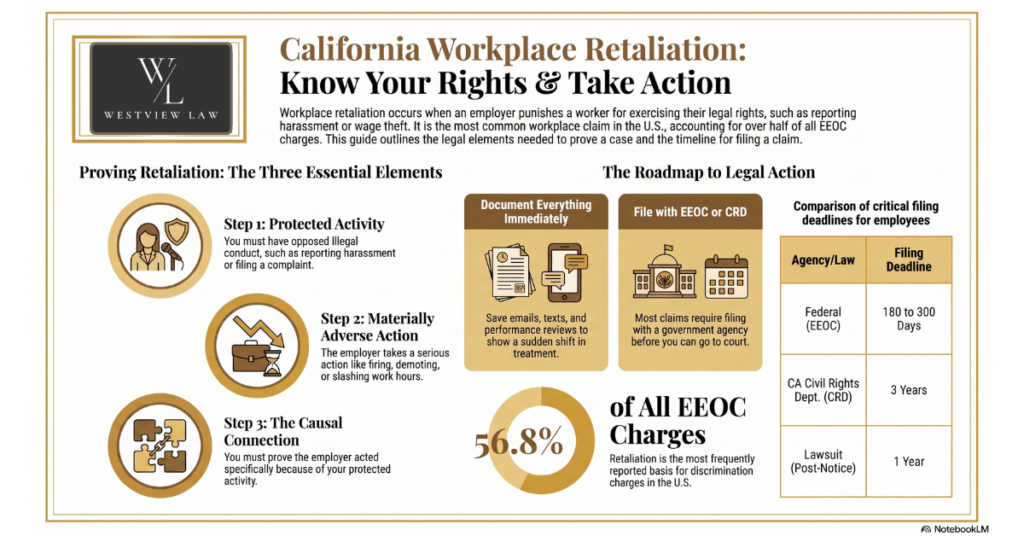
Workplace retaliation happens when an employer takes a materially adverse action against an employee because of protected activity. Retaliation is also one of the most common workplace claims in the country. According to the U.S. Equal Employment Opportunity Commission, retaliation was alleged in 56.8% of all discrimination charges filed in FY 2024, making it the most frequently reported basis for an EEOC charge.
Under both employment law and labor law, statutes prohibit retaliation against workers who assert their legal rights. Employer retaliation can take many forms, but the key question is whether the employer acted because the employee engaged in protected activity rather than for a legitimate business reason. When an employer retaliates against an employee for exercising a protected right, the law may provide a remedy.
The legal framework comes from both federal and state law. Federally, the EEOC enforces anti-retaliation protections built into Title VII of the Civil Rights Act of 1964, the Americans with Disabilities Act (ADA), the Age Discrimination in Employment Act (ADEA), and other statutes. In California, employees get broader coverage through the Fair Employment and Housing Act (FEHA) and several Labor Code provisions. A single situation often violates more than one at once.
Common scenarios look familiar once you see the pattern. An employee reports sexual harassment and is written up for the first time in years. A worker files a wage complaint and finds her shifts slashed the next week. Someone backs up a coworker's discrimination claim and is suddenly excluded or transferred to a worse assignment. Firing is the obvious example, but demotions, pay cuts, bad references, and a manufactured paper trail of poor reviews all count.
It's important to remember that engaging in protected activity does not make you untouchable. An employer can still discipline or fire you for legitimate, non-retaliatory reasons such as poor performance that predates your complaint, a real policy violation, or a layoff that hits your whole team. Retaliation law targets punishment for speaking up, not every negative thing that follows.
What Are the Legal Grounds for Filing a Retaliation Lawsuit?
Federal and California laws work together to protect employees who report or oppose illegal conduct. At the federal level, federal laws such as Title VII of the Civil Rights Act, the ADA, and the ADEA prohibit retaliation related to workplace discrimination and harassment.
The Civil Rights Act protects employees who oppose discrimination, including discrimination based on race, color, religion, sex, or national origin, and who file complaints or submit a formal complaint about a hostile work environment or other unlawful practices. These protections also extend to many workers in the federal sector.
Additional federal protections come from the Fair Labor Standards Act, the Family and Medical Leave Act, the Occupational Safety and Health Act, and other workplace statutes. Together, these laws protect employees who report wage violations, exercise leave rights, or raise workplace safety concerns without fear of retaliation.
The U.S. Department of Labor also enforces numerous whistleblower laws that protect employees who report fraud, safety hazards, environmental violations, and other unlawful conduct. California adds some of the strongest protections in the country. FEHA's anti-retaliation provision, Government Code § 12940(h), makes it unlawful for an employer to retaliate against someone because they opposed conduct prohibited by FEHA, filed a retaliation complaint, testified, or otherwise assisted in an investigation or legal proceeding.
Labor Code § 1102.5, the state's whistleblower statute, protects employees who report a suspected legal violation to a government agency or internally to someone with authority to fix it, and it only requires a reasonable belief that the law was broken, even if you turn out to be wrong.
Retaliation also differs from the underlying discrimination. Employment discrimination is about being treated worse because of who you are. Retaliation is about being punished for what you did: reporting the bias, opposing it, or helping someone else's case. Even if your original harassment or discrimination complaint doesn't succeed, you can still win a retaliation claim, because the two questions are separate.
Retaliation After Resigning
Retaliation does not always end when you resign. Some former employer's actions may continue after your employment ends, including giving false or misleading references, blacklisting workers within an industry, or interfering with new job opportunities. While employers can share truthful information about a former employee, they generally cannot make false statements or take actions intended to damage someone's career.
If a former employer contacts your new employer to spread false claims, pressures a company not to hire you, intentionally blocks your future employment, or where the employer refused to provide an honest reference because you previously reported unlawful conduct, those actions may be unlawful. Keep records of suspicious communications, withdrawn job offers, or negative comments from former supervisors. That information can help an employment attorney determine whether post-employment retaliation or another legal claim may apply.
Examples of Retaliation by Industry
Retaliation can happen in almost any workplace, but it often looks different depending on the industry. In healthcare, a nurse reports unsafe patient staffing levels and is suddenly reassigned to less desirable shifts, excluded from overtime opportunities, or given additional job responsibilities without justification.
At a tech company, a software engineer raises concerns about gender discrimination during promotions and is removed from a high-profile project shortly afterward. In retail, a sales associate files a complaint about unpaid overtime or minimum wage violations and then sees their weekly hours drastically reduced despite a strong performance record.
Construction workers may face retaliation after reporting serious safety violations to a supervisor or government agency. A foreman who repeatedly raises concerns about missing fall protection equipment, for example, could be demoted or terminated days later. Government employees might experience retaliation after reporting misuse of public funds or unethical conduct, such as receiving an unexpected poor performance review or being transferred to a less favorable position without a legitimate reason.
Restaurant workers also encounter retaliation when they speak up about workplace violations. A server who reports sexual harassment by a manager may suddenly receive fewer shifts, while a line cook who complains about wage theft could be fired for a minor policy violation that had previously been overlooked.
Although the circumstances vary by industry, the common thread is the same. An employer may isolate an employee from other employees, prevent a co-worker from collaborating with them, or intentionally exclude them from meetings and opportunities that are important to their role; therefore, an employee exercises a protected right, and the employer responds with an adverse action that would discourage a reasonable worker from speaking up.
How to Prove Retaliation in a Lawsuit

Every retaliation case rests on three elements. First, you engaged in protected activity. Second, your employer took a materially adverse action against you. Third, there is a causal relationship showingthat the employer's adverse action happened because of the protected activity. Miss any one, and the claim fails.
The materially adverse standard comes from the Supreme Court's decision in Burlington Northern & Santa Fe Railway Co. v. White (2006). The employer's conduct must be serious enough that it would discourage a reasonable employee from making or supporting a discrimination complaint. That reaches well beyond firing and pay: a punitive transfer, a damaging reference, being frozen out, and even harm that lands outside the job can qualify. Petty annoyances and minor slights do not.
Causation is where these cases are often won or lost. For federal retaliation claims under Title VII, employees generally must show the adverse action would not have occurred but for their protected activity. California retaliation claims may be analyzed under different standards depending on the statute involved. That is a stricter test than the motivating factor standard used for status-based discrimination.
When retaliation is proven through circumstantial evidence, courts often apply the McDonnell Douglas framework. Here, you make a prima facie case, the employer offers a legitimate non-retaliatory reason, and you show that the reason is pretext. Ultimately, the employee must present clear evidence or other proof creating reasonable cause to believe retaliation occurred and satisfy the but-for causation requirement.
Evidence is what transforms legal elements into a strong retaliation case. Protected activity is shown through the complaint email, the EEOC charge, or a witness who heard you object. The adverse action shows up in a termination letter, a demotion notice, or a schedule change. Causation often turns on timing, such as a first-ever write-up landing days after you reported harassment.
How to Gather Evidence to Support Your Retaliation Claim
Documentation is your best friend in a retaliation case. Save emails and text messages, especially anything referencing your complaint or the discipline that followed. Keep performance reviews from before and after the protected activity, because a sharp drop with no real change in your work speaks volumes. Make note of coworkers who witnessed important conversations or events, as they may later serve as witnesses in federal and state courts if your case proceeds to litigation.
Write things down as they happen. A short, dated log of each incident that includes who said what, when, and who else was there beats a memory reconstructed months later. Keep your own copies at home or in a personal email account, not just on a work device, as you could lose them the day you're terminated, while being careful not to take confidential company records.
Timing carries real weight. Courts pay attention to temporal proximity. The shorter the gap between your complaint and the punishment, the stronger the inference. Consistency matters too. If the employer claims you were fired for performance, but your file was clean until the week you spoke up, that gap between the story and the record is what a good retaliation claim is built on. Emails, performance reviews, and witness testimony can further strengthen your claim.
What Is the Timeline of a Retaliation Case?
While every retaliation claim is different, most cases follow a similar process. Some disputes settle shortly after an employee files a complaint, while others move through agency investigations and litigation before reaching a resolution. Here's what a typical retaliation case timeline looks like:
| Stage | What Happens |
|---|---|
| 1. Employee Reports a Workplace Violation | The employee reports discrimination, harassment, wage theft, unsafe working conditions, or another legally protected concern to the employer or a government agency. |
| 2. Employer Takes Adverse Action | The employer allegedly retaliates by firing, demoting, reducing hours, issuing unwarranted discipline, or taking another materially adverse action. |
| 3. Employee Gathers Evidence | The employee preserves emails, text messages, performance reviews, witness information, and a timeline of events to support the claim. |
| 4. Charge Is Filed | If required, the employee files a charge with the EEOC or the California Civil Rights Department (CRD). Certain California claims may proceed directly to court. |
| 5. Agency Review or Investigation | The agency may investigate the complaint, request information from both sides, or offer mediation to resolve the dispute. |
| 6. Right-to-Sue Notice Issued | Once administrative requirements are satisfied, the employee may receive a Right-to-Sue Notice, allowing the lawsuit to move forward. |
| 7. Settlement Discussions | The parties may negotiate a settlement or participate in mediation before litigation continues. |
| 8. Lawsuit Is Filed | If no resolution is reached, the employee files a retaliation lawsuit in the appropriate court. |
| 9. Discovery | Both sides exchange documents, take depositions, and gather evidence to prepare for trial. |
| 10. Settlement or Trial | Many cases settle before trial, but unresolved disputes are decided by a judge or jury. |
What Does NOT Count as Retaliation?
Not every negative employment action is unlawful retaliation. Employers can still make legitimate business decisions, even if an employee recently engaged in protected activity. For example, a company may conduct a genuine layoff because of financial difficulties, eliminate positions during a company-wide restructuring, or discipline an employee for documented performance problems that existed before the employee filed a complaint. Likewise, an employer may take corrective action for misconduct, attendance issues, or policy violations that are unrelated to the employee's protected activity.
Personality conflicts, disagreements with a supervisor, receiving constructive criticism, and other petty slights generally do not amount to unlawful retaliation. The law distinguishes between ordinary workplace frustrations and actions that are serious enough to discourage a reasonable employee from exercising their legal rights. By contrast, extreme forms of retaliation such as termination, demotion, significant pay reductions, blacklisting, or other materially adverse actions are far more likely to support a legal claim when they are motivated by protected activity.
What Is Employer Coverage in Retaliation Lawsuits?

Not every employer is covered by every law, so coverage thresholds are one of the first things to check. Federally, Title VII, the ADA, the Equal Pay Act, and GINA apply to employers with 15 or more employees, while the ADEA covers employers with 20 or more employees.
California is far more inclusive because FEHA reaches employers with 5 or more employees, and its harassment provisions extend to employers with just one, a threshold that decides whether many California workers have a claim at all. Retaliation has remained the most frequently alleged basis of discrimination charges filed with the EEOC for several consecutive years, accounting for 56.8% of all charges received in FY 2024.
Liability also depends on who did what. An employer is generally more directly on the hook when a supervisor with authority takes the adverse action than when the conduct comes from a coworker. Still, the company can be liable if it knew or should have known about retaliatory behavior and failed to act. This is one reason retaliation remains a frequently alleged basis for employment claims.
A failure to investigate is often its own problem. When an employee reports harassment or discrimination and the employer brushes it off, punishes the messenger, or lets the retaliation continue, that response itself becomes evidence of whether the company had a real process or simply closed ranks against the person who complained.
What Steps Can Employers Take to Mitigate the Risk of Retaliation Claims?
Responsible employers reduce their exposure by putting real systems in place: a clear, written anti-retaliation policy, regular training for managers and staff, and prompt, neutral investigations whenever someone raises a concern. Good policies can reduce economic damages, back pay, and costly settlement amounts. Prevention is always better than litigation.
Documentation also protects employers. Legitimate employment decisions should always be well documented. Decision-makers should be separate from complaint investigators whenever possible. Settlement amounts depend on several factors, including the evidence and the employee's losses. Strong evidence often leads to higher settlements.
How to Protect Your Rights Against Workplace Retaliation
You have several paths, and they aren't mutually exclusive. You can raise an internal complaint with HR, file complaints with the EEOC or the California Civil Rights Department, or pursue both when appropriate. For wage or safety issues, the California Labor Commissioner handles retaliation tied to Labor Code violations. When those routes stall or the harm is serious, a lawsuit may be the right move.
Good resources exist to help you start. The EEOC explains federal protections and the charge process, and the California Civil Rights Department covers FEHA claims and right-to-sue notices. Because the rules and deadlines are technical, consulting an employment attorney early is often the most valuable step you can take.
What Is the Importance of Seeking Legal Counsel for a Retaliation Lawsuit?
An experienced employment attorney does more than file paperwork. They can tell you quickly whether you have a viable claim, identify which laws apply, and map out a strategy that fits your goals.
Counsel helps at every stage: preserving evidence before it disappears, meeting the strict CRD and EEOC deadlines, valuing your damages realistically, and handling the McDonnell Douglas burden-shifting fight when the employer offers its "legitimate" reason. That is often where retaliation cases are won, because the employee must provide evidence that the employer's stated reason is a pretext for retaliation.
As Taylor Markey, a former U.S. EEOC Assistant Regional Attorney and Of Counsel at Westview Law, puts it, "Retaliation cases usually aren't won with a single smoking-gun email. They're won by lining up the timeline of what the employee did, how the employer knew, and what changed right afterward. The employees who document things as they happen give their lawyers far more to work with than the ones who wait."
Ready to Pursue a Retaliation Claim?
Retaliation is punishment for exercising a protected right, and proving it comes down to three elements: protected activity, a materially adverse action, and a causal connection. Both the EEOC federally and FEHA and the Labor Code in California stand behind employees who speak up, and California's protections, with no cap on damages and a lower coverage threshold, rank among the strongest anywhere.
The deadlines move faster than people expect. Federally, an EEOC charge generally must be filed within 180 days of the adverse action, extended to 300 days where a state agency enforces the same protection. In California, a CRD complaint must be filed within three years, and once you receive a right-to-sue notice, the lawsuit itself must be filed within one year. Waiting can quietly cost you your claim, so acting early protects your options.
Were you fired soon after reporting something your employer didn't want to hear? That timing is exactly what our Westview Law attorneys dig into, because California law protects workers who speak up and punishes the employers who retaliate. Our workplace retaliation attorneys in California have handled these cases from both sides of the table, so we know how the defense will spin it and how to hold up your side with evidence. Reach out today for a free confidential review, and let's find out whether you have a retaliation claim worth pursuing.
Frequently Asked Questions
Retaliation laws protect employees from being punished for exercising their legal rights. These frequently asked questions explain retaliation lawsuits in simple terms and help you understand your rights and legal options.
How Do You Prove Retaliation in a Lawsuit?
To prove retaliation, you must show that you engaged in protected activity, suffered an adverse employment action, and that the two are connected. Evidence such as emails, witness statements, performance reviews, and the timing of events can help support your claim.
What Are the Elements of a Retaliation Claim?
A retaliation claim generally requires three elements: protected activity, an adverse employment action, and a causal connection between them. Depending on the law, you may also need to show the retaliation would not have happened without your protected activity.
How Do I Know if I Have a Valid Retaliation Claim?
You may have a valid claim if you reported or opposed unlawful conduct and then experienced a negative employment action because of it. An employment attorney can review the facts and determine whether your case meets the legal requirements.
What Is the Process for Filing a Retaliation Lawsuit?
Most retaliation claims begin by filing a complaint with the appropriate government agency before going to court. Once you receive a right-to-sue notice, you can generally file a lawsuit if your claim qualifies.
What Types of Damages Can I Seek in a Retaliation Lawsuit?
You may be able to recover lost wages, emotional distress damages, attorney's fees, and, in some cases, punitive damages. The amount and types of compensation available depend on the law and the facts of your case.
How Long Do I Have to File a Retaliation Lawsuit?
The deadline depends on the law under which you are filing your claim. Because filing deadlines can be short and vary by jurisdiction, it is important to speak with an attorney as soon as possible.
Disclaimer: This article is provided for general informational purposes only and does not constitute legal advice. Reading it or contacting Westview Law PC does not create an attorney-client relationship. Laws, deadlines, and procedures change over time and vary by state, including in California, and outcomes depend on the specific facts of each case. For advice about your situation, consult a licensed attorney in your jurisdiction.