


FMLA intermittent leave lets eligible employees take time off in small blocks instead of one continuous leave. You may qualify if you work for a covered employer, meet the FMLA's length of service and hours worked requirements, and need leave for a qualifying medical or family reason. Understanding your FMLA rights can help you protect your job, request leave correctly, and avoid problems with your employer.
At Westview Law, we represent California employees in disputes involving the FMLA and its state counterpart, the CFRA, along with discrimination, retaliation, and wage-and-hour claims. Our team includes attorneys who have handled these issues from the inside, including Of Counsel Taylor Markey, a former Assistant Regional Attorney with the EEOC. Founder David Safvati has been recognized as a Super Lawyers Rising Star in Southern California, and the firm works on contingency, so most clients pay nothing unless we recover for them. If your employer has denied, delayed, or punished you for taking leave, contact us for a free case review.
This post breaks down how intermittent FMLA leave works, who qualifies, how to request it, the mistakes both sides make, and how to handle disputes when they come up.
What Is FMLA Intermittent Leave?
The Family and Medical Leave Act gives eligible employees up to 12 workweeks of job-protected, unpaid leave in a 12-month period. Intermittent leave is one way to use that entitlement. Instead of stepping away from work for weeks at a stretch, the employee takes the same leave in smaller pieces, like an hour, an afternoon, or a couple of days, as the need arises. The total still counts against the 12-week cap, but the time comes off in installments rather than all at once.
That is the core difference between continuous and intermittent leave. Continuous leave is one unbroken block: an employee has surgery, recovers for six weeks, and returns. Intermittent leave, by contrast, is spread out.
Intermittent leave is becoming more common. According to the U.S. Department of Labor's 2018 FMLA Employee Survey, 15% of U.S. employees took leave for an FMLA-qualifying reason during the previous year, and intermittent leave is being used more frequently than in earlier surveys.
A reduced leave schedule is a close cousin of the employee's usual weekly or daily hours drop for a period, say from five days to three, while they manage treatment or recovery. Both let a worker keep a foot in the workplace instead of disappearing entirely.
Not every FMLA reason can be taken intermittently by default. When the leave is for a serious health condition, like when it involves the employee's own or a covered family member's, and involves planned or ongoing medical treatment, the employee has a right to take it intermittently or on a reduced schedule when it is medically necessary.
The same is true for a qualifying exigency tied to a family member's military service and for military caregiver leave. Leave for the birth or placement of a child through adoption or foster care is different. This is because an employee can only take that leave intermittently if the employer agrees.
The rules live in the federal statute and in the Department of Labor's regulations at 29 CFR Part 825, which the Wage and Hour Division enforces. Those regulations spell out how leave is counted, what certification an employer can ask for, and how intermittent time gets tracked. If you want the primary source, the Department of Labor (DOL) publishes the full text. Reading the actual language helps because a lot of workplace friction comes from people guessing at the rules instead of checking them.
What Is the Eligibility Criteria for FMLA Intermittent Leave?
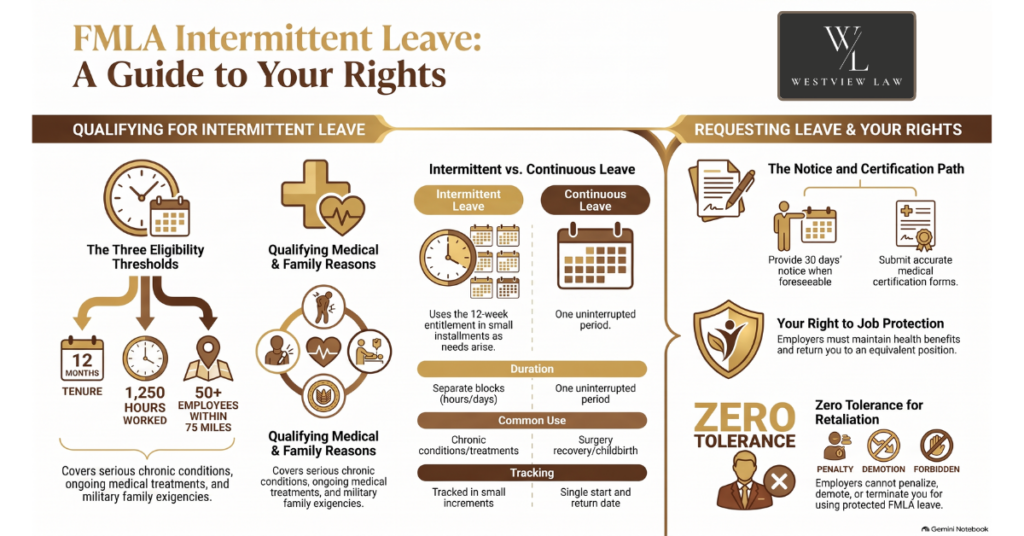
Eligibility turns on three numbers, and all three have to be met. First, the employee must have worked for the employer for at least 12 months, though those months do not have to be consecutive. Second, they must have worked at least 1,250 hours during the 12 months right before the leave starts, which is roughly 24 hours a week, and paid time off usually does not count toward it.
Third, the employer has to be a covered employer with 50 or more employees within 75 miles of the worksite. Miss any one of these and the FMLA does not apply, even if the medical need is real.
Once an employee clears those thresholds, the reason for the leave has to fit an FMLA qualifying category. The FMLA covers several qualifying situations. These include your own serious health condition, caring for a spouse, child, or parent with a serious health condition, and bonding with a newborn or a child placed through adoption or foster care.
It also covers qualifying military family needs, including certain issues related to a family member's active duty and caring for a covered service member with a serious injury or illness. The definition of a family member is specific. It means a son or daughter, a legal ward, a foster child, an employee's spouse, or a parent and does not stretch to cover every relative.
For intermittent scheduling in particular, the leave generally has to involve a serious health condition. That means an illness, injury, or physical or mental condition involving inpatient care or continuing treatment by a health care provider.
Chronic conditions like asthma, migraines, diabetes, or a mental or physical disability that flares up periodically fit the pattern well, because they produce recurring periods when the employee is unable to work. So does planned medical treatment like chemotherapy sessions, physical therapy, and prenatal visits where the appointments happen on a schedule.
Military-related leave rounds out the picture. An employee whose spouse, child, or parent is a covered military member on covered active duty can take intermittent leave for a qualifying exigency, and the Uniformed Services Employment and Reemployment Rights Act protects related reemployment rights for those returning from service.
Military caregiver leave carries a larger entitlement of up to 26 workweeks in a single 12-month period to care for a covered service member with a serious injury or illness. It helps to think of FMLA eligibility as two gates: you pass through the employment gate first, then the qualifying-reason gate.
What Is the Process of Requesting Intermittent Leave?

The first move belongs to the employee, but it does not have to be formal. When the need is foreseeable, like when it is for a scheduled surgery, a course of treatment, or a due date, the employee should give at least 30 days' notice.
When it is not foreseeable, such as a sudden flare-up, the employee gives notice as soon as practicable, usually the same or next business day. You do not have to say the letters “FMLA” to request FMLA leave; you just have to give enough information for the employer to recognize that the leave may qualify. From there, the employer is on notice and has to start the clock.
Documentation is where most requests get tested. An employer can require a medical certification from the employee's health care provider confirming the serious health condition, when it began, how long it is expected to last, and, for intermittent leave, the expected frequency and duration of the episodes or treatments.
The DOL provides a standard medical certification form (WH-380-E for the employee's own condition and WH-380-F for a family member's), and completing it accurately is the single best thing an employee can do to protect the leave. If the certification is incomplete or unclear, the employer has to tell the employee in writing what is missing and give at least seven calendar days to fix it. Employers may also, in limited situations, request a second or third opinion at their own expense or request recertification periodically.
The employer's obligations run on a tight timeline. Within five business days of learning that leave may be FMLA-qualifying, the employer must give the employee an eligibility notice and a rights-and-responsibilities notice. After it has enough information, it has five business days to issue a designation notice stating whether the leave is approved as FMLA and how much time will be counted.
Silence is not an option. An employer that drags its feet or ignores a request risks an interference claim, and the burden of running the process correctly sits squarely on the company, not the worker.
FMLA Intermittent Leave vs Continuous Leave
Now that you understand how intermittent FMLA leave works, it helps to compare it with continuous leave. The table below highlights the key differences so you can quickly see which type of leave may apply to your situation.
| Intermittent Leave | Continuous Leave |
|---|---|
| Leave is taken in separate blocks of time | Leave is taken in one uninterrupted period |
| Works well for chronic conditions or recurring treatments | Common after surgery, childbirth, or extended recovery |
| Employee may miss a few hours, days, or work on a reduced schedule | Employee is fully away from work during the leave period |
| Requires tracking leave time in smaller increments | Easier for employers to track and administer |
| Often involves ongoing communication about absences | Usually has a clear start and return date |
What Are the Common Mistakes in Handling FMLA Intermittent Leave Requests?
Intermittent leave trips up both sides more than any other kind, mostly because the time comes in small, irregular pieces that are easy to mishandle. A missed form here, a vague policy there, and a straightforward request turns into a dispute. The good news is that the common errors are predictable, which means they are preventable.
1. Frequent Oversights by Employers
Employers most often stumble on eligibility, records, and communication. Some managers assume a part-time or newer worker cannot qualify without actually checking the 12-month and 1,250-hour math, and they deny leave that the law protects.
Others approve the leave but keep sloppy records, so when an employee takes a few hours here and a day there, no one can say how much of the 12 workweeks is left, which invites a fight later. And plenty of problems come down to poor communication: HR approves the leave but never tells the frontline supervisor, who then writes the employee up for the same absences the company already blessed.
2. Employee Missteps in Leave Requests
Employees create their own headaches too. The most common is turning in incomplete or incorrect documentation, a medical certification form that a health care provider left half-blank, or one that never mentions the intermittent nature of the condition.
Another is failing to give adequate notice, either not flagging a foreseeable treatment 30 days out or going silent when an unexpected episode hits. The third is misreading the scope of intermittent leave, assuming it covers any absence loosely related to health, when it only covers time genuinely tied to the certified serious health condition or qualifying reason.
What Are the Strategies to Avoid Common Mistakes?
Regular HR training is the highest-leverage fix. Front-line managers, not just the HR department, need to recognize when an absence might trigger FMLA rights, because the law puts the employer on notice the moment it should reasonably know a leave may qualify.
A short annual session that walks supervisors through real scenarios, like the chronically late employee whose tardiness is actually migraine-related or the worker who mentions a spouse's chemotherapy in passing, prevents the reflexive discipline that turns into a lawsuit. Training also keeps everyone speaking the same language when an employee requests leave.
A standardized request process removes guesswork. When every leave request runs through the same intake, such as the same forms, the same acknowledgment, and the same certification deadline, nobody has to improvise, and the required notices go out on time. It also creates a clean paper trail showing the employer did what the regulations require, which matters a great deal if the leave is ever challenged.
Technology carries a lot of this weight now. Leave-tracking software that logs intermittent time in real minutes and hours keeps the running total of the employee's FMLA entitlement accurate, so the employer knows exactly how much job-protected leave remains. It also flags when a certification is expiring or a recertification is due, which stops small oversights from compounding.
Finally, both sides benefit from writing things down. An employee who confirms a leave request by email and an employer who documents each approval and each block of time used rarely end up arguing about what was said. Clear records protect the honest party on either side of the table.
What Are the Legal Rights and Responsibilities for Employers?
FMLA is a two-way street. Employers carry real obligations, and employees hold rights that the law backs with teeth. Understanding both keeps a workplace out of trouble.
1. Employer Obligations Under FMLA
A covered employer has to maintain the employee's group health benefits during FMLA leave on the same terms as if the employee were still working. If the worker normally pays a share of the premium, they keep paying it, but the coverage itself cannot be cut off because they are on leave.
The employer also has to preserve the job, and when the employee returns, they are entitled to the same position or an equivalent one with the same pay, benefits, and essential functions. This is what job-protected leave actually means in practice.
At the same time, the employer has to keep operations running while someone is out intermittently, and the law leaves room for that. For planned treatment, the employer can ask the employee to make a reasonable effort to schedule appointments so they do not unduly disrupt the business.
The employer can also temporarily move an employee on a foreseeable reduced leave schedule to an alternative position that better accommodates the recurring absences, as long as the pay and benefits stay equivalent. What the employer cannot do is use business needs as a cover to deny leave the employee is entitled to take.
2. Employee Rights Under FMLA
An eligible employee has the right to take FMLA leave without being penalized for it. The absences covered by approved leave cannot be counted against the employee under an attendance policy, cannot be used as a strike toward discipline, and cannot be the reason for a demotion or termination.
Employees can also choose, or their employer can require them to, substitute accrued paid leave such as sick leave or paid time off to receive pay during what is otherwise unpaid FMLA leave, though the FMLA protection runs the same either way.
Retaliation is the bright line. An employer cannot fire, demote, cut hours, or otherwise punish a worker for requesting or using FMLA leave, and doing so exposes the company to an interference or retaliation claim.
Health benefits stay in place throughout the leave, and on return the employee steps back into their role with their seniority and benefits intact. When an employer crosses these lines, and in our experience the retaliation often looks like a sudden performance problem that appears right after leave is requested, the employee has grounds to push back.
How to Handle Disputes and Legal Challenges on FMLA Leave
FMLA disputes can happen when leave is denied, delayed, or followed by unfair treatment at work. If you believe your rights have been violated, the steps below can help you protect your position, preserve important evidence, and understand your legal options.
1. Start with the internal record: Gather every document tied to the leave, like the request, the medical certification, approval or denial notices, and any discipline that followed. A clean timeline of who knew what and when is the foundation of every FMLA claim, and it often reveals the problem on its own.
2. Raise the issue in writing with HR: Put the concern in a short, factual email rather than a hallway conversation, so there is a dated record that you flagged it. Many disputes resolve here because the employer would rather fix a paperwork error than defend a lawsuit.
3. Ask for the specific reason in writing: If leave is denied or an absence is disciplined, request the employer's written explanation and the count of FMLA time it believes you have used. This forces the company to commit to a position, and gaps or contradictions in that explanation frequently become the heart of a claim.
4. Watch for retaliation after you speak up: If a write-up, schedule cut, or restructuring lands shortly after you request or use leave, note the dates precisely. For example, an employee approved for intermittent migraine leave who is suddenly marked “not a team fit” two weeks later has a textbook retaliation pattern worth documenting. This is a hypothetical example, but it mirrors how these cases actually surface.
5. Know when to bring in a lawyer: Once you are facing termination, a denied reinstatement, or discipline you believe is retaliatory, talk to an employment attorney before you sign anything or accept a severance offer. FMLA claims have deadlines, and an early conversation preserves options that a wait-and-see approach can quietly close off.
6. Consider the enforcement paths: You can file a complaint with the DOL's Wage and Hour Division or, in many cases, file suit directly, and California employees often have parallel CFRA claims that can be pursued together. A quick example: a worker denied leave because a manager wrongly assumed part-timers never qualify may have both a federal FMLA interference claim and a state claim; which one leads depends on the facts.
How to Manage FMLA Intermittent Leave Effectively

Managing intermittent leave well is less about legal maneuvering and more about planning and honest communication. When both sides treat it as a shared logistics problem instead of a battle, it usually runs smoothly.
1. Balancing Work and Health Needs
Scheduling is the practical center of intermittent leave. For planned medical treatment, an employee can often book appointments at the edges of the workday or on lighter days, which meets the “reasonable effort” expectation and keeps disruption low. When absences are unpredictable, cross-training a teammate to cover essential functions means the work does not stall every time the employee steps out.
Temporary adjustments help both sides breathe. An employer can shift a portion of the workload, extend a deadline, or move the employee to a role that fits a reduced leave schedule for a stretch, then restore the original setup once treatment ends. Flexible arrangements like remote work or a modified start time can let an employee stay productive through a health condition rather than burning FMLA hours they might need later.
2. Communication Best Practices
Open communication prevents most intermittent-leave conflicts. An employee who gives a realistic heads-up about likely frequency and an employer who confirms what is approved rarely end up guessing about each other's intentions. Neither side has to overshare. The point is enough information to plan around, not a running medical diary.
Light-touch check-ins keep the arrangement on track. A brief periodic update on how the leave is progressing lets the employer plan coverage and lets the employee flag a change in their needs before it becomes a problem. Clear return-to-work guidelines, like what the employee should expect on the day they come back and any fitness-for-duty certification the employer may require, remove the awkwardness from the reentry and reduce the chance of a reinstatement dispute.
3. Leveraging Legal Support from Westview Law
Westview Law helps on both the front end and the back end. Employees come to us when leave has been denied, delayed, or answered with discipline, and we work through the certification, the timeline, and the employer's notices to figure out whether the FMLA or California's CFRA was violated. Because we take these matters on contingency, an employee can get a real assessment of their FMLA leave benefits and options without paying up front.
Good legal guidance often pays for itself in avoided mistakes. As Paul Marks, a Westview Law employment attorney, puts it, “Most FMLA problems we see are not close calls; they are avoidable process failures, a missed notice, or a manager who acted before checking the rules, and catching them early usually changes the outcome.”
An illustrative example: a California employee whose intermittent leave was quietly counted as unexcused absences was able to have the discipline reversed once the certification and DOL timeline were laid out clearly, a representative scenario, not a specific client, but one that reflects how these matters commonly resolve.
How Can an Attorney Help if Your FMLA Leave Rights Are Violated?
An attorney can help you understand whether your employer violated your rights under the Family and Medical Leave Act (FMLA). They will review your leave request, employment records, company policies, and any communications with your employer. This helps determine if your leave was wrongfully denied, you were pressured to return early, or you faced retaliation for taking protected leave.
If your rights were violated, an attorney can deal directly with your employer on your behalf. In many cases, legal action begins with a demand letter or negotiations to resolve the issue without going to court. If that is not successful, your lawyer can file a claim, gather evidence, interview witnesses, and represent you throughout the legal process.
An experienced employment attorney can also help you pursue compensation. Depending on your situation, you may be able to recover lost wages, lost benefits, reinstatement to your job, attorney's fees, and other damages allowed under the law. Getting legal advice early can also help protect important evidence and ensure you meet the deadlines for filing a claim.
Ready to Protect Your FMLA Leave Rights?
Intermittent FMLA leave is one of the most useful protections the law offers and also one of the easiest to lose to a paperwork slip or a misinformed manager. Getting the basics right, like who qualifies, how to request leave, what documentation is fair to ask for, and where the line on retaliation sits, spares employers costly claims and gives employees the security to handle a serious health condition without gambling their job.
For both sides, the winning move is the same: know the rules, keep clean records, and communicate early. If you are an employee who has been denied leave or punished for taking it, or an employer trying to handle a request the right way, do not guess your way through it. Speak to an employment attorney to protect your rights.
Has your employer denied your FMLA leave or punished you for taking protected time off? At Westview Law, we represent California employees in FMLA, CFRA, discrimination, retaliation, and wage-and-hour disputes. Our team includes Of Counsel Taylor Markey, a former Assistant Regional Attorney with the EEOC, and founder David Safvati, a Southern California Super Lawyers Rising Star. We handle most cases on a contingency fee basis, so contact us today for a free case review.
Frequently Asked Questions
If you need to take time off work in small amounts instead of all at once, you may qualify for intermittent FMLA leave. These frequently asked questions explain how intermittent leave works and what rights and responsibilities employees have under the FMLA.
How Do I Qualify for FMLA Intermittent Leave?
Employee eligibility depends on working for a covered employer and having an FMLA qualifying reason, such as a qualifying serious health condition. Your employee's FMLA leave entitlement is determined under the FMLA regulations, and the medical certification process may include second and third opinions when permitted.
What Conditions Qualify for FMLA Intermittent Leave?
Employees may take FMLA leave intermittently for a qualifying serious health condition, medical appointments, a qualifying family member, a newborn child, or certain qualifying military service situations.
How Much Notice Is Required for FMLA Intermittent Leave?
If the need for leave is foreseeable, provide 30 days' notice when possible. To leave under the FMLA, employees should notify their employer as soon as practicable and complete the required certification. If an employee fails to provide proper notice or documentation, leave may be delayed in some circumstances.
What Are Some Common Reasons for Taking FMLA Intermittent Leave?
An employee takes FMLA leave for ongoing treatment, medical appointments, caring for a family member, or when the employee is unable to work because of a qualifying medical condition. In some cases, substitute paid leave may be used during the FMLA leave period.
How Is FMLA Intermittent Leave Different From Continuous Leave?
Intermittent leave is taken in separate blocks of time or as reduced schedule FMLA leave, while a continuous period of leave is taken without interruption. An employee's FMLA leave is calculated based on the employee's actual workweek, and employers must apply the rules consistently to similarly situated employees. An employer may also temporarily transfer an employee temporarily to another position when allowed by the FMLA.
Disclaimer: This article is provided for general informational purposes only and does not constitute legal advice. Reading it does not create an attorney-client relationship. The FMLA is a federal law, and its application depends on the specific facts of your situation, your state, and applicable regulations. For advice about your own circumstances, consult a qualified FMLA or employment attorney.