


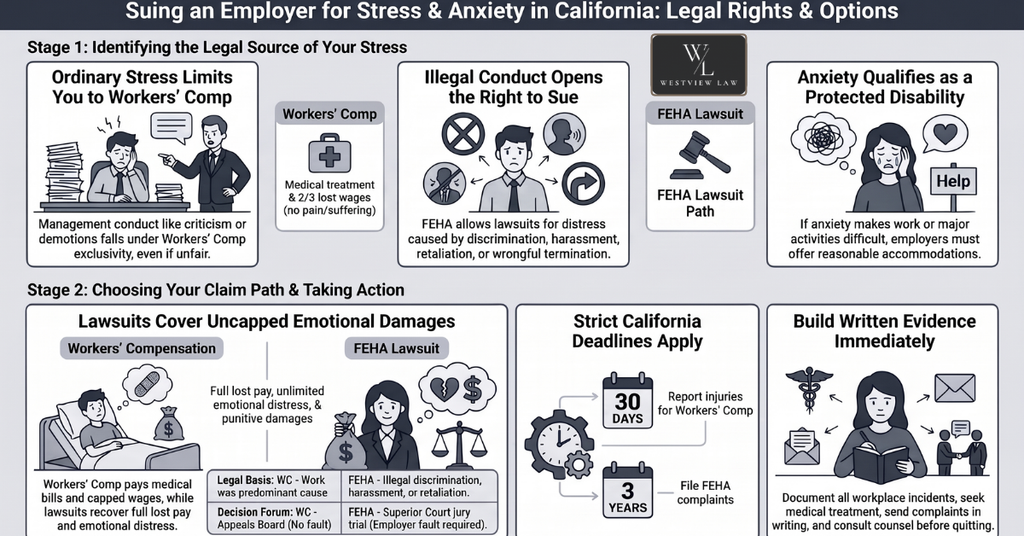
Sometimes it depends as different things cause stress. If your anxiety comes from discrimination, harassment, retaliation, or a failure to accommodate a disability, California law generally lets you sue your employer and recover emotional distress damages. If it comes from a heavy workload, a harsh boss, or ordinary workplace conflict, your remedy is usually workers' compensation, not a lawsuit.
Westview Law handles discrimination, harassment, retaliation, and wrongful termination cases involving California workers. Our team includes Taylor Markey who used to work at Assistant Regional Attorney with the U.S. Equal Employment Opportunity Commission. If work is affecting your mental health, call us at (310) 906-4862 or request a free case review.
Here is an explanation of where California sets the boundaries, what anxiety qualifies as a disability, what workers compensation pays for psychological injuries, what a lawsuit can recover, and the deadlines for each.
Why "Stress" Alone Usually Isn't Enough to Sue

California's workers' compensation system is, in most cases, the only remedy for an injury that happens at work. Under Labor Code section 3602, when workers' comp applies, it generally replaces the right to sue your employer. That rule covers psychological injuries as well as physical ones.
California Supreme Court has directly addressed claims related to emotional distress now. In Cole v. Fair Oaks Fire Protection District (1987) and later in Miklosy v. Regents of the University of California (2008), the court held that conduct which is "a normal part of the employment relationship," such as demotions, criticism, and discipline, falls under workers' comp "even if... intentional, unfair or outrageous."
In practice, that means a manager who yells, sets impossible deadlines, or writes an unfair review usually can't be sued for the anxiety it causes. It may still be a worker's compensation claim. Our post goes into more detail about whether you can sue your employer for a work injury covers that particular rule and its other exceptions in more detail.
When You Can Sue: Stress Caused by Unlawful Conduct
The picture changes if what's behind your anxiety is illegal. Claims under California's Fair Employment and Housing Act (FEHA) are not part of regular employment benefits and courts have ruled that workers compensation does not preclude pursuing those claims. In Accardi v. Superior Court (1993), for example, the Court of Appeal allowed an employee to pursue FEHA claims and emotional distress damages from sexual harassment despite the exclusivity rule.
FEHA protects against discrimination for employers with five or more workers and forbids harassment at any employer level. Here are some of the situations that commonly lead to a lawsuit.
Discrimination
If you were treated worse because of your race, sex, age, disability, religion, sexual orientation, gender identity, or another protected trait, and that treatment caused anxiety or depression, emotional distress damages are part of a FEHA discrimination claim. Distress doesn't need to result in a diagnosis to be counted; however, medical records make proving this much easier.
Harassment and a Hostile Work Environment
Harassment based on a protected trait, including sexual harassment, is illegal when it's severe or pervasive enough to change the conditions of your job. General rudeness or bullying with no connection to a protected trait usually isn't. Under Government Code section 12940(j), the coworker or supervisor who harassed you can be personally liable, not just the company.
Retaliation
If your boss punished you for complaining about discrimination or harassment, ask for reasonable accommodations, take protected leave time or report illegal behavior then that is retaliation. Under Labor Code section 1102.5 California's main statute called whistleblower there is protection for reporting suspected illegal activity.
Wrongful Termination
If you get fired for illegal reasons like discrimination, retaliation or refusing to do something that breaks the law, you qualify for a wrongful termination claim and you can also recover damages for emotional distress. Getting fired alone is usually not much of an issue unless the reason for firing is illegal.
When Anxiety Is a Disability Your Employer Must Accommodate

This is the part many employees overlook. Under Government Code section 12926(j), a mental disability includes any "emotional or mental illness" that limits a major life activity, and that can include anxiety disorders. California's standard is lower than federal law's: the condition only has to make the activity "difficult," and working counts as a major life activity.
If your anxiety qualifies, your employer has to engage with you in good faith about reasonable accommodations. That might mean some changes to your usual schedule, a shift in what you do at work, working from home, or even taking time off. California regulations consider paid or unpaid leave as a reasonable accommodation when it's likely to help you return to work. An employer that ignores your request, or fires you for making it, may be liable for failure to accommodate and disability discrimination.
You may also be eligible for protected leave under the California Family Rights Act. CFRA covers employers with five or more employees and gives eligible workers, those with more than 12 months of service and at least 1,250 hours in the past year, up to 12 weeks of job-protected leave for their own serious health condition. FMLA and CFRA guide explains how these two laws overlap.
Workers' Compensation for Psychological Injuries
If work stress is causing you anxiety rather than illegal behavior, workers' compensation may pay for therapy and lost wages too. You don't have to prove your employer did anything wrong, but psychiatric claims have extra hurdles under Labor Code section 3208.3.
Actual events of your employment must be the "predominant" cause of the psychiatric injury, which courts have read to mean more than half of all causes combined. If the injury came from being a victim of a violent act at work, or directly exposed to one, the bar drops to a "substantial" cause, defined as 35 to 40 percent.
You generally must have worked for the employer for at least six months, though they don't have to be continuous. That rule doesn't apply if an injury occurs because of something very sudden and unusual at work. And workers' comp won't cover a psychiatric injury substantially caused by a lawful, nondiscriminatory, good-faith personnel action, such as a legitimate layoff or a fair performance review.
Workers' compensation covers medical treatment including therapy. If you can't work while you recover, temporary disability benefits under Labor Code section 4653 generally pay two-thirds of your average weekly wages, subject to state minimums and maximums. It does not compensate for pain and suffering or for punitive damages. Report the injury to your employer in writing promptly; Labor Code section 5400 sets a 30-day notice deadline, and waiting longer can put your benefits at risk.
Workers' Comp vs. a Lawsuit: How They Compare
Some employees have both kinds of claims at once, for example a comp claim for the psychological injury and a FEHA lawsuit for the harassment behind it. Here is the comparison table showing differences between the two routes.
| Factor | Workers' compensation | FEHA lawsuit |
|---|---|---|
| What you have to show | Work was the main cause of a psychiatric injury. | Discrimination, harassment, retaliation, or failure to accommodate |
| Fault | Not required | Required |
| Pain and suffering | Not available | Available as emotional distress damages |
| Lost wages | Two-thirds of wages, with caps | Full lost pay, past and future. |
| Punitive damages | Not available | Available in some cases |
| Where it's decided | Workers' Compensation Appeals Board | Superior court, typically before a jury. |
What You Can Recover in a Lawsuit

A successful FEHA case can include emotional distress damages, back pay and lost future earnings, the cost of therapy and medical care, and in many cases the attorney's fees you paid to bring the case. There is no limit to damages for emotional distress under FEHA and the amount awarded depends on how severe and long-lasting the harm was and how well that harm is documented.
It's possible to get punitive damages but they're hard to win. Under Civil Code section 3294, you have to show by clear and convincing evidence that the employer acted with malice, oppression, or fraud. When the employer is a company, an officer, director, or managing agent has to have been involved in, approved, or ratified the conduct.
Deadlines for Stress and Anxiety Claims
Each type of claim has its own clock, and missing one can end the claim entirely. The table below lists the main California deadlines.
| Type of claim | Deadline |
|---|---|
| Notice to employer regarding a work injury (workers' comp) | 30 days from the injury |
| FEHA complaint to the Civil Rights Department | 3 years from the unlawful act |
| Lawsuit under FEHA after right-to-sue notice | 1 year from the notice |
| Wrongful termination in violation of public policy | 2 years from the firing |
| Whistleblower retaliation under Labor Code 1102.5 | Generally 3 years |
Before you can file a FEHA lawsuit, you have to file a complaint with the California Civil Rights Department and get a right-to-sue notice. Many employees rush to get one right away so that they can go to court.
How to Protect Your Claim
Start with taking care of your health. Talk to a doctor or therapist and be specific about what's going on at work because those records will serve as the strongest proof that the anxiety exists and that it is linked to work stuff. Keep going to appointments; gaps in treatment are easy for an employer to exploit.
Write down incidents as they happen, with dates, what was said, who was there, and any complaint you made to HR. Keep emails, texts, appointments, and performance reviews which you have a right to keep but do not download sensitive internal company documents. If you complain to HR, do it in writing so there's a record of the date and what you reported.
If you're considering quitting something important, talk to a lawyer first. In some cases, conditions bad enough to force you out can be treated as a firing under the rules on constructive discharge, but the evidence has to be strong.
Talk to Westview Law About Your Situation
Whether anxiety results in a workers' compensation claim or a lawsuit under FEHA will depend on specific details and the first step is distinguishing what actions caused the harm. A short consultation can tell you which route fits and which deadlines apply.
Call Westview Law at (310) 906-4862 or request a free case review to talk through what's happening at work.
Frequently Asked Questions
Below are answers to common questions about suing an employer for stress and anxiety in California.
Can I Sue My Employer for a Stressful Work Environment?
Usually that kind of stress doesn't come from heavy workloads, tight deadlines or a difficult boss. Generally workers compensation is the only remedy for that type of harm. If the environment involves harassment, discrimination, or retaliation at work, you may be able to sue under FEHA.
Is Anxiety Considered a Disability in California?
It can be. California defines mental disability as including mental or emotional illness that makes performing an important activity such as work very difficult. If your anxiety meets qualifying standards, your employer must consider reasonable accommodations including time off.
Can I Sue for Emotional Distress Without Being Fired?
Yes. Claims of discrimination, harassment and retaliation don't necessarily mean you get fired. Feeling distressed because of illegal treatment while you are still working can count as part of a claim under FEHA.
Is Workplace Bullying Illegal in California?
Not on its own. Bullying becomes illegal when it targets traits that are protected like race, sex or disability or when it retaliates against someone who has done something protected.
Can I Be Fired for Taking Time Off for Anxiety?
Being fired because you take CFRA leave or if your anxiety qualifies as a disability that needs leave as reasonable accommodation is generally considered illegal. Eligibility depends on both the size of your employer and how long you have been working there.
Can I Get Workers' Comp and Also Sue My Employer?
In some cases, yes. A workers' comp claim for the psychological injury and a FEHA lawsuit for the discrimination or harassment that caused it can proceed separately, though any overlap in recovery is accounted for.
Disclaimer: This piece contains general information about California labor law and workers compensation that is as of October 2026 and should not be considered legal advice. Reading this doesn't establish an attorney-client relationship with Westview Law. Whether you have a claim and when the deadline applies depends very much on the specifics of your case. Talk to a licensed employment lawyer in California about your situation.