


The statute of limitations for employment claims differs in California depending on what kind of claim you're making and the laws that apply. Generally discrimination and harassment complaints go through California Civil Rights Department within three years whereas wage claims, for wrongful termination, and disputes over contracts all have their own timelines. Miss the deadline that applies to you, and you can lose the claim even if your employer clearly broke the law.
Westview Law represents employees across California in discrimination, harassment, retaliation, wage, and wrongful termination cases. Founding partner David M. Safvati (State Bar #326605) is a Fellow of the American Board of Trial Advocates, and of counsel Taylor Markey (State Bar #319557) previously served as an Assistant Regional Attorney with the U.S. Equal Employment Opportunity Commission. If you're worried a deadline is coming up, request a free consultation today.
This guide details when you should file your claims for discrimination, sexual harassment, wrongful termination, retaliation over wages and hours worked, and claims about equal pay. It describes when the clock begins ticking, what results if deadlines are missed, and also details exceptions which can affect calculations.
What Is the Statute of Limitations for Employment Claims?

A statute of limitations is the window you have to take a specific legal step, such as filing an agency complaint or starting a lawsuit. In California employment law, there is a different window depending on what kind of claim you have, which statute applies, and also facts related to the violations involved. A discrimination complaint, an unpaid overtime claim, and a breach of contract claim can arise from the same job and still carry three different deadlines.
Some claims begin with filing an administrative complaint with a government agency like California Civil Rights Department (CRD), the federal Equal Employment Opportunity Commission (EEOC) or Labor Commissioner. Others go straight to court. Discrimination claims under California's Fair Employment and Housing Act (FEHA) require both: a CRD complaint first, then a lawsuit after you receive a right-to-sue notice. The explanation of that two step process is given below under CRD.
Exceptions like equitable tolling and delayed discovery can affect when deadlines begin or how they count down, but they don't apply automatically. Talking to HR or negotiating with your boss doesn't stop a legal deadline from running out. To be safe, you want to figure out what kind of rule has been broken, figure out which law this rule touches upon, and then confirm the deadline and the proper agency or court.
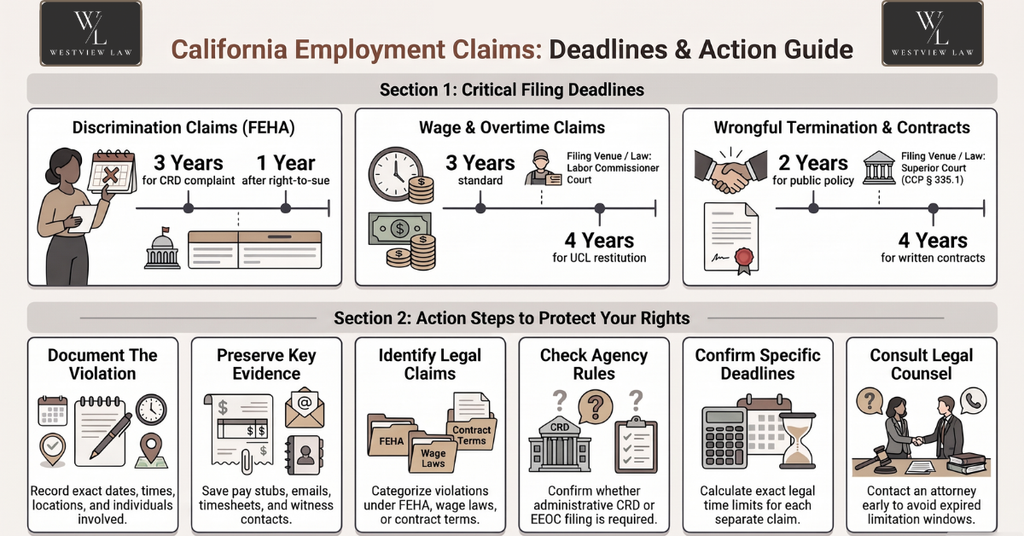
This table contains key deadlines for employment matters in California in one place. Use it as a starting point, then confirm the deadline for your specific facts.
| Claim Type | Deadline | Where to File / Governing Law |
|---|---|---|
| FEHA discrimination, harassment, or retaliation | 3 years from the unlawful act | CRD complaint (Gov. Code § 12960) |
| FEHA lawsuit following a right-to-sue notice | 1 year from the date of the notice | Superior Court (Gov. Code § 12965) |
| Federal discrimination claims (Title VII and similar laws) | 300 days from the discriminatory act in California | EEOC charge |
| Retaliation under laws enforces by the Labor Commissioner. | 1 year from the retaliation (can be extended for good cause) | Labor Commissioner (Lab. Code § 98.7) |
| Wrongful termination in violation of public policy | 2 years | Superior Court (CCP § 335.1) |
| Breach of a written employment contract | 4 years | Superior Court (CCP § 337) |
| Breach of an oral employment agreement | 2 years | Superior Court (CCP § 339) |
| Unpaid minimum wage or overtime | 3 years | Labor Commissioner or court (CCP § 338(a)) |
| Restitution of unpaid wages under the Unfair Competition Law | 4 years | Superior Court (Bus. & Prof. Code § 17208) |
| California Equal Pay Act wage claim | 3 years from the last violation, with recovery for up to 6 years | Labor Commissioner or court (Lab. Code § 1197.5) |
| Equal Pay Act retaliation lawsuit | 1 year | Superior Court (Lab. Code § 1197.5) |
| Statutory penalty claims, including PAGA | 1 year | LWDA notice, then court (CCP § 340) |
| Intentional infliction of emotional distress | 2 years | Superior Court (CCP § 335.1) |
| Workers' compensation claim | 1 year from the date of injury, in most cases | Workers' Compensation Appeals Board (Lab. Code § 5405) |
What Is the Statute of Limitations for Different Employment Claims in California?
Deadlines change with the type of violation, the law behind the claim, and whether an agency complaint has to come first. An employee may have three years to report discrimination to the CRD but only one year to file a retaliation complaint with the Labor Commissioner. Claims about wages, wrongful termination, equal pay and contract disputes each have different rules as well.
Workplace Discrimination and Harassment
FEHA prohibits workplace discrimination based on age, disability, national origin, sexual orientation, and other protected characteristics. It also covers sexual harassment and harassment based on any protected characteristic as well. You generally have three years from the discriminatory or harassing act to file a complaint with the CRD, and then one year from your right-to-sue notice to file a lawsuit. Both deadlines are fully detailed below under the CRD section.
Federal law adds a separate, shorter track. If you plan to bring a federal discrimination claim under Title VII or a similar law, you generally must file a charge with the EEOC within 300 days in California. According to EEOC's guide to filing time limits, the normal time limit of 180 days gets extended to 300 days if a state agency such as CRD enforces laws against the same kind of discrimination.
Workplace Retaliation
The deadline for retaliation claim varies depending on the law that protects whatever activity you're doing. Under the laws enforces by Labor Commissioner, if someone retaliates against someone who reports wage violations or asserts their labor rights, that person generally has one year from when they experience this retaliation to lodge a complaint. The Labor Commissioner can extend this period for good reason. The Labor Commissioner's retaliation complaint page explains how to file this information.
Revenge from FEHA takes a different route. If your employer punished you for reporting discrimination or sexual harassment, that claim goes to the CRD under the three-year deadline. If you were punished for reporting unpaid wages, the Labor Commissioner's process and its one-year deadline usually apply. Pinpointing the protected activity, and the law that protects it, tells you which deadline governs.
Wrongful Termination
Wrongful termination's deadline varies depending on the reason for your firing. A firing based on discrimination or another FEHA violation goes to the CRD under the three-year deadline, followed by the right-to-sue process. Other kinds of wrongful termination claims can have different deadlines and specific requirements set by agencies as well.
A claim for wrongful termination in violation of public policy generally has a two-year statute of limitations. These claims arise when an employer fires someone for refusing to violate the law, reports a legal wrongdoing, or exercises a lawful right.
If your termination breached an employment contract, the deadline depends on the form of the contract. A claim based on a written contract generally has four years, and a claim based on an oral contract generally has two. Identify the legal basis for the claim first, because two employees fired on the same day can face different deadlines.
Unpaid Wages and Overtime
Claims for unpaid wages, unpaid minimum wage, and unpaid overtime generally have a three-year statute of limitations, because they rest on obligations created by statute. You can either file through Labor Commissioner or go to court.
Sometimes an employee who sues can go back further in time. Under the Unfair Competition Law, a claim for restitution of unpaid wages can be brought within four years, which adds a fourth year of recovery in many cases. Penalty claims are different: claims for statutory penalties, including penalties sought under the Private Attorneys General Act (PAGA), generally carry a one-year deadline. Deadlines for contract termination due to wrongful termination also apply if pay has been set via either oral or written agreements.
One pay dispute can lead to multiple claims each with different deadlines for filing and recovery periods. Keep track of pay stubs, timesheets, work schedules, employment contracts and notes about missed meals and rest time.
Equal Pay Violations
The California Equal Pay Act prohibits paying employees less than coworkers of another sex, race, or ethnicity for substantially similar work, subject to exceptions the law recognizes. The overview of Westview Law's for California Equal Pay Act describes what constitutes work that is substantially similar.
Since January 1, 2026, an Equal Pay Act lawsuit to recover wages can be filed up to three years after the last date the cause of action occurs. Each time you get paid for work that is subject to an illegal pay decision, a new cause of action begins; each such check starts the clock anew. You can get full compensation for the whole duration that the violation went on, up to six years. You can file a complaint either with Labor Commissioner or take your case to court.
Retaliation for raising an equal pay concern has a separate and shorter deadline. A lawsuit for Equal Pay Act retaliation generally must be filed within one year after the cause of action occurs.
Employment-Related Personal Injury and Emotional Distress Claims
Some employment disagreements include personal injury, such as distress due to behavior from an employer. Independent tort claims, such as intentional infliction of emotional distress, are generally subject to California's two-year statute of limitations for personal injury. Emotional distress damages sought within a discrimination claim follow the FEHA deadlines instead.
Workers' compensation rules can also prevent another lawsuit separately. California's workers' compensation system is generally the exclusive remedy for injuries it covers, so an employee can't sue simply because the harm happened at work. A workers' compensation claim itself generally must be filed within one year of the injury. Whether there is a separate lawsuit available depends on what the boss did and why you have a claim. So get some help from an attorney as soon as possible if your boss has harmed you physically or psychologically.
How Long Do You Have to File a Complaint With the California Civil Rights Department?

CRD implements FEHA that stops discrimination in the workplace along with harassment and retaliation too. If you believe your employer violated FEHA, you generally have three years from the date of the unlawful act to file a complaint with the CRD. The CRD requests that employees fill out an intake form within three years after their last injury happened. This deadline covers discrimination based on certain protected characteristics such as age, disability, nationality and sexual orientation. It also deals with sexual harassment and retaliation against those who oppose discrimination.
To file a lawsuit under FEHA you also need that notice of right to sue from the CRD. You don't have to go through this investigation by CRD. According to the CRD's complaint process page, you can skip it and file your own lawsuit, but in employment cases you must first get an immediate right-to-sue notice. Talk with an employment lawyer before you choose that route, because the CRD will not investigate your complaint once you do.
The deadlines for CRD and lawsuit are different. The three year period applies for lodging your complaint with CRD. Once the right-to-sue notice issues, you generally have one year from the date of the notice to file your FEHA lawsuit. Meeting the first deadline doesn't fulfill the second one. If you choose the CRD investigation, additional tolling rules can affect the lawsuit deadline, so read every notice you receive closely.
When Does the Statute of Limitations Start?
Most claims for employment disputes begin the moment that violation occurs. If an employer fires someone unlawfully or denies a promotion because of discrimination, the deadline generally runs from that decision. Some claims involve a series of related incidents, and that can change how the deadline is counted.
A single employment decision is treated differently from an ongoing pattern of harassment. A termination or a denied promotion is usually a discrete act with its own deadline. A continuing course of harassment, or repeated failures to accommodate a disability, may qualify under California's continuing violation doctrine. Courts ask whether the conduct was similar in kind, happened with reasonable frequency, and had not become permanent before the filing period. Just because an employee has lots of problems doesn't mean this doctrine applies though.
For example, suppose an employee believes they were denied a promotion because of their age in January 2023, then hears age-related comments from their supervisor in 2025. They shouldn't assume those recent remarks reset any deadlines for that previous decision about promotion. The promotion denial may be treated as a separate, completed act, while the later comments would be assessed on their own facts to decide whether they form part of a continuing violation.
Two other doctrines can either change when things start or stop the clock. Under the delayed discovery rule, a deadline may start when someone discovers facts that show they've been harmed by misconduct that was improper. Or if they should reasonably have discovered these facts at some point. Tolling may pause a limitation period in situations the law recognizes. It doesn't matter whether an employee was unaware of their rights or kept trying to fix things internally; neither absolves them of responsibility. Record the important dates for key events and see a lawyer rather than relying on exceptions to save a delayed claim.
What Happens If You Miss the Deadline to File an Employment Claim?

Failing to meet the statute of limitations means you lose your right to get compensation. If you file after the deadline, your employer can ask the court to dismiss the case as untimely, and solid evidence of wrongful termination, discrimination, unpaid wages, or harassment won't overcome an expired deadline on its own.
A missed deadline doesn't always mean every claim is gone. The California Courts self-help guide to statutes of limitations explains that tolling can stop some periods from counting against a deadline, and that a deadline may run from the date a problem was discovered or reasonably should have been discovered. Both rules depend on facts. A claim that has a longer time limit may still be open such as a four year contract claim or a UCL claim if a previous claim for wages has expired after three years.
If you feel like time has run out for you to meet your deadline, contact an employment lawyer in California right away. An attorney can review the facts, identify every claim that may apply, and check whether an exception or another legal route is still open.
How Can You Protect Your Right to File an Employment Claim?
To protect your claim you should document what happened and confirming the deadlines apply. No matter if you're facing wrongful firing, discrimination, sexual harassment, retaliation or unpaid wages, taking these six steps will help you preserve evidence and keep yourself moving faster than your opponents.
Step 1: Document the alleged violation and when it occurred.
Record exactly what happened, when, where, and who was involved. Include the dates of key employment decisions, such as a termination, a denied promotion, or a change in pay or working conditions. For ongoing harassment or wage violations, record each incident separately instead of relying on a general timeline. These details help a lawyer pin down when each deadline started.
Step 2: Preserve relevant evidence.
Make sure you save copies of emails, texts, performance evaluations, pay statements, time sheets, employment contracts, disciplinary notices, and other records which back up your claim. If coworkers see what happened, record their names and what they observe. Keep records according to the law and do not look at confidential information of the company that you are not authorized to see.
Step 3: Identify the legal claim or claims that may apply.
Determine if your situation falls under discrimination, sexual harassment, retaliation, wrongful termination, unpaid wages, or any other violation related to California employment law. A single incident can support more than one claim, and each claim can have its own deadline. For example, a claim under FEHA for discrimination is handled differently from an overtime pay claim.
Step 4: Determine whether you must file an administrative complaint.
Some claims require an agency filing before you can sue. A FEHA discrimination or harassment lawsuit generally requires a CRD complaint and a right-to-sue notice first. Other claims may also go to the Labor Commissioner or the EEOC. Make sure to confirm which agency if any, handles your claim and what they require.
Step 5: Confirm every applicable filing deadline.
Make sure to check deadlines both for filing a complaint against the agency and for filing a lawsuit; these often vary. Use the quick-reference table above as a starting point, then confirm each deadline for your facts. Remember that an internal grievance or settlement talks with your employer won't pause the statute of limitations.
Step 6: Consult a California employment lawyer before the deadline approaches.
A lawyer looks into all the facts, identifies every possible claim, clarifies what requirements different agencies have, and also calculates when deadlines occur. Seeking advice early gives you time to gather evidence and file what is necessary. If a deadline may be close, say so when you first contact the attorney.
When Should You Contact a California Employment Lawyer?
Contact a California employment lawyer as soon as you suspect your employer has violated your rights. Deadlines for important actions are very short and delaying them means you lose options. An attorney can tell you which laws apply, assess your claims, and explain whether an agency complaint has to come first.
The table below matches common situations with the reasons to get advice and what a lawyer can do.
| Situation | Why You Should Seek Legal Advice | How an Employment Lawyer Can Help |
|---|---|---|
| Wrongful termination | You believe your employer fired you for discriminatory reasons, in retaliation for protected activity, or in violation of public policy or an employment contract. | Assess the legal basis for your claim, identify the statute of limitations, and determine whether agency filing requirements apply. |
| Workplace discrimination | You believe you were treated unfairly because of a protected characteristic, such as age, disability, national origin, or sexual orientation. | This cell evaluates whether the conduct violates the FEHA or federal law and explains the complaint deadlines. |
| Sexual harassment | You have experienced unwanted sexual conduct or other harassment that may violate California employment law. | This cell helps document conduct, explains the CRD complaint process, and calculates deadlines for the complaint and the lawsuit. |
| Retaliation | Your employer punished you for reporting discrimination, raising wage concerns, or exercising another protected right. | Identify the law that governs the retaliation claim, assess the evidence, and clarify the filing procedure and time limit. |
| Unpaid wages or overtime | Your employer may have failed to pay minimum wage or overtime, provide meal and rest breaks, or follow other wage rules. | Review pay records and timesheets, identify wage and hour violations, and determine how far back recovery can go. |
| A filing deadline may be approaching. | You are unsure how much time remains, or you have already gone to HR without taking legal action. | Calculate the deadlines, identify required agency steps, and assess whether an exception may apply. |
You don't need every piece of evidence before you call a lawyer. An attorney can tell you which important papers are necessary and help you move forward before it's too late.
Need an Employment Lawyer?
Knowing the statute of limitations for your employment claim protects your right to pursue it. Whether you're dealing with wrongful termination, discrimination, harassment, retaliation, or unpaid wages, a missed deadline can end your case before it starts. Getting early advice lets you spot which laws apply and file timely with any required agencies.
If you believe your employer violated California employment law, contact Westview Law for a free, confidential consultation. Our lawyers will explain your rights, the deadlines that fit your case and the next steps should be for your claim.
Frequently Asked Questions
Most questions about employment deadlines come down to how much time you have and which steps have to come first. These answers respond to the questions that employees frequently ask.
How Long Do I Have to Sue My Employer in California?
It depends on what the claim is. Some claims have a statute of limitation of two years but some allow three or four years. FEHA discrimination claims also require a CRD complaint and a right-to-sue notice before you can file your own lawsuit.
Is the Statute of Limitations the Same as the Deadline to File an HR Complaint?
No. Internal company complaint procedures and legal filing deadlines are separate, and reporting misconduct to HR does not pause the statute of limitations. You still have to file with the right government agency or file a lawsuit within the deadline that applies.
Can I Sue My Employer If the Statute of Limitations Has Expired?
If you file a claim after the deadline has passed, your case will be dismissed even if you have proof that your employer violated some laws. Rules the delayed discovery or different claim with longer deadlines may still open up avenues for you based on the specifics of your case.
Does the Three-Year Deadline Apply to Every Employment Claim in California?
No, generally the three year deadline applies for complaints for discrimination, harassment and retaliation under FEHA and also for some wage and equal pay claims. Claims for retaliation complaints to the Labor Commissioner for wrongful termination and oral contract claims have shorter time limits.
Does Getting a Right-to-Sue Letter Mean I Can Wait to File My Lawsuit?
Generally you have one year from the date of a notice that you have rights to sue (CRD) to file your lawsuit under FEHA. Read this notice right away and confirm the deadline with an employment lawyer.
Legal Disclaimer: This article gives general information about California employment law and should not be considered as legal advice. Reading this article doesn't create any attorney-client relationship with Westview Law. Legal deadlines and requirements vary based on the specific claim and circumstances; you should consult with a qualified employment lawyer regarding your case.