


Don't sign a severance agreement until you know what you're giving up, and hold off entirely if you think your firing was illegal, your final pay is tied to signing, or the deadline is shorter than California allows. Most severance packages trade payments for releases from legal claims. Once you sign a legitimate release form, claims usually go away, including ones that you are not aware of having at first.
Westview Law handles cases related to discrimination, retaliation and wage disputes for employees in wrongful termination who work in California. Our team includes Taylor Markey who was formerly at Assistant Regional Attorney with the U.S. Equal Employment Opportunity Commission. If you've been handed a severance agreement, call us at (310) 906-4862 or request a free case review before you sign.
This article talks about the red flags that should keep you from signing at all.
What Is a Severance Agreement?
A severance agreement is a contract your employer offers when your job ends. You get some money and also potentially ongoing health insurance or a neutral reference. In return, you generally agree to release any legal claims against the company and also accept terms such as confidentiality, non disparagement, and cooperation for future litigation.
The EEOC describes the deal plainly: employers offer "money or benefits in exchange for a release" of claims, including discrimination claims. Focus for employees is on the money. But what matters most is the release.
If you want to figure out if an amount is fair or if you need help negotiating, our guide on severance pay in California talks about typical packages and negotiation. Here are seven situations in which signing something immediately would be a bad idea along with the California laws behind each one, and what signing documents means and doesn't mean.
1. You Haven't Been Given the Time California Requires
Employers often hand over an agreement with a short deadline, sometimes "by end of day." In many cases California doesn't allow that.
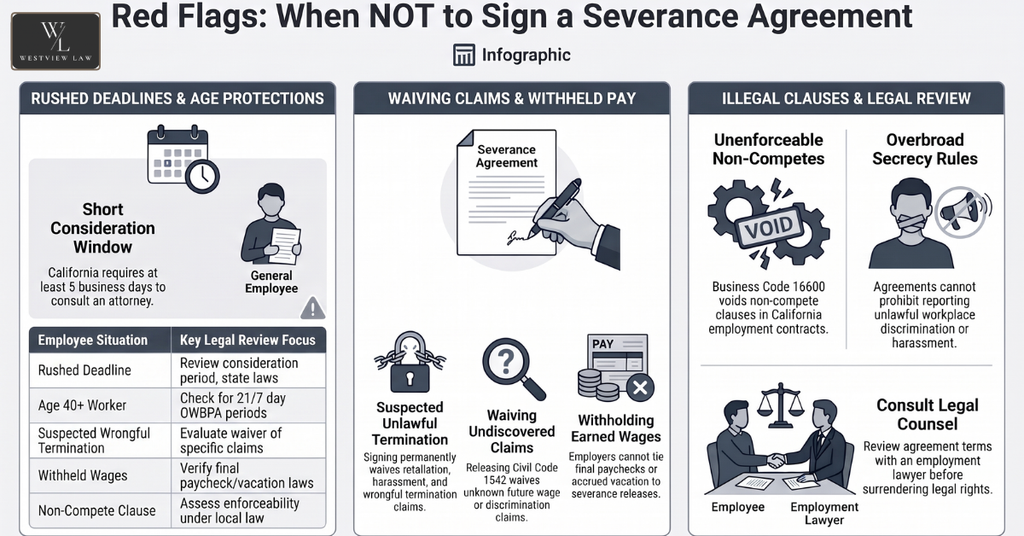
Under Government Code section 12964.5, a separation agreement that releases claims must tell you that you have the right to consult a lawyer, and must give you at least five business days to do it. You can sign sooner, but only if that's your own choice. Employers can't force you to accept this offer by threatening to withdraw it or offering a better deal if you sign up early.
Workers 40 and older get more time under the federal Older Workers Benefit Protection Act. If the agreement waives age discrimination claims, you get at least 21 days to consider it (45 days if you're part of a group layoff) and seven days after signing to change your mind. These periods apply only to age claims for workers 40 and over, so a 30-year-old shouldn't expect a 21-day window. If you think that age was involved with your termination, we explain those claims on the age discrimination page.
If your deadline looks shorter than these, ask for more time in writing and keep a copy of every message about it.
2. You Think You Were Fired for an Illegal Reason
If you were let go shortly after reporting harassment, asking for a disability accommodation, taking medical leave, or complaining about pay, the timing itself is worth a second look. It's the same whether you explain firings in three different ways to three different managers.
A severance release almost always covers claims for discrimination, retaliation, harassment, and wrongful termination. If you have a real claim, a few weeks of pay may be a small fraction of what it's worth. Employers often provide severance payments because they recognize there is risk involved.
Have the facts reviewed before you sign. If you resigned because conditions became unbearable, that can count too, under the rules on constructive discharge.
3. The Release Covers Claims You Don't Know About Yet
Most California severance agreements include a waiver of Civil Code section 1542. That statute protects you by default. It says:
"A general release does not extend to claims that the creditor or releasing party does not know or suspect to exist in his or her favor at the time of executing the release and that, if known by him or her, would have materially affected his or her settlement with the debtor or released party."
When you waive section 1542 protection, you are giving it up. You make claims that have not yet been discovered, like finding an error in wages months after they were issued or learning through a former colleague that there is a pattern of discrimination.
Waiving number 1542 is not uncommon and doesn't always mean someone would refuse. But it should be priced in. If the release is broad and the payment is small, the deal may favor the employer more than it looks.
4. Your Final Paycheck Depends on Signing

Severance and wages are two different things. Your final wages are already yours. Severance is extra.
Under California Labor Code section 201, an employer that fires you must pay all earned wages immediately, on your last day. If you quit without notice, section 202 gives the employer 72 hours. Under Section 227.3, requires the employer to pay out accrued but unused vacation pay at your final rate of pay. The California Labor Commissioner's final pay FAQ follows these rules.
Labor Code section 206.5 goes further. An employer can't require you to release a wage claim unless those wages have actually been paid, and a release that breaks this rule is void. So if the agreement holds back your final check, commissions you've already earned, or vacation pay until you sign, that's a serious problem. If you're owed back pay, our unpaid wages page explains your options.
5. The Confidentiality or Non-Disparagement Clause Goes Too Far
Employers can ask you to keep the severance amount confidential. They can't stop you from talking about unlawful conduct at work.
Section 12964.5 requires any non-disparagement or confidentiality clause in a California separation agreement to include language substantially like this: "Nothing in this agreement prevents you from discussing or disclosing information about unlawful acts in the workplace, such as harassment or discrimination or any other conduct that you have reason to believe is unlawful." If that sentence or something similar is missing then the clause may be unenforceable.
Federal law has its own limits. No agreement can stop yourself from filing a charge with the EEOC or participating in an investigation by them. For non-supervisory employees, the National Labor Relations Board's 2023 decision in McLaren Macomb currently treats broad confidentiality and non-disparagement clauses in severance agreements as unlawful, though the Board has signaled it may revisit that rule.
6. The Agreement Includes a Noncompete
Some employers still slip noncompete language into severance agreements. In California, it almost never holds up.
Business and Professions Code section 16600 voids agreements that restrain someone from a lawful profession, trade, or business, and since 2024 the statute says this applies "no matter how narrowly tailored" the clause is. Section 16600.5 makes such clauses void wherever and whenever they were signed and lets employees sue over them and recover attorney's fees. Employers had to notify both current employees as well as former ones by February 14, 2024, that their contracts of noncompetition were null and void.
A few narrow exceptions exist, mostly tied to selling a business. Separate analysis is done for clauses that protect real trade secrets. But a plain "you can't work for a competitor for a year" clause is a sign the agreement was written without California law in mind, and the rest of it deserves a careful read.
7. The Payment Terms and Benefits Are Vague

A good deal specifies exactly how much you will receive, when, and in what form. Watch for payments in installments that stop if the employer later claims you breached the agreement, clawback clauses that make you repay severance, and vague promises about health coverage that don't say who pays the COBRA premiums or for how long.
Ask what happens to unvested stock, earned bonuses, and commissions on deals that close after you leave. If the agreement doesn't say, get the answer in writing before you sign.
Many people also worry that severance will cost them unemployment benefits. In California, the Employment Development Department treats true severance pay as not being wages for unemployment purposes, so it generally doesn't reduce your benefits. Payments that are marked as severance pay but turn out to be regular wages, like a bonus you've already earned, can be handled differently.
What Signing a Severance Agreement Does and Doesn't Do
Once you sign a valid agreement and the revocation period (if any) passes, you're generally bound by it. You receive your payment and also relinquish any claims that are covered by this release. Undoing a signed release later is hard and usually means proving that it was invalid; for example because it didn't meet the age-waiver rules, or was signed under fraud or coercion.
Some rights persist even after signing. You can still file a charge with the EEOC, and a release can't waive your right to wages already owed under section 206.5. Claims for things that occur after signing aren't covered either.
The table below matches common situations to what an employment lawyer would look at.
| Your situation | What a lawyer would review |
|---|---|
| You were fired soon after a complaint, leave, or accommodation request | Whether you have a retaliation, discrimination, or wrongful termination claim worth more than the offer |
| You're 40 or older | Whether the age-discrimination waiver complies with federal requirements |
| Your final pay or vacation is being held until you sign | Whether the release is void under Labor Code 206.5 and whether waiting-time penalties apply |
| The agreement has strict confidentiality or a noncompete. | Whether these clauses comply with Gov. Code 12964.5 and B&P 16600. |
| The offer seems low | What the release covers and what a stronger offer could include. |
Talk to Westview Law Before You Sign
A severance agreement is often your last chance to address what happened at work, and it usually has to be decided within days. Taking some time to learn about the release date, check final pay details, and look for clauses that California law doesn't permit allows you to avoid making a decision that you cannot change later.
Call Westview Law at (310) 906-4862 or request a free case review. We can review your agreement, explain what you'd be giving up, and help you decide whether to sign, push back, or walk away.
Frequently Asked Questions
Below are answers to common questions about severance agreements in California.
Can I Refuse to Sign a Severance Agreement?
Yes, you're not required to sign anything. If you refuse, you generally won't receive the severance payment, but you keep any legal claims you have. Your earned wages and vested vacation must be paid either way.
How Long Do I Have to Sign a Severance Agreement in California?
In California you need at least five business days to consult with a lawyer before signing any documents that release claims. If you're 40 or older and the agreement waives age discrimination claims, federal law gives you at least 21 days (45 in a group layoff) plus seven days to revoke after signing.
Can My Employer Hold Back My Final Paycheck Until I Sign?
No, California requires final wages, including vested vacation, to be paid on time whether or not you sign. Employers cannot force you to give up a claim for wages that they haven't paid you.
Can I Sue My Employer After Signing a Severance Agreement?
Usually not for the claims you released, if the release is valid. You can still file with EEOC and some releases that have been signed turn out to be invalid. This is particularly true if the release didn't follow age waiver rules or attempted to waive unpaid wages.
Will Severance Affect My Unemployment Benefits in California?
Generally no. The EDD does not consider true severance payments as wages when calculating unemployment benefits. Payments that are really earned wages, like bonuses or commissions, may be treated differently.
Do I Need a Lawyer to Review a Severance Agreement?
You're not required to have one, and California law requires that you be told you can consult one. A lawyer is most useful if you think your firing was unlawful, the release is broad, or your final pay is tied to signing.
This article gives general information on employment law in California and at the federal level as of October 2026 and is not intended as legal advice. Reading this doesn't create any attorney-client relationship with Westview Law. Whether a severance agreement or any clause in it is enforceable depends on its exact wording and the facts of your situation. Talk to a licensed employment attorney in California before signing anything.