



Wage theft happens any time an employer keeps money a worker has already earned, and in California it costs workers billions of dollars every year. Knowing your rights matters because the law here is strong, but it only helps if you understand how to use it. This guide breaks down what wage theft looks like, the laws that protect you, and the exact steps to get your stolen wages back.
Westview Law PC is an employee-side California employment firm based in Los Angeles that fights for workers in wrongful termination, discrimination, retaliation, and wage-and-hour cases across the state. Founder and Managing Partner David M. Safvati has been named a Super Lawyers “Southern California Rising Star” (2022–2024) and was recognized in “Best of the Bar – Top 100 Verdicts in California, 2024,” and Of Counsel Taylor Markey previously served as an Assistant Regional Attorney at the U.S. EEOC. That mix of trial results and government enforcement experience is exactly what a wage-theft claim needs when an employer digs in and refuses to pay. Contact us today for a free consultation to find out where you stand.
Below, we cover what wage theft is, the state and federal laws that apply, how to file a wage claim, how AB 1003 changed the stakes, how to report violations, and the penalties employers face.
What Is Wage Theft?
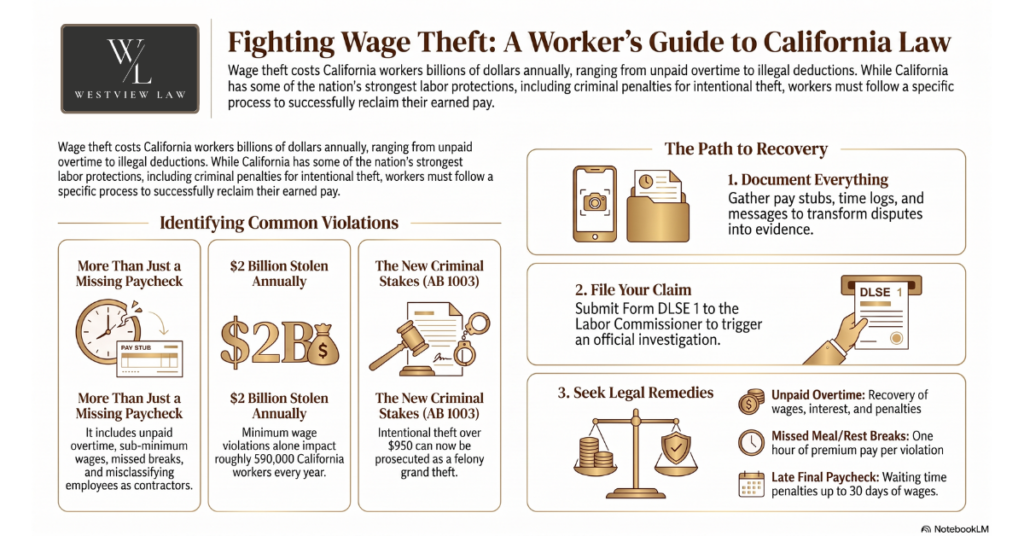
Wage theft occurs when an employer fails to pay employees the full wages they have legally earned. It shows up in a lot of ways: unpaid overtime, paying below minimum wage, illegal or unauthorized deductions from a paycheck, forcing people to work off the clock, skipping required meal breaks and rest breaks, withholding a final paycheck, and misclassifying employees as independent contractors to dodge overtime and other protections.
Unpaid commissions and denied business expense reimbursements count too. If your employer keeps money you actually earned, that constitutes wage theft under California law, whether it was one shortchanged paycheck or a pattern going back years.
The scale of the problem is bigger than most people think. Research from the Economic Policy Institute estimates that minimum wage violations alone take roughly $2 billion a year from about 590,000 California workers, with the average victim losing around $3,300 annually. And that figure only counts one category of wage theft. Add unpaid overtime, stolen tips, and unlawful deductions, and the real number climbs higher.
Certain industries see this more than others. Restaurants, construction, hotels, car washes, garment shops, warehouses, and nail salons show up again and again, and the workers hit hardest are often the ones who can least afford it. Many are paid in cash, work irregular hours, or worry that speaking up will cost them their job.
The damage doesn't stop with the individual worker. When employers pocket wages, families fall behind on rent and groceries, and some end up relying on public assistance to cover the gap left by pay that should have been in their pockets. Honest businesses that follow the law get undercut by competitors who cheat, and the state loses payroll tax revenue. Wage theft is not just a violation of one person's rights; it drags down the wider economy.
What Are the Wage Theft Laws in California?
California has some of the strongest worker protections in the country, and that works in your favor. State wage laws set the minimum wage, require overtime pay, mandate meal and rest breaks, and control how and when you must be paid. As of January 1, 2026, the statewide minimum wage is $16.90 per hour for all employers. Keep in mind that many cities and counties set their own local minimums that run higher than the state rate, so check the rules where you actually work.
At the federal level, the Fair Labor Standards Act (FLSA) sets a baseline for minimum wage and overtime nationwide. When state and federal wage laws differ, employers have to follow whichever one gives the worker more protection. In practice, that almost always means California law controls, because our overtime rules, break requirements, and minimum wage go further than the FLSA.
The California Labor Code is where most of the specific protections live. It requires overtime pay at one and a half times your regular rate after eight hours in a day or 40 in a week and double time past 12 hours in a day. It bans unauthorized deductions from your wages, requires accurate itemized pay stubs, and sets deadlines for paying you, including your final check when the job ends. Labor Code section 203 adds waiting time penalties of up to 30 days' wages when an employer willfully delays a departing worker's final pay.
The agency that enforces most of this is the California Labor Commissioner's Office, formally the Division of Labor Standards Enforcement (DLSE). This office investigates wage claims, holds hearings, and issues orders directing employers to pay what they owe. You do not need a lawyer to file with them, and the process is free, though many workers still choose to have an attorney in their corner, especially when an employer fights back hard.
How to File a Wage Claim in California
If your employer has not paid you the wages you earned, you have the right to file a wage claim in California. While the process may seem overwhelming at first, it follows a clear series of steps. Here's how it works from start to finish.
Step 1: Gather Your Documentation
Pull together pay stubs, pay records, time sheets, work schedules, text messages, and anything else that shows what you worked and what you were paid. If you kept your own log of hours, that helps. Strong evidence is what turns a “he said, she said” dispute into a claim an employer can't easily wave away. As one Westview Law wage-and-hour attorney puts it, “Most workers are owed more than they realize, and the ones who keep good records and speak up are the ones who get made whole.”
Step 2: Fill Out the Wage Claim Form
Complete the Labor Commissioner's Initial Report or Claim (Form DLSE 1), which asks for your employer's information, your pay rate, the hours you worked, and the specific wages you're owed, whether that's unpaid overtime, minimum wage shortfalls, missed break premiums, or unpaid commissions. Be as accurate and specific as you can. Guesswork weakens your case, so use your records to back up the numbers.
Step 3: Submit Your Claim
File the completed form and copies of your evidence with your local DLSE office by mail, in person, or through the online portal. Keep copies of everything you send. Once it's filed, the office reviews the claim and usually schedules a settlement conference, and if that doesn't resolve it, a formal hearing follows.
Step 4: Handle Common Challenges
Expect some pushback. Employers may claim you were an independent contractor, argue you were properly classified as exempt, or say the records don't exist. Detailed evidence and honest testimony are how you overcome these tactics, and this is often the point where having an experienced wage-and-hour attorney makes the biggest difference.
Step 5: Know the Timeline
Wage claims take time, often several months from filing to hearing, and sometimes longer if the case is contested or ends up in civil court. Watch the deadlines: you generally have three years to file for unpaid wages, overtime, minimum wage, or illegal deductions, two years for claims based on an oral promise, and up to four years if a claim is brought in court under the Unfair Competition Law. Missing the window can cost you the right to recover, so act sooner rather than later.
What Is the Impact of Ab 1003 on Wage Theft in California?
For a long time, wage theft was treated mostly as a civil matter, something an employer could settle by eventually paying up if a worker pushed hard enough. Assembly Bill 1003 changed that. Signed in 2021 and effective January 1, 2022, this law added section 487m to the California Penal Code and made the intentional theft of wages a criminal offense.
Here is what the law actually says. When an employer intentionally steals wages, including tips, in an amount greater than $950 from any one employee, or more than $2,350 total from two or more employees, within any consecutive 12-month period, it can be charged as grand theft. Grand theft is a wobbler, meaning prosecutors can pursue it as either a misdemeanor or a felony depending on the facts.
AB 1003 also defines an employee to include independent contractors, which closes a loophole employers used to exploit by misclassifying workers and then arguing they weren't really employees at all. The idea is straightforward: if you knowingly rob your workers of what they earned, you can face the same kind of criminal exposure as someone who steals money any other way.
Consider a hypothetical case to see how this plays out. Say a restaurant owner routinely pockets a slice of the servers' pooled tips and shaves hours off timecards, and over eight months this adds up to more than $2,350 taken from the waitstaff as a group.
Under AB 1003, that owner isn't just on the hook for repaying the money in a civil claim; a prosecutor could bring grand theft charges. (This example is illustrative, not a real case.) That criminal possibility is exactly why AB 1003 gives the law real teeth against employers who treat wage theft as a cost of doing business.
How to Report Wage Theft in California

If you believe your wages have been stolen, you have a clear path to report it. The main route is filing a wage claim with the California Labor Commissioner's Office, which investigates the complaint and can order your employer to pay. You don't need to prove your entire case up front; you need to give the office enough information to open a wage theft investigation.
Start by contacting the Labor Commissioner's Office directly. You can reach a local DLSE district office by phone or in person, and staff can walk you through which claim applies to your situation. If you're worried about retaliation, know that California law makes it illegal for an employer to fire, demote, or punish you for reporting wage theft or filing a claim, and retaliation itself can lead to additional penalties against the employer.
You can also file using the official online complaint form on the DIR website, which lets you submit your claim and supporting documents without visiting an office in person. The online option is convenient, but accuracy still matters, so take your time and match your entries to your records.
Throughout all of this, keeping detailed records is the single most useful thing you can do. Save pay stubs, note the hours you actually work, screenshot schedules and messages, and hold on to anything showing what you were promised and what you were paid. Free resources are available too, including the DLSE's own guides, legal aid organizations, worker centers, and employee-side firms that offer free consultations. The more organized your evidence, the stronger your claim.
What Are the Penalties for Wage Theft in California?
Employers who commit wage theft face real consequences, and they stack up quickly. On the civil side, an employer that fails to pay properly can be ordered to pay the unpaid wages plus interest, along with a range of civil penalties. Missed meal or rest breaks carry a premium of one hour's pay each, and a willfully late final paycheck triggers waiting time penalties of up to 30 days' wages under Labor Code section 203.
Beyond back pay, California adds statutory penalties designed to deter violations. These can include liquidated damages equal to the unpaid minimum wages, penalties for inaccurate or missing pay stubs, and fines that grow with each affected employee and each pay period. In a case involving many employees, the total restitution and penalties an employer owes can far exceed the original amount of wages that were withheld.
Since AB 1003, the intentional theft of wages can also cross into criminal territory. When an employer knowingly steals more than $950 from one worker or $2,350 from two or more within a year, prosecutors can charge grand theft as a misdemeanor or a felony. A criminal conviction can mean probation, jail or prison time, and a permanent record, which is a serious escalation from a purely civil dispute.
The impact on a business can be severe. Between the back wages, penalties, interest, attorney's fees, and possible criminal charges, wage theft can become far more expensive than simply paying workers correctly in the first place. California agencies recover substantial sums for workers every year through enforcement actions and investigations, and employers who cut corners on pay increasingly find that the math doesn't work in their favor. If you're weighing whether a violation is worth pursuing, remember that the law is built to make cheating cost more than compliance.
Common Types of Wage Theft vs. Your Legal Remedies
Wage theft can take many forms, and each type comes with different legal remedies. The table below compares the most common wage theft violations and the rights California workers may have to recover their unpaid wages.
| Wage Theft Practice | What It Looks Like | Your Potential Legal Remedy |
|---|---|---|
| Unpaid overtime | Working overtime without overtime pay | Recover unpaid overtime, interest, and penalties |
| Minimum wage violations | Paid below California's minimum wage | Recover unpaid wages and liquidated damages |
| Off-the-clock work | Required to work before or after shifts without pay | Recover wages for all hours worked |
| Illegal paycheck deductions | Unauthorized deductions from wages | Recover deducted wages and statutory penalties |
| Missed meal or rest breaks | Required breaks not provided | One hour of premium pay for each violation |
| Unpaid final paycheck | Employer delays final wages after termination | Waiting time penalties of up to 30 days wages |
| Employee misclassification | Labeled an independent contractor incorrectly | Recover unpaid wages, overtime, and benefits |
How Can an Attorney Help With Stolen Wages in California?

A California employment attorney can review your pay records and determine whether your employer violated state wage laws. They can calculate unpaid wages, overtime, missed meal and rest break premiums, minimum wage violations, unpaid commissions, or illegal paycheck deductions. They also explain your legal options and help you gather the evidence needed to support your claim. In many cases, having an attorney involved encourages employers to take the matter more seriously and work toward a resolution.
If your employer refuses to pay what you are owed, an attorney can file a wage claim with the California Labor Commissioner or pursue a lawsuit when appropriate. They can negotiate settlements, represent you during hearings, and fight to recover unpaid wages, interest, penalties, and, in some cases, attorney's fees. Most importantly, they help protect you from mistakes and make sure your rights are enforced while you focus on moving forward.
For example, Sarah noticed that her paychecks were missing overtime wages even though she regularly worked more than 40 hours a week. After getting nowhere with her employer, she contacted the attorneys at Westview Law. They reviewed her time records, filed a wage claim, and negotiated on her behalf. As a result, Sarah recovered her unpaid wages along with additional penalties allowed under California law, giving her the compensation she deserved without having to handle the process alone.
Have Your Wages Been Stolen in California?
Wage theft is common, it's illegal, and California gives workers strong tools to fight back. You've earned your pay, and the law backs your right to collect every dollar of it, from unpaid overtime and minimum wage to stolen tips, unauthorized deductions, and missed breaks. The key is to act: keep your records, know your deadlines, and don't assume an employer's word is the final say. If you think your wages have been stolen, talk to someone who handles these cases every day.
Have you been denied the wages you earned? Westview Law PC is a California employee-side employment firm that fights for workers in wage theft, wrongful termination, discrimination, and retaliation cases across the state. Founder and Managing Partner David M. Safvati has been recognized as a Super Lawyers Southern California Rising Star (2022–2024) and in Best of the Bar – Top 100 Verdicts in California, 2024. Contact us today for a free consultation and find out where you stand.
Frequently Asked Questions
Wage theft California cases affect thousands of workers each year, often leaving employees without the rightful wages, benefits, or other payments they have earned. Here are answers to common questions about wage theft, your rights under California labor laws, and the legal remedies available.
How Can I Report Wage Theft in California?
You can report California wage theft violations by filing a wage claim with the California Labor Commissioner's Office or pursuing a civil action in certain cases. An employment lawyer can help you recover your earned wages and determine the best legal option.
What Are the Penalties for Wage Theft in California?
Employers who violate California labor laws may have to pay unpaid wages, penalties, interest, attorneys' fees, and other compensation. Depending on the employer's intent and the violation, wage theft may also be treated as a crime, and laws such as Assembly Bill 1003 may impose additional consequences.
What Is Wage Theft in California?
Wage theft occurs when an employer fails to pay employees the wages, benefits, or other payments they have legally earned. Common examples include unpaid overtime, off-the-clock work, minimum wage violations, and a failure to pay employees for all hours worked.
How Common Is Wage Theft in California?
Wage theft is a widespread issue affecting workers across many California industries. Although enforcement resources are limited, employees who are not properly compensated can still pursue legal remedies under California law.
What Are Some Examples of Wage Theft Practices in California?
Examples include failing to pay minimum wage or overtime, requiring off-the-clock work, making unlawful deductions, withholding final paychecks, or managers taking employee tips. Employers also commit wage theft through the failure to provide all legally required wages and benefits.
What Are the Legal Remedies Available to Employees Who Have Experienced Wage Theft in California?
Employees may recover unpaid or earned wages, penalties, interest, and other damages through a wage claim or civil action. Depending on the circumstances, the court or labor commissioner may also order the employer to pay attorneys' fees and ensure employees are fully compensated.
Disclaimer: This article is provided for general informational purposes only and does not constitute legal advice. Reading it does not create an attorney-client relationship with Westview Law PC or any of its attorneys. Wage and hour laws change and apply differently depending on your specific facts. If you believe you have experienced wage theft, consult a qualified California employment or wage-and-hour attorney about your particular situation.