


California employment lawsuits typically settle between the mid-five figures and low six figures, though severe cases can reach much higher. No reliable public average exists since most cases settle privately under confidentiality terms. Your actual payout depends on a specific mix: lost wages, emotional distress damages, punitive damages, and attorney's fees.
Westview Law PC represents California employees from our office at 1880 Century Park East in Los Angeles, and case value is something we assess before a complaint is ever filed. Taylor Markey, our of-counsel attorney, previously served as an Assistant Regional Attorney at the U.S. Equal Employment Opportunity Commission, where evaluating what a discrimination claim was actually worth was the daily work. Founder David M. Safvati, named to Super Lawyers Southern California Rising Stars from 2022 through 2024, built this firm around trying cases rather than avoiding them, which is what gives a settlement number its weight. Contact us for a free case review, and we will tell you honestly what your claim looks like.
This post breaks down the types of compensation available, what raises or lowers a case's value, how California's damages rules differ from federal ones, the steps involved in suing, and how to push your recovery as high as the facts allow.
Understanding Case Values in California Employment Lawsuits

Case value starts with which law applies. California's Fair Employment and Housing Act covers discrimination, workplace harassment, and retaliation at employers with five or more employees. The California Labor Code governs unpaid wages and whistleblower retaliation, and federal law adds Title VII, the ADA, and the ADEA through the Equal Employment Opportunity Commission.
People bring legal claims for wrongful termination, workplace discrimination, sexual harassment, a hostile work environment, retaliation after a complaint or a workers' compensation claim, wage and hour violations, and breach of an employment contract. Those categories carry very different price tags, which is why two people fired on the same day can hold claims worth ten times apart.
The Equal Employment Opportunity Commission recovered about $660 million for workers across 88,201 new discrimination charges in fiscal year 2025, and that figure covers only charges that ran through the federal agency. That is why understanding how case value gets built matters.
Your recovery is not just one number pulled from the air. It comprises lost wages and lost benefits, compensation for emotional harm, punitive damages in the worst cases, and attorney's fees on top. Knowing which parts of that stack your facts support is the difference between taking a quick offer and knowing what the claim is worth.
What Are the Types of Compensation Available?
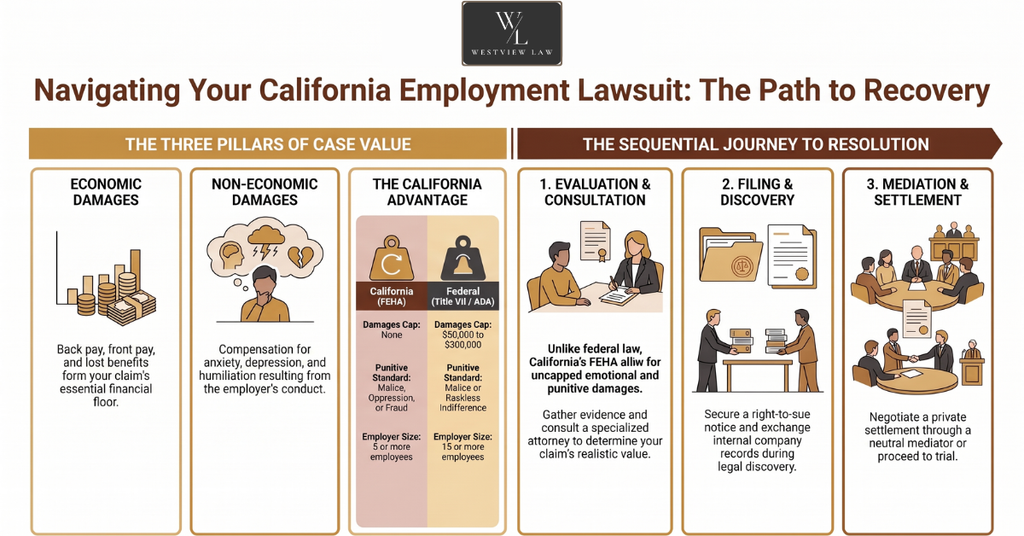
Economic damages are the foundation and usually the largest piece. Back pay covers what you lost from the termination to the resolution, and front pay covers future losses when returning to the job is not realistic and finding comparable employment takes time.
Lost benefits count too, including health insurance premiums you had to cover yourself, retirement contributions your employer stopped making, bonuses, commissions, and unused vacation. In wage cases, you can recover unpaid wages directly, plus penalties that often exceed the wages themselves, all part of the fair compensation the law aims to restore.
Non-economic damages compensate for emotional harm, and in a California wrongful termination case they are often the difference between a modest case and a serious one. Emotional distress claims cover anxiety, depression, sleep loss, humiliation, and the strain that spills into your health and your family. There is no formula, so emotional distress damages tend to track how long the conduct lasted, how public it was, and whether you sought treatment.
Punitive damages sit on top and are reserved for egregious employer conduct. Under California law, you have to show by clear and convincing evidence that the employer acted with malice, oppression, or fraud and that a company officer, director, or managing agent was involved.
The purpose is not to compensate you but to punish the employer and deter future violations, which is why courts award punitive damages that can dwarf the underlying losses. Most cases do not qualify, and any lawyer who promises punitive damages at a first meeting is overselling.
Attorney's fees deserve their own mention because they change the math. In most FEHA and wage claims, a prevailing employee can recover reasonable attorney's fees and litigation costs from the employer, which means legal fees are not automatically carved out of your recovery, and small-value claims remain worth bringing.
Consider a straightforward scenario. An employee earning $85,000 a year requests a schedule accommodation for a medical condition, is written up for the first time two weeks later, and is fired within the month. She is out of work eight months before landing a job paying $70,000.
Her economic damages run roughly $57,000 in back pay plus the $15,000 annual gap going forward, her emotional distress claim rests on documented treatment, punitive damages are unlikely unless HR ignored a clear complaint, and her attorney's fees are recoverable if she prevails. The lesson is that wage loss is arithmetic anyone can do, while the parts that actually move the number are the documentation and the employer's conduct after she spoke up.
What Are the Factors That Influence Compensation in Employer Lawsuits?

Two employees with similar jobs and similar firings can have very different outcomes. Three things usually explain the gap.
1. Severity of the Violation
The nature of what happened sets the ceiling. A single ambiguous comment, an isolated scheduling error, or a few unpaid hours sits at the minor end and usually resolves for the wages owed plus a modest amount.
Severe cases look different: months of harassment that management knew about and ignored, a firing that followed a sexual harassment complaint by days, an accommodation refused outright, or a pattern affecting multiple employees. Severity drives emotional distress damages and opens the door to punitive damages, so identical lost wages can support very different totals.
2. Documented Evidence and Witnesses
Employment cases are won on records. Performance reviews that were strong until the week you complained, emails that contradict the employer's stated reason, and a personnel file with no prior discipline make a claim concrete rather than contested.
Witness statements do similar work, since a coworker who confirms the meeting or the remark converts your account into corroborated evidence. Cases without documentation are not worthless, but they settle lower because the other side prices in the risk that a jury will not believe you.
3. Employee's Role and Conduct
Your conduct affects the number more than people expect. California law requires you to make reasonable efforts to mitigate your losses, which means you should be looking for comparable employment and keeping a record of your applications; otherwise, the defense will argue that your losses are self-inflicted.
Deleting messages, taking confidential company files, or posting about the case online hands the employer arguments unrelated to the merits and can even shift focus away from the employer's actions that caused the harm in the first place. Keep your account consistent and let your employment attorney handle communication with your former employer.
What Are the Differences Between California and Federal Case Caps?
A damages cap is a statutory ceiling on part of what you can recover, no matter what a jury awards. Federal law caps the combined total of compensatory and punitive damages in Title VII and ADA cases based on employer size: $50,000 for employers with 15 to 100 employees, $100,000 for 101 to 200, $200,000 for 201 to 500, and $300,000 for employers with more than 500. The caps exist to limit exposure for smaller employers, and they bite hardest in serious emotional distress cases.
Importantly, the cap does not cover everything, and this is one reason California wrongful termination cases are often filed under state law instead. Back pay, front pay, interest, and attorney's fees fall outside it, so a federal verdict can still exceed $300,000 in total. Age discrimination claims under the ADEA work differently again, using liquidated damages rather than capped compensatory and punitive damages.
| Factor | California (FEHA) | Federal (Title VII / ADA) |
|---|---|---|
| Damages cap | None | $50,000 to $300,000 based on employer size |
| What's included in the cap? | Not applicable | Compensatory and punitive damages combined |
| What falls outside the cap | Not applicable | Back pay, front pay, interest, attorney's fees |
| Attorney's fees | Recoverable by prevailing employee | Recoverable by prevailing employee |
| Punitive damages standard | Malice, oppression, or fraud by an officer, director, or managing agent | Malice or reckless indifference, subject to the combined cap |
| Employer size requirement | Five or more employees | Fifteen or more employees |
| Where most cases are filed | State superior court | Federal district court, often paired with a state claim |
California's Unique Position
California does not cap FEHA damages at all. Emotional distress and punitive damages under the Fair Employment and Housing Act are limited only by what a jury finds reasonable and what the courts allow on review, where punitive awards are generally kept within a single-digit ratio to compensatory damages as a matter of constitutional due process.
The practical implication is significant. An identical set of facts can be worth several times more under California law than under the federal Civil Rights Act, which is why most California employment lawsuits are filed in state court under FEHA, with federal claims added only when they help.
Steps to Sue Your Employer in California

Suing your employer in California follows a clear path, from that first consultation call to filing, negotiation, and resolution. Knowing each step ahead of time helps you set expectations and avoid surprises along the way.
Step 1: Evaluate the Merits of Your Claim
Identify the protected characteristic or protected activity, the adverse action, and the connection between them, then gather your performance reviews, personnel file, pay stubs, and messages. If the employer's stated reason is contradicted by its own records, you likely have something worth pursuing.
Step 2: Consult an Employment Attorney
Bring the documents and a dated timeline to a free case review, and ask directly how the firm values the claim and what the realistic range is. Most employment attorneys work on contingency, so this conversation costs you nothing.
Step 3: File With the Appropriate Agency
Discrimination, harassment, and retaliation claims go to the California Civil Rights Department, and parallel federal claims go to the Equal Employment Opportunity Commission. You are requesting a right-to-sue notice, which you need before filing an FEHA lawsuit in court.
Step 4: File the Civil Complaint
Once the notice issues, your attorney files in state superior court, naming the claims and the relief sought. Deadlines are strict, generally one year from the right-to-sue notice for an FEHA claim.
Step 5: Move Through Discovery
Both sides exchange documents, answer written questions under oath, and take depositions, which typically runs six months to over a year. This is where the employer's internal emails surface and where most case values are finally set.
Step 6: Attempt Mediation
A neutral mediator, usually a retired judge, works between both sides toward a number, and most California employment disputes resolve here rather than at trial. Nothing said in mediation can be used against you if it fails.
Step 7. Decide Between Settling and Trying the Case
Settling is faster, private, and certain, while trial offers a higher ceiling along with real risk, delay, and public exposure. That decision is yours, and it should be made with a clear picture of what comparable cases have actually paid.
Maximizing Your Compensation
Start with the arithmetic you can do yourself. Add gross lost wages from termination to today, add lost employment benefits including health insurance and retirement contributions, then project forward based on how long finding comparable employment is realistically taking. That figure is your economic floor, and it is the piece both sides agree on most easily.
The rest of the analysis requires judgment rather than a calculator. Emotional distress gets valued against what similar juries have awarded in similar cases. Punitive exposure depends on how senior the bad actor was and how the company responded after learning about it, and attorney's fees keep growing as the case moves forward, which adds its own pressure to settle.
This stage is where legal representation from an experienced employment lawyer earns its keep, because published verdicts and confidential settlement knowledge are not something you can look up, and it often makes the difference in your financial recovery. Before taking any legal action, it helps to know what your case is actually worth.
Strategies for Success
Build the case before you need it. Preserve documents early, request your personnel file while you still can, keep a dated log, get treatment if the stress is genuinely affecting you, and keep applying for comparable work, keeping a record of your efforts.
In settlement negotiations, do not name the first number and do not treat an early offer as a measure of your case. Be prepared to litigate, because employers price cases partly on whether opposing counsel actually tries them.
Ready to Seek Compensation From an Employer in California?
What you can get for suing your employer in California comes down to a few key factors. These include the wages and benefits you lost, the emotional harm you can document, whether the employer's conduct was bad enough to support punitive damages, and how strong your paper trail is. California also gives employees more room than federal law does. There's no cap on FEHA damages, and attorney's fees are recoverable, which is why California cases often outvalue their federal counterparts.
Do not try to price your own claim based on search results. The public numbers are unrepresentative, the deadlines are short and different for each type of claim, and an early offer from an employer is a negotiating position rather than a valuation. Talk to an employment attorney before you accept anything or let a deadline pass. They can look at your specific facts and give you a real sense of what your case is worth.
Wondering what your case is actually worth? Westview Law PC can tell you. We're a Los Angeles employment law firm, and case valuation is where we start, before we ever file a complaint. Founder David M. Safvati was named to Super Lawyers Southern California Rising Stars from 2022 through 2024, and he built this firm on trying cases, not avoiding them. That's what gives a settlement number real weight. Contact us for a free case review, and we'll tell you honestly what your claim looks like.
Frequently Asked Questions
California employees most often ask us what an employment claim is actually worth. Here's what shapes that answer.
Is It Worth Suing Your Employer?
It comes down to your evidence and your actual losses, not how unfair the situation felt. If you have documented lost wages, California's fee-shifting rules and uncapped FEHA damages usually make it worth pursuing, and a free consultation can tell you where you stand.
What Types of Compensation Can I Seek in a Lawsuit Against My Employer in California?
You can pursue back pay, front pay, lost benefits, emotional distress damages, and punitive damages where the employer acted with malice or fraud. Wage claims can also recover unpaid wages plus penalties, and prevailing employees typically recover attorney's fees too.
Are There Any Limits on the Amount of Compensation I Can Receive in a Lawsuit Against My Employer in California?
Federal law caps combined compensatory and punitive damages between $50,000 and $300,000 depending on company size, but back pay, front pay, and attorney's fees sit outside that cap. California itself places no cap on FEHA damages.
How Can I Determine the Potential Value of My Lawsuit Against My Employer in California?
Start with lost wages and benefits since termination, which provides you a solid economic floor. From there, emotional distress and attorney's fees are harder to estimate on your own, so an employment lawyer familiar with comparable settlements is your best next step.
Is It Worth Pursuing a Lawsuit Against My Employer in California for Potential Financial Compensation?
For many employees, yes, especially with documented wage loss and fee-shifting rules on their side. The real trade-offs are time, since a contested case can run one to three years, and evidence strength, so it's worth weighing both with an attorney before deciding.
Disclaimer: This article is general information about California employment law and is not legal advice. Reading this article does not create an attorney-client relationship with Westview Law PC. The compensation figures and ranges discussed are illustrative and do not predict the outcome of any particular claim, and the scenario described above is a hypothetical rather than an actual client matter. Employment law changes over time, and prior results do not guarantee a similar outcome. Consult a licensed California employment attorney about your situation.