



A hostile work environment exists when harassment or discrimination becomes serious enough to interfere with an employee's ability to do their job. Workers who experience ongoing misconduct based on a protected characteristic may have the right to file a lawsuit if their employer fails to address the problem. At Westview Law, our employment attorneys have represented California workers in hostile work environment and harassment claims against employers of every size.
At Westview Law, our attorneys have extensive experience representing employees facing workplace harassment, discrimination, and retaliation. We stay current on federal and state employment laws to provide clear, practical guidance tailored to each client's situation. Every hostile work environment claim is unique, which is why we take the time to evaluate the facts and explain your legal options. If you believe your workplace conditions have crossed the line, contact us today for a confidential consultation and learn how we may be able to help protect your rights.
This post explains what makes a workplace legally hostile, the steps to file a hostile work environment lawsuit, how employer liability works, and what employees and employers can do about it.
What Is a Hostile Work Environment?
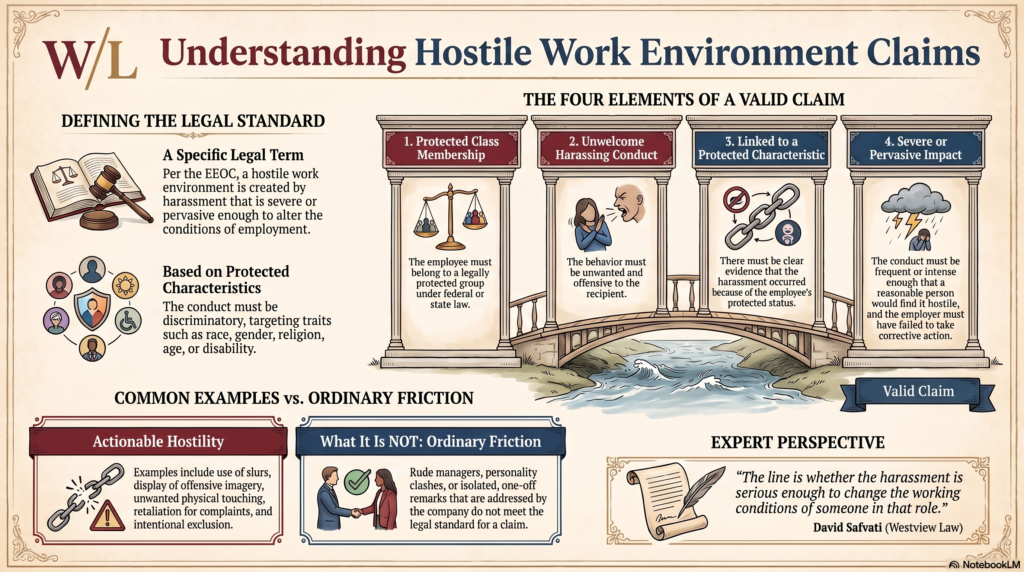
A hostile work environment is a legal term, not just a description of a tough job. According to the U.S. Equal Employment Opportunity Commission (EEOC), a hostile work environment exists when harassment based on an employee’s protected characteristics is severe or happens often enough that a reasonable person would consider the workplace abusive.
A workplace becomes legally "hostile" when unwelcome conduct based on a protected characteristic is severe or pervasive enough that a reasonable person in the employee's position would find it abusive, creating a toxic environment, and the affected employee actually perceives it that way. The conduct does not need to be both severe and pervasive. This means that a single severe incident or a steady drumbeat of less serious ones can each meet the standard. The federal framework comes from Title VII of the Civil Rights Act of 1964, and California layers on broader protections through the Fair Employment and Housing Act.
The kinds of behavior that contribute to a hostile environment cover a wide range. Slurs, jokes, or imagery targeting a protected group; unwanted touching, sexual comments, or pressure; threats and intimidation; retaliation against someone who reports harassment; and exclusion or sabotage tied to a protected characteristic can all qualify as harassing behavior. The conduct can come from supervisors, co-workers, or even non-employees like vendors or clients when the employer knows about it and fails to act.
To bring a valid claim, an employee generally has to show four things. First, that they belong to a protected class. Second, that they experienced unwelcome harassing conduct. Third, that the conduct was based on the protected characteristic. Fourth, that the conduct was severe or pervasive enough to alter the conditions of employment, and that the employer either knew or should have known and failed to take prompt corrective action.
Ordinary workplace friction, such as a rude manager, a disliked policy, or a one-off offensive remark that is promptly addressed, usually will not meet the standard on its own. "The line is whether the harassment is serious enough to change the working conditions of someone in that role," says David Safvati, employment attorney at Westview Law.
What Are the Key Factors That Contribute to a Hostile Work Environment?
Repeated offensive conduct related to a protected characteristic is the most common ingredient. Even when no single comment or act would, on its own, justify a lawsuit, a sustained pattern of racial slurs, offensive jokes, offensive comments, name-calling, unwanted touching, or hostile treatment tied to a protected trait can clearly establish a hostile environment. Frequency matters because the law evaluates the total picture, not isolated moments.
Severity is the other side of the same coin. A single physical assault, an explicit threat tied to a protected characteristic, a demand for sexual favors, or a serious incident of sexual harassment can satisfy the standard on its own, even without a long history of similar conduct. Courts weigh both the severity of any given incident and how often the behavior occurred.
The employer's response or lack of one often shapes how severity and pervasiveness are evaluated. When complaints are ignored, brushed off, or punished with retaliation, what might have been an isolated problem becomes part of a hostile environment that the employer is responsible for. By contrast, prompt and effective corrective action can sometimes limit or end an employer's exposure.
Finally, the impact on the employee's work performance and mental health matters. Anxiety, missed work, declining performance reviews, a forced transfer, or medical treatment for stress are all relevant. They show that the conduct affected the employee in the way the law contemplates by altering the conditions of employment, and they help quantify damages.
Should You Report Harassment Internally or File a Lawsuit?
While understanding the legal process is important, employees also need to decide how they want to address workplace harassment in the first place. Many employees who experience harassment never formally report it. The EEOC has cited research indicating that approximately 90% of individuals who experience workplace harassment do not take formal action, such as filing a complaint or charge. This means reported cases likely represent only a fraction of the actual problem.
In some situations, an internal complaint may successfully resolve the issue, while in others, formal legal action may be necessary. The comparison below highlights the key differences between pursuing an internal resolution and filing a hostile work environment lawsuit.
| Factor | Internal Resolution Through HR | Hostile Work Environment Lawsuit |
|---|---|---|
| Speed | Often resolved more quickly through internal investigations and corrective action. | Can take months or even years to reach a settlement or court judgment. |
| Cost to Employee | Usually involves little to no direct cost for the employee. | May involve legal expenses, although many employment attorneys work on contingency. |
| Potential Outcome | May result in discipline, policy changes, training, or an end to the harassment. | Can result in financial compensation, attorney fees, reinstatement, workplace changes, or court-ordered remedies. |
| Evidence Requirements | Complaints should be supported by documentation, but formal evidentiary standards are generally lower. | Strong evidence is critical to prove harassment, employer knowledge, damages, and liability. |
| Employer Accountability | Gives the employer an opportunity to investigate and correct the problem internally. | Holds employers legally accountable when they fail to prevent or address harassment. |
| Stress and Time Commitment | Typically less adversarial and less disruptive to an employee's daily life. | Litigation can be emotionally demanding and require substantial time and participation. |
| Risk of Retaliation | Employers are prohibited from retaliating, but employees may still fear workplace consequences. | Anti-retaliation protections remain in place, and retaliation may create additional legal claims. |
| Best Suited For | Situations where the employer appears willing to investigate and resolve the issue promptly. | Cases involving severe harassment, repeated misconduct, retaliation, or an employer's failure to take corrective action. |
What Is the Legal Process for Filing a Hostile Work Environment Lawsuit?
Filing a hostile work environment lawsuit is a structured process, and the initial steps you take before filing often shape the outcome. Documenting the harassment, reporting it correctly, and preserving your rights up front make every later stage stronger. A hostile work environment lawyer can also help you evaluate potential legal action early in the process.
Step 1: Documenting Incidents and Gathering Evidence.
Keep a contemporaneous record of every incident with dates, times, locations, what was said or done, and who witnessed it. Save emails, texts, photos, voicemails, performance reviews, and any other materials that show the employer's conduct, its impact, or how it affected the working relationship.
Step 2: Reporting the Issue Internally to HR or Management.
Employees are usually expected to report harassment through their employer’s internal complaint process before taking legal action. Most employers require harassment to be reported through internal channels first, and doing so puts the company on formal notice and triggers their duty to investigate. Submit the complaint in writing, follow internal reporting procedures, raise concerns promptly, and keep a dated copy for yourself so the employer has an opportunity to take appropriate action. If employees fail to report internally, it may reduce the amount of compensation they can recover in a lawsuit.
Step 3: Seeking Legal Counsel for Advice on the Situation.
An employment lawyer can evaluate the strength of your claim, identify deadlines, and advise on whether to pursue an administrative agency, a private settlement, or a lawsuit. Many employment attorneys offer free consultations and work on a contingency basis. A hostile work environment lawyer can also help determine whether further legal action is appropriate.
Step 4: Preparing the Complaint: Essential Elements to Include.
A complaint should identify the parties, the protected characteristic, the specific conduct, the dates and witnesses, the harm suffered, and the legal claims being asserted. Whether the claim involves employment discrimination, unlawful discrimination, or harassment based on other protected characteristics, vague or incomplete complaints invite dismissal, so precision matters.
Step 5: Filing With the Appropriate Legal Authority or Court.
If an employer does not resolve the issue through its internal complaint process, employees can file a charge with the EEOC and/or a state anti-discrimination agency. In many cases, this procedure is a required step before employees can move forward with a lawsuit. Most federal harassment claims must first be filed as a charge with the US Equal Employment Opportunity Commission within 180 days, or 300 days in states like California that have an equivalent appropriate agency.
In California, an employee can also file directly with the Civil Rights Department within three years of the conduct. Depending on the claim, the matter may later proceed to federal court under the applicable employment act and related laws.
Step 6: Serving the Complaint on the Employer or Defendant.
Once a lawsuit is filed, the complaint must be formally served on the employer following the court's procedural rules. Taking the appropriate steps to ensure proper service starts the employer's response deadlines and moves the case into litigation.
Proving a Hostile Work Environment

The strength of a hostile work environment case usually comes down to evidence. Direct evidence of harassment such as emails, texts, recordings, and witness statements is gold, but circumstantial evidence often carries equal weight when it shows a consistent pattern. The earlier you start preserving records, the more material you have to work with. This evidence is often necessary to meet the legal standard in hostile work environment and workplace discrimination cases.
Witness testimony plays a central role. Co-workers who saw or heard the conduct, who experienced similar treatment, or who watched the employer's response can substantiate what you describe. Even witnesses who are reluctant to come forward can often be subpoenaed or deposed. Their testimony can help show that the conduct involved a person's race, religious beliefs, sexual orientation, age discrimination, or another protected characteristic.
Expert witnesses and psychological evaluations add another layer. A workplace expert may testify about industry norms and how a reasonable workplace would have responded. A psychologist can document the emotional and physical impact of the harassment, which both proves the abusive nature of the environment and supports claims of damages.
The case ultimately rests on establishing a pattern of behavior and its impact. While isolated incidents may not always be enough to support a claim, courts often look at the totality of the circumstances. "Most hostile environment cases are built one incident at a time," says an employment attorney at Westview Law. "When you line up the documentation, the witnesses, and the harm in one place, the pattern becomes hard for an employer to explain away."
Alicia had been dealing with repeated sexist remarks from a supervisor for months. She kept a record of each incident, saved emails, and reported the behavior to HR, but nothing changed. After speaking with an attorney at Westview Law, she learned she had a strong hostile work environment claim. With her documentation and witness statements, her legal team helped her pursue action against her employer, resulting in a favorable settlement, workplace policy changes, and compensation for the stress and harm she experienced.
What Is an Employer’s Liability for Harassment?
Employers have real legal exposure when harassment occurs in their workplace, and the rules differ depending on who did the harassing and how the employer responded. Anti-discrimination laws at the federal and state levels help protect employees, including workers employed by federal contractors. Federal and state laws require employers to take reasonable steps to prevent and correct harassment.
When the harasser is a supervisor and the harassment results in a tangible employment action such as a firing, demotion, or denial of promotion, the employer is generally strictly liable. When the harasser is a co-worker, the employer is liable if it knew or should have known about the harassment and failed to take prompt corrective action.
Implementing an effective anti-harassment policy is a basic legal expectation. A compliant policy clearly defines prohibited conduct, names multiple ways to report it (so an employee is not forced to complain to the harasser), promises a prompt and impartial investigation, prohibits retaliation, and is communicated to every employee.
Training reinforces the policy. California requires employers with five or more employees to provide periodic sexual harassment prevention training to supervisors and non-supervisors alike. Even where training is not legally mandated, regular sessions reduce risk by clarifying expectations and giving employees the language and confidence to report concerns early.
What Are the Consequences for Employers in Hostile Work Environment Cases?

The potential penalties are significant. Successful claims can lead to compensatory damages for lost wages, back pay, emotional distress, medical expenses, and compensatory damages. In some cases, courts may award punitive damages where the employer acted with malice or reckless indifference. The EEOC recovered nearly $700 million for workers in 2024. Through enforcement actions, mediation, settlements, and litigation, the agency recovered almost $700 million for nearly 21,000 workers who experienced employment discrimination, the highest monetary recovery in recent EEOC history.
Other possible remedies include reinstatement or front pay and an order requiring the employer to pay the employee's attorney fees. Public agencies like the EEOC and California's Civil Rights Department can also pursue penalties separately.
The non-monetary fallout often hits even harder. A high-profile hostile work environment case can damage a company's reputation, depress employee morale, drive turnover, and trigger scrutiny from regulators and the press. For many employers, the cost of preventing harassment up front is a small fraction of what one serious case can cost on the back end.
What Are the Prevention and Resolution Strategies for Hostile Work Environment Lawsuits?
The best lawsuits are the ones that never have to be filed. Prevention and early resolution save employees from harm and save employers from legal exposure. A comprehensive anti-harassment policy is the foundation.
It should ban harassment based on every protected characteristic, help create a workplace free from harassment and workplace bullying, give employees multiple confidential reporting channels, require prompt investigation, and explicitly protect anyone who reports or participates in an investigation from retaliation. Employers should also ensure that any confidentiality agreements comply with applicable law.
Regular training and workshops put the policy into practice. Annual or biennial training for supervisors and employees, scenario-based exercises, and follow-up communication keep harassment prevention front of mind and signal that the company takes it seriously.
Clear reporting and resolution procedures matter just as much as the policy itself. Employees need to know exactly how to report, what will happen after they do, and who will hear from them. An efficient, fair process encourages early reporting before issues escalate into lawsuits.
Addressing and Resolving Issues Internally

When a complaint does come in, mediation and other internal conflict resolution can resolve issues for many employees without litigation. A trained mediator can help the parties communicate, identify underlying problems, and reach a workable resolution that may include policy changes, training, or other remedial steps.
Employers must also carefully evaluate allegations while recognizing that concerns about false claims do not eliminate the duty to investigate. HR plays a critical role at this stage. Investigators must move quickly, interview the complainant, the accused, and witnesses, review documents, and reach a conclusion supported by the evidence. Where the investigation substantiates harassment, the employer should take corrective action proportionate to the conduct and document every step, because a careful internal process is one of the strongest defenses if a lawsuit later follows.
Have You Faced a Hostile Work Environment?
Hostile work environments are damaging both to the employees who endure them and to the companies that fail to address them. Recognizing the legal definition, documenting incidents, and acting within the deadlines are the steps that turn a difficult situation into a viable claim. The longer the conduct continues unaddressed, the more harm it causes and the harder the case becomes to manage.
If you believe you are facing a hostile work environment, Westview Law can help you understand your rights and pursue the strongest available remedies. Our employment attorneys in California handle federal harassment claims from initial complaint through resolution. Contact us today for a free case evaluation and find out where you stand.
Frequently Asked Questions
Employees often have questions about what qualifies as a hostile work environment and what legal options may be available. The answers below address some of the most common concerns about hostile work environment lawsuits and the claims process.
How Can I Prove a Hostile Work Environment Lawsuit?
You can support your claim with documents, witness statements, and records of complaints made to your employer. Strong evidence helps show what happened and how it affected you.
What Are the Potential Outcomes of a Hostile Work Environment Lawsuit?
Possible outcomes include a settlement, financial compensation, workplace changes, or a court judgment. In some cases, employees may also recover attorney fees.
How Do I Know If I Have a Valid Claim for a Hostile Work Environment Lawsuit?
A valid claim usually involves harassment based on a protected characteristic that is severe or ongoing. An employment lawyer can review your situation and explain your legal options.
What Steps Should I Take Before Filing a Hostile Work Environment Lawsuit?
Document incidents and report concerns through your employer's complaint process. Save all communications and consider speaking with an attorney early.
How Long Do I Have to File a Hostile Work Environment Lawsuit?
The deadline depends on the type of claim and the laws that apply. Acting quickly can help protect your legal rights.
What Kind of Evidence Is Important to Gather for a Hostile Work Environment Lawsuit?
Save emails, text messages, complaint records, and any other relevant documents. Keep a detailed timeline of incidents and identify any witnesses who may support your claim.
Disclaimer: This article is for general information only and does not constitute legal advice. Reading it or contacting Westview Law does not create an attorney-client relationship. Hostile work environment claims depend on the specific facts of each case and on the laws of the jurisdiction where the work happened. Consult a qualified employment attorney for advice about your individual situation.