


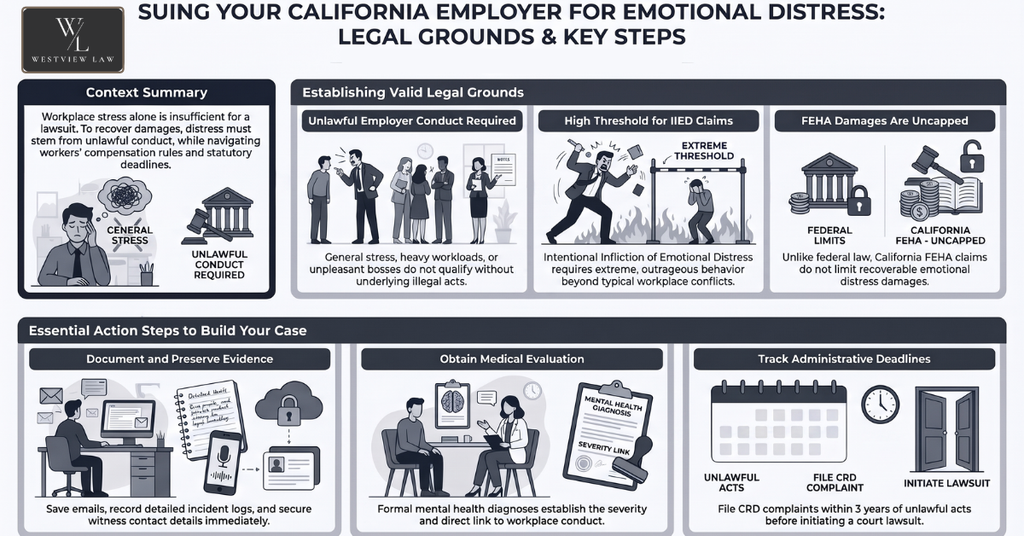
Yes, you can sue your employer in California if that employer has done something wrong that causes you emotional distress like discrimination, harassment, retaliation, or wrongful termination. Workplace stress by itself isn't quite enough. Whether you have a case depends on what your employer did, which laws apply, and the evidence you can gather.
Westview Law represents employees across California in discrimination, harassment, retaliation, and wrongful termination cases. Founding partner David M. Safvati (State Bar #326605) is a Fellow of the American Board of Trial Advocates, and of counsel Taylor Markey (State Bar #319557) previously served as an Assistant Regional Attorney with the U.S. Equal Employment Opportunity Commission. If your employer's conduct is taking a toll on your mental health, request a free, confidential consultation.
This guide explains when you can sue your employer in California for emotional distress and what kind of claims you can pursue along with supporting evidence. It also covers compensation, workers' compensation limits, filing deadlines, and the steps to take now.
When Can You Sue Your California Employer for Emotional Distress?

You may have grounds to sue your California employer for emotional distress if its conduct broke an employment law or meets the elements of a recognized legal claim. Disputes involving discrimination, harassment, retaliation and wrongful termination are the main reasons behind these lawsuits.
Workplace discrimination is the first. If your employer treated you worse because of a protected characteristic such as race, sex, disability, or age, you can seek emotional distress damages as part of a discrimination claim. Workplace harassmentworks in the same way. Sexual harassment, or harassment based on another protected characteristic, can support a claim when it meets the legal standard.
Retaliationis another. If your employer punished you for reporting discrimination, opposing harassment, reporting a workplace violation, or other protected activity, you may have a retaliation claim. It is the same for wrongful terminationalso: emotional distress damages would be part of a claim if you were fired against California law or fundamental public policy.
Finally, serious misconduct can support a separate claim as well. When an employer's conduct is extreme and outrageous and causes severe emotional distress, you may be able to bring an intentional infliction of emotional distress claim, subject to the limits discussed below.
Not every bad experience at work justifies suing. A heavy workload, an unpleasant manager, unfair criticism, or a disagreement with your boss does not by itself create legal liability. The real question is whether your employer violated a legal duty or acted in a way that satisfies a recognized claim. California law regarding workers compensation can also prevent some claims against employers.
If you think your employer's conduct has caused you emotional harm, an employment attorney can tell you whether the facts support a claim and what your options are.
What Types of Emotional Distress Claims Can You Bring Against an Employer in California?
Employees in California have different types of claims they can use to seek compensation for distress caused by their employers. The main routes are intentional infliction of emotional distress, negligence claims where the law allows recovery, and emotional distress damages within a discrimination, harassment, retaliation, or wrongful termination lawsuit.
Intentional Infliction of Emotional Distress
IIED is a tort claim for conduct that is outrageous and extremely offensive which results in very serious emotional distress. Under CACI 1600, the California jury instruction for this claim, you must prove that the employer's conduct was outrageous, that the employer intended to cause emotional distress or acted with reckless disregard of the probability that it would, that you suffered severe emotional distress, and that the conduct was a substantial factor in causing it.
An employer who carries out an extremely abusive campaign against an employee could end up with an IIED claim. Ordinary disagreements, insults, unfair criticism, and even an unjustified firing usually fall short of the "extreme and outrageous" standard.
Workers' compensation exclusivity also matters here. California generally bars employees from suing their employers in tort for emotional injuries that arise out of the normal employment relationship. Whether to pursue a claim under IIED hinges upon the conduct involved and whether any exceptions apply; for example, conduct that also violates FEHA rules.
Negligent Infliction of Emotional Distress
Negligence causing emotional distress means that someone has been harmed emotionally because of carelessness rather than deliberate or reckless actions. California does not recognize negligent infliction of emotional distress as an independent tort. An employee has to prove an ordinary negligence claim instead: a legal duty of care, a breach of that duty, causation, and harm the law allows you to recover for.
Calling an employer's conduct "negligent" or showing that it caused anxiety does not establish liability on its own. The employee still has to fit the facts into a recognized theory of negligence.
Workers' compensation can bar claims of negligence related to workplace injuries as well. The California Division of Workers' Compensation runs a no-fault system that pays benefits for work injuries while limiting employees' ability to sue insured employers over those injuries. Exceptions exist, but they are narrow.
Emotional Distress Damages in Employment Lawsuits
You don't need a separate claim for emotional distress to get compensation for emotional suffering. If your employer's conduct supports an employment claim, you can seek emotional distress damages within a discrimination, harassment, retaliation, or wrongful termination lawsuit.
The FEHA (California's Fair Employment and Housing Act) prevents covered employers from discriminating against their workers based on characteristics that are protected by law. It also forbids harassment targeting people based on legally protected characteristics in any workplace regardless of every size. Violations of Remedies for FEHA result in damages for emotional distress, lost wages, reinstatement and also, if applicable under the law, punitive damages.
The California Civil Rights Department (CRD) enforces those laws. According to the CRD, FEHA's discrimination rules generally apply to employers with five or more employees, while its harassment protections apply even when an employer has fewer than five. That distinction can determine viability of a claim.
To recover from such an incident you usually have to show that there was a legal wrongdoing involved and demonstrate that this wrong had an emotional impact as well. Messages from the workplace, witness statements, personal records, and medical or mental health records all help.
Can You Sue Your Employer for Stress, Anxiety, or Depression Caused by Work?

Yes, if your stress, anxiety, depression, panic attacks, or sleep problems come from unlawful conduct or facts that support a recognized claim. Having these symptoms does not on its own give you grounds to sue. The key thing is what caused them, whether your employer violated the law, and which kinds of remedies are available.
The table below compares common situations and whether each one is likely to support a claim.
| Situation | Can You Sue Your Employer? | What You Should Know |
|---|---|---|
| Stress from a heavy workload | Not necessarily. | A heavy workload, strict deadlines, or regular job stress alone don't typically support a claim. Discrimination, retaliation, or other illegal actions causing the workload could alter that. |
| Anxiety caused by workplace harassment | Potentially, yes. | If the anxiety is due to unlawful harassment based on a protected characteristic, you may have an employment claim and can seek emotional distress damages. |
| Depression following workplace discrimination | Potentially, yes. | If discriminatory treatment violated California employment law and caused emotional harm, you can seek compensation as part of a discrimination claim. |
| Panic attacks following the reporting of workplace misconduct | Potentially, yes. | If your employer retaliated against you for protected activity, you may have a retaliation claim. Evidence linking the retaliation to your symptoms supports a request for emotional distress damages. |
| Sleep disturbances caused by an abusive manager. | It depends. | Sleep problems indicate emotional distress but do not alone prove the employer is liable. What is crucial is the manager's actions and whether they support a valid claim. |
| Psychological injury resulting from work-related circumstances | Workers' compensation may be available. | Workers' compensation can cover qualifying psychiatric injuries that arise out of and in the course of employment, subject to eligibility rules. A separate lawsuit against the employer may be barred by workers' compensation exclusivity. |
Can You Sue If You Never Saw a Therapist?
Yes, potentially. You don't automatically need a formal mental health diagnosis or a history of therapy to pursue every emotional distress claim. You still have to prove the elements of your claim and show the emotional harm you experienced.
Evidence can include notes you write about your symptoms, communications showing actions taken by your boss, witness statements and testimony that show changed in your mental health and daily life. Stronger cases are built with medical records and professional evaluations especially when the employer disputes how serious the distress is.
What Evidence Do You Need to Prove Emotional Distress at Work?
To prove emotional distress at work, you generally need evidence of what your employer did and how that conduct affected you. Exactly what kind of evidence you need depends on the specifics of your claim. But documenting both those things is important for making your case strong.
Claims of very strong emotional distress rely heavily on different pieces of information from those below. Start collecting them as early as you can, since messages get deleted and memories fade.
| Type of Evidence | What to Collect | How It Can Help Your Claim |
|---|---|---|
| Emails and messages | Emails, texts, chat messages, and other communications containing harassment, threats, discriminatory remarks, or signs of retaliation. | This cell shows what your employer said or did and whether that conduct supports a legal claim. |
| Incident records | A dated account of each incident: what happened, who was involved, where it took place, and who saw it. | This cell builds a timeline and shows if the conduct was repeated or part of a pattern. |
| Medical and mental health records | Medical records, mental health evaluations, diagnoses, prescriptions, and treatment notes, where available. | Shows the nature, severity, and length of your distress and its link to events at work. |
| Witness statements | Provide the names and contact details of coworkers or others who observed the conduct or noticed changes in you. | Provides your account of the conduct and its effect on you. |
| Employment records | Performance reviews, disciplinary notices, termination letters, HR complaints, and messages with management. | Shows what your employer did, how you responded, and whether the facts support claims of discrimination, retaliation, or wrongful termination. |
| Personal impact records | Notes on changes in your sleep, daily routine, relationships, concentration, or job performance. | Describe how the distress impacted your daily life. |
How Much Can You Sue Your California Employer for Emotional Distress?
There is no reliable average level of compensation for distress claims against employers in California and no promise of specific amounts that can be made beforehand. The recovery that you receive will depend on the facts of your case such as how bad your suffering was the strength of evidence you bring forth and the relevant laws your claim is brought under. Different outcomes can result for two employees who have committed similar misconduct.
Severity and duration carry the most weight. Longer or deeper distress leads to greater damage and linking up your employer's behavior to your suffering through emails, witness statements, and other incident records makes that connection clearer. Medical and mental health records help show severity, especially for anxiety, depression, sleep problems, or trouble with daily activities. The underlying violation matters too, because discrimination, harassment, retaliation, and wrongful termination claims each have their own elements and remedies.
FEHA claims have two features that impact value. First, FEHA does not cap emotional distress damages. Claims by Federal Title VII are different: Title VII damages cap caps both compensatory and punitive damages at between $50,000 and $300,000 depending on the size of the employer. Second, under Government Code § 12965, a court can award a prevailing FEHA plaintiff reasonable attorney's fees and costs, including expert witness fees.
You can also recover other losses along with damages for emotional distress too. If the unlawful conduct cost you income, you can seek lost wages and other financial losses. Punitive damages are available only when you prove oppression, fraud, or malice by clear and convincing evidence under Civil Code § 3294. They punish especially wrongful conduct rather than repay your losses, and they aren't available in every case.
Keep in mind that the amount you demand, the amount a jury might award, and the amount you finally receive are three different numbers. A settlement reflects the strength of the evidence, the risk of trial, and the cost of continued litigation, so an opening demand is not a prediction of the result. We have another article on how much you can get for suing your employer in California that goes into greater detail about the other types of compensation.
Can Workers' Compensation Prevent You From Suing Your Employer for Emotional Distress?
Yes. California's workers' compensation exclusivity rule can stop you from filing a separate lawsuit for emotional distress caused by a work-related injury. Workers' compensation pays benefits for qualifying work injuries, including some psychiatric injuries, and in exchange limits your right to sue an insured employer in civil court. The rule does not block every employment lawsuit, though. The employer's conduct and the legal basis of your claim decide whether you can pursue compensation outside the workers' compensation system.
Under California Labor Code § 3208.3, generally speaking a psychiatric injury that is compensated must be a diagnosed mental disorder which results in disability or a need for medical treatment. Employment must be the predominant cause, meaning more than 50% of the causation from all sources combined. In most cases you must also have worked for the employer for at least six months, though that requirement doesn't apply when the injury came from a sudden and extraordinary employment condition. The statute also excludes claims substantially caused by lawful, nondiscriminatory, good-faith personnel actions. You can read all this information in the full text of Labor Code § 3208.3.
These rules make it very difficult to get workers' compensation when stress results from normal management decisions. If your employer criticizes your performance, passes you over for a promotion, transfers you, or disciplines you in good faith, the resulting stress may not qualify for psychiatric injury benefits. That changes if the decision was discriminatory, retaliatory against someone, or otherwise illegal.
Exclusivity does not bar claims under laws that create their own remedies. FEHA is an important example. Remedies for violations of FEHA include damages for emotional distress and, if legal standards are met, punitive damages irrespective of whether workers have received compensation through workers compensation programs. California Civil Rights Department has more information on those protections and remedies.
Consider two hypothetical situations. In the first, an employee develops anxiety after a bad performance review and being passed over for a promotion. If the employer acted lawfully and in good faith, exclusivity may bar a separate emotional distress lawsuit. The employee may also be unable to get psychiatric injury benefits, because the claim falls within the exclusion for good-faith personnel actions.
In the second case, an employee develops anxiety because of repeated use of racial slurs by a supervisor and the employer fails to take any action against this. The employee may have a discrimination or harassment claim under California law and can seek emotional distress damages. Whether the employee can also bring a separate tort claim depends on the facts and the applicable legal rules.
How Long Do You Have to Sue Your California Employer for Emotional Distress?

The deadline depends on the legal claim you bring. Discrimination claims, standalone emotional distress tort claims, and some retaliation claims each run on different clocks. Missing any of those deadlines can cause your case to fail even if there's strong evidence.
Under FEHA, employees generally have three years from the date of the alleged unlawful act to file a complaint with the California Civil Rights Department. This covers the discrimination, harassment, and retaliation complaints the CRD handles.
To file a FEHA lawsuit, you generally must first file a complaint with the CRD and get a right-to-sue notice. After the notice issues, you generally have one year from the date of the notice to file your lawsuit complaint process page from CRD explains how to get an immediate right to sue notice that allows you to bypass the investigation process and go straight to court.
Claims can also have shorter deadlines. California has a two year statute of limitations under Code of Civil Procedure § 335.1 covers personal injury claims including distress resulting from intentional infliction of emotion. All retaliation complaints that you file with California Labor Commissioner's Office must be submitted within one year after retaliation occurs. Wrongful termination claims can have different deadlines depending on whether they rest on FEHA, another statute, or a public policy theory.
Don't assume that every case of emotional distress claim has a three year timeframe. The deadline for an administrative complaint is not always the same as the deadline for a lawsuit, and the rules vary by claim and by the date of the injury.
If you've suffered emotional distress because of actions from your employer in California, Westview Law can help you figure out what kinds of claims are open to you, when the deadlines are, and how to protect your rights.
What Should You Do If Your Employer Is Causing You Emotional Distress?
If your boss's behavior impacts your mental health, take some clear steps that protect your health, preserve important evidence and also help you figure out what legal options you have. Work through them in that order.
Step 1: Document Every Incident
Write down each incident that contributes to your distress: the date, time, place, people involved, what happened, and who saw it. Be specific about things like discrimination, threats, or retaliation instead of general impressions. Record the actual words spoken and actions taken.
Step 2: Preserve Relevant Evidence
Keep emails, texts, performance evaluations, disciplinary notices and any other documents that show what your employer has done. Keep copies only of documents you're authorized to access, and don't take confidential company information without permission. If you think your employer may delete messages, note where they're stored so your attorney can advise you on preserving them.
Step 3: Seek Medical or Mental Health Support
If you're struggling with ongoing anxiety, depression, panic attacks or sleep troubles, it's important to speak with a qualified healthcare professional. The treatment helps you recover and records reflect how much and severe your distress was.
Step 4: Evaluate Whether Your Employer's Conduct Violates the Law
Ask whether the source of distress is conduct that may be illegal, like discrimination, harassment, retaliation, or wrongful termination. Ordinary work stress, unfair criticism from bosses, and conflicts with management do not stand alone as reasons for making a claim on their own. The test here is whether your boss has violated some legal duty or has behaved in ways that meet elements for a well recognized type of claim.
Step 5: Consider Reporting the Conduct
You can report this behavior to HR, a supervisor or any other company representative. Make sure you keep copies of any written complaint and the responses to them. Internal reporting is not required before every lawsuit, so consider getting legal advice before you decide how to proceed, especially if you fear retaliation.
Step 6: Check the Applicable Filing Deadlines
Find out which claims may be relevant and whether you need to file an administrative complaint first. FEHA discrimination claims, for example, generally require a CRD complaint within three years of the unlawful conduct. Other claims have different deadlines, so don't assume one time limit covers everything.
Step 7: Consult a California Employment Attorney
After documenting what happened and collecting your evidence, you should speak with an employment lawyer. An attorney can tell you if there is any basis for a claim, help you understand how workers compensation rules influence your options, figure out what damages you can recover and also lay out what comes next.
When Should You Contact a California Employment Lawyer?
If you have ongoing harassment, discrimination, retaliation for reporting some wrongdoing or getting fired after engaging in protected activity, contact an employment lawyer in California. You should also get advice if your employer's conduct has caused serious emotional harm and you believe it may violate California employment law.
A lawyer can review your situation, identify which claims apply, and tell you whether emotional distress damages are available. A lawyer can also help you preserve evidence, track filing deadlines, and assess whether workers' compensation rules or other limits affect your options. Taking action early is important because missing a deadline can render what was valid claim.
If your employer's actions are affecting your mental health, contact Westview Law for a free, confidential consultation. Our lawyers will explain your rights under California employment law and what comes next with your specific case.
Frequently Asked Questions
Employees who are dealing with emotional distress at work tend to ask the same core questions about whether they can sue and what they can recover. The answers below address the most common ones under California law.
Can I Sue My Employer for Emotional Distress Without Being Fired?
Yes. You can sue for emotional distress while you still have your job, as long as your employer's conduct supports a recognized claim. Emotional distress damages can be awarded for unlawful discrimination, harassment, or retaliation even if there is no termination of employment.
Can I Sue My Employer for Emotional Distress Without a Doctor's Note?
Yes. While doctors' notes aren't necessary for every claim about emotional distress, you still need evidence that fits the legal theory and facts involved. Medical records and evaluations of mental health serve to bolster an argument by showing how much distress is severe and by linking that to conduct at work.
Can I Sue My Employer for Yelling at Me or Humiliating Me?
Yelling, humiliating someone, or giving them harsh criticism does not automatically mean you have grounds to sue them. The context, severity, and nature of the conduct can support a claim if it amounts to unlawful harassment, discrimination, retaliation, or other actionable misconduct, such as a hostile work environment based on a protected characteristic.
Can I Sue My Employer for Emotional Distress After Being Wrongfully Terminated?
Yes. If your firing violated California law or a fundamental public policy, you can bring a wrongful termination claim that includes emotional distress damages. Recovery depends on the legal basis for your claim, available evidence, and the circumstances surrounding your dismissal.
Can I Recover Emotional Distress Damages for Workplace Discrimination in California?
Yes. California law allows employees to recover emotional distress damages when they prove a discrimination claim under the Fair Employment and Housing Act (FEHA). It varies based on facts involved, evidence showing emotional harm and the legal requirements related to the claim.
Legal Disclaimer: This article provides general information on California employment law and does not constitute legal advice. Reading this article does not create any attorney-client relationship with Westview Law. Every case is unique and the outcome for a claim about emotional distress depends on specifics of that case, applicable law, and evidence that exists.