


Workplace retaliation occurs when an employer punishes an employee for engaging in a legally protected activity, such as filing a complaint, reporting harassment, or cooperating with a workplace investigation. That punishment can take many forms, including a sudden demotion, a cut in hours, a hostile shift change, or outright termination. An experienced employment lawyer helps you identify whether what you're experiencing constitutes retaliation, preserves the evidence that matters, and pushes back through the right legal channel before deadlines run out.
Workplace retaliation can have serious consequences, but employees have legal protections when they report discrimination, harassment, wage violations, or other unlawful conduct. At Westview Law, our employment attorneys help workers understand their rights and assess whether an employer's actions may constitute unlawful retaliation. We are committed to providing straightforward legal guidance backed by current employment laws and a careful review of the facts. Contact us today for a confidential consultation to discuss your situation and learn about your legal options.
In the sections below, we'll cover how retaliation is defined, the federal and state laws that protect you, real-world examples we see, the industries where claims cluster, prevention strategies for employers, and how Westview Law can help.
Understanding Workplace Retaliation
Retaliation in the workplace is any adverse action an employer takes against an employee for engaging in protected activity. Protected activity is the legal term for things like filing a complaint about discrimination, reporting sexual harassment, cooperating in an employer investigation, requesting a religious practice accommodation, raising workplace safety concerns, or participating in an Equal Employment Opportunity Commission (EEOC) charge brought by a coworker.
Complaints involving workplace discrimination are a common form of related protected activity. The key question courts ask is whether a reasonable employee would have been dissuaded from making or supporting a complaint by what the employer did. If the answer is yes, you may have a retaliation claim.
It helps to separate retaliation from other workplace misconduct. Plain discrimination targets you because of who you are, your race, sex, age, disability, religion, or another protected category.
Retaliation targets you because of what you did. You spoke up, filed a complaint, reported misconduct, helped someone else file, or engaged in another protected activity. A single situation can involve both and often does. An employee who reports sexual advances from a supervisor and is then written up for attitude problems two weeks later is dealing with alleged harassment and retaliation at the same time.
What Are the Forms of Retaliatory Actions?
Retaliation takes many forms, and the obvious ones are only part of the picture. Termination is the clearest example. So is a demotion or being passed over for a promotion you were on track for. A salary reduction, a transfer to a less desirable position, a sudden cut in hours, or being moved off of important meetings and high-profile projects can all qualify as adverse action under federal law. Depending on the circumstances, such actions may be considered retaliatory.
Less obvious patterns matter just as much. A previously strong employee suddenly receiving unjustified negative performance evaluations after filing a complaint. False rumors begin circulating about a worker who reported a safety violation. A supervisor freezing someone out of training, mentoring, or client contact. A hostile work environment can build week by week until the employee feels forced to resign, a situation the law calls constructive discharge. None of these need to come with a dramatic firing to count.
Courts look at the cumulative picture and the timing. If working conditions noticeably worsened after you engaged in protected activity, that pattern can support a claim, even when no single action looks like a smoking gun on its own.
What Is the Legal Framework for Retaliation Claims?

Several federal statutes prohibit workplace retaliation, and most overlap. Title VII of the Civil Rights Act is the backbone. It bars retaliation against employees who oppose employment discrimination based on race, color, religion, sex, or national origin, or who participate in an EEOC proceeding.
The Americans with Disabilities Act and the Age Discrimination in Employment Act carry their own anti-retaliation provisions. The Fair Labor Standards Act protects workers who report wage and hour violations or help uncover potentially discriminatory wages.
The Occupational Safety and Health Act protects employees who raise occupational safety concerns. And the Whistleblower Protection Act covers federal employees who disclose illegal practices, with parallel whistleblower protections under more than twenty other federal statutes administered by the Department of Labor.
The Equal Employment Opportunity Commission is the federal agency that enforces most workplace anti-retaliation laws. When you file a charge with the EEOC, the agency investigates, can attempt conciliation, and in some cases sues on your behalf. According to the EEOC's FY 2024 enforcement data, retaliation was the most frequently alleged basis for discrimination charges, accounting for 42,301 of the 88,531 charges filed that year. The agency reported that retaliation has remained the most commonly filed charge category for 17 consecutive years.
State-Specific Regulations
State laws often go further than federal protections. Many states extend coverage to smaller employers that fall below the federal employee-count threshold, recognize other related protected activity categories, lengthen the deadline for filing a complaint, or allow larger damages.
Some states have separate whistleblower statutes covering employees who report violations of state law, public health and safety issues, or potential fraud against state programs. In some jurisdictions, certain protections may also extend to job applicants.
Because the rules vary so much from one jurisdiction to another, talking with local employment counsel matters. A claim that looks weak under federal law might be strong under your state's statute, and the filing deadlines can be as short as 180 days. Our team at Westview Law works through both layers, state and federal, to make sure no protection gets left on the table.
Lawful Management Action vs. Possible Retaliation
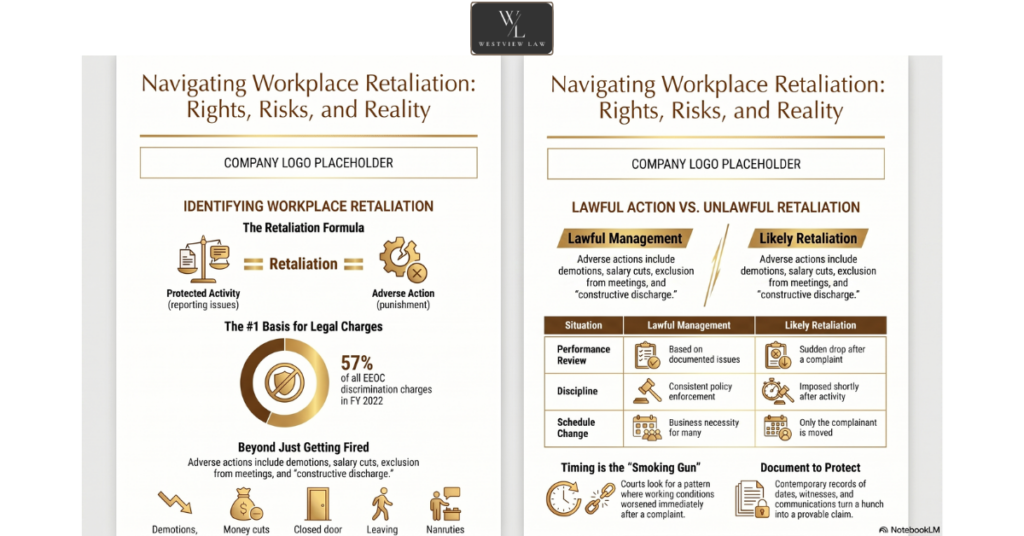
Not every negative action by an employer is illegal retaliation. Employers can still discipline employees, conduct performance reviews, make scheduling changes, and enforce workplace policies when there is a legitimate business reason for doing so. The difference often comes down to the timing and circumstances, as well as whether the action occurred after an employee engaged in protected activity. The table below highlights some key distinctions between lawful management decisions and actions that may raise concerns about workplace retaliation.
| Situation | Usually Lawful | May Be Retaliation |
|---|---|---|
| Performance review | Based on documented performance issues | Sudden negative reviews after a complaint |
| Schedule change | Business necessity affects multiple employees | Only the complaining employee is reassigned |
| Discipline | Supported by consistent policy enforcement | Imposed shortly after protected activity |
| Termination | Legitimate business reason with documentation | Closely follows a protected complaint |
What Are the Consequences of Retaliation for Employers?
The financial exposure for an employer that engages in retaliation is significant. A successful claim can include back pay for lost wages from the date of the adverse action, front pay where reinstatement isn't workable, compensatory damages for emotional distress and reputational harm, and punitive damages in cases involving malice or reckless indifference.
Attorney's fees and costs are recoverable under most of the federal statutes. Courts can also order injunctive relief, reinstating the employee, expunging discipline from the personnel file, or requiring the company to implement anti-retaliation training. In some cases, the dispute may result in a lawsuit.
The potential for agency involvement is just as real. The EEOC can pursue enforcement actions, issue findings of cause, and litigate in federal court. The Department of Labor can investigate FLSA and OSHA whistleblower complaints separately.
According to the EEOC's FY 2022 data, retaliation was alleged in 41,900 of the 73,485 discrimination charges filed that year, accounting for approximately 57% of all charges. Retaliation has remained the most frequently alleged basis for EEOC charges for many years. That trend is also seen in federal case law, where employees can win retaliation claims even if they cannot prove the underlying discrimination claim, as long as they engaged in protected activity and suffered unlawful retaliation for doing so.
Beyond the legal bill, there's the operational damage. A public retaliation case erodes overall employee morale, makes recruiting harder, and signals to other employees that reporting issues isn't safe. The negative impact can extend to employee well-being, productivity, and company culture. As one of our employment attorneys puts it, "The companies that get sued for retaliation usually aren't the ones with the worst original problem. They're the ones that punished someone for raising it."
Examples of Workplace Retaliation
Consider a composite example we often see. An employee reports to HR that her direct supervisor has been making unwanted sexual advances. The employer investigation drags on for weeks. During that time, she's pulled off her two largest accounts, been excluded from important meetings, and given a sudden negative performance review that contradicts three years of strong evaluations. She's not fired. She doesn't have to be. The pattern itself, including the timing, changes in working conditions, and sidelining, forms the basis of the retaliation claim.
A second pattern we see regularly involves safety reporting. A warehouse worker reports a forklift-related violation to a manager and then to OSHA. Within a month, his shift is changed to a less desirable schedule, his overtime is cut, and a supervisor begins documenting minor infractions that no one else gets written up for. When he eventually resigns because the working conditions have become unbearable, the law may treat that as constructive discharge, a forced resignation that counts as a termination for legal purposes.
A third version shows up around immigration status. A worker raises concerns about unpaid overtime, and the employer responds by suddenly requiring re-verification of work authorization documents, even though nothing about the worker's status has changed. Using immigration status as a weapon against employees who file wage complaints is a well-documented form of retaliation, and the FLSA protects workers regardless of immigration status when they assert their rights.
Steps to Take After Experiencing Retaliation at Work
Experiencing retaliation at work can be stressful and confusing. Taking the right steps early can help protect your rights and preserve important evidence. Here is a simple step-by-step approach to follow.
Step 1. Document What Happened: Write down each incident as soon as possible. Include dates, times, locations, and the names of anyone involved.
Step 2. Save Important Evidence: Keep copies of emails, text messages, performance reviews, and other relevant documents. Store them somewhere safe and organized.
Step 3. Review Company Policies: Check your employee handbook or workplace policies. Look for information about reporting retaliation and filing complaints.
Step 4. Report the Retaliation: Follow your employer's reporting procedures if you feel comfortable doing so. Submit complaints in writing whenever possible.
Step 5. Keep a Record of Your Complaint: Save copies of all reports, responses, and communications related to your complaint. This can help create a clear timeline of events.
Step 6. Identify Potential Witnesses: Make note of coworkers or others who may have witnessed what happened. Their observations may be helpful later.
Step 7. Avoid Deleting Anything: Keep all workplace communications and records related to your employment. Even small details may become important.
Step 8. Speak With an Employment Lawyer: A lawyer can explain your rights and review your situation. They can also help you understand whether additional legal action may be available.
Step 9. Monitor Ongoing Workplace Conduct: Continue documenting any new incidents or changes in treatment. Consistent records can help show patterns of behavior.
Step 10. Take Care of Yourself: Workplace retaliation can take an emotional toll. Reach out to trusted friends, family members, or professional support if needed.
Common Industries with High Retaliation Claims

Retaliation claims show up across every sector, but a handful of industries generate them at higher rates. Healthcare consistently ranks near the top. Nurses, aides, and technicians who report patient safety issues, billing fraud, or harassment by physicians often face pushback.
Retail and hospitality are close behind, driven by high turnover, frontline supervision with minimal HR training, and large numbers of younger or hourly workers who are unfamiliar with their rights. Warehousing and logistics, especially in the e-commerce boom, have produced a steady stream of safety-related whistleblower claims.
Construction and agriculture round out the list. Both rely heavily on subcontracting, both have significant safety reporting obligations under the Occupational Safety and Health Act, and both employ workers who may feel particularly vulnerable to a manager who threatens their job after a complaint.
The thread tying these industries together is structural. High turnover means supervisors aren't always trained on what constitutes retaliation. Frontline managers often handle complaints informally without a clear complaint process. Pressure around immigration status, language barriers, and safety reporting culture make workers hesitant to come forward and easier to push out when they do. That mix is where retaliation claims grow.
How to Prevent Retaliation in the Workplace
Most retaliation claims are preventable. The companies that avoid them treat anti-retaliation as a working system, not a line in a handbook. Here's a practical sequence we recommend to employer clients, along with proactive steps that help reduce the risk of retaliation claims.
- Write a clear anti-retaliation policy and put it in the employee handbook: Spell out what protected activity means, name examples of prohibited negative action, and identify at least two reporting channels, such as a manager and an HR or compliance lead, so employees aren't forced to report to the person they're complaining about.
- Train every manager and supervisor annually: First-line supervisors are where most retaliation actually happens. Train them on what counts as adverse action, on the timing patterns that look retaliatory in litigation, and on what to do when an employee files a complaint about someone they manage.
- Build a documented complaint process: Every formal complaint should get a written intake, an assigned investigator, a defined timeline, and a closing letter to the complainant. Workplace investigations that drag on without communication are the breeding ground for retaliation claims.
- Carefully separate the complainant from the accused while the investigation runs: Don't move the person who complained. Move the accused, or adjust reporting lines, so the complainant isn't punished for speaking up.
- Audit personnel decisions in the six months after a complaint: Before any discipline, demotion, transfer, or termination touches an employee who recently engaged in protected activity, have a second set of eyes, HR or counsel, review the documentation. This single step catches the majority of avoidable claims.
- Close the loop with the complainant: Tell them, in writing, what was investigated and what was done. Silence after a complaint is one of the most common triggers for a follow-on retaliation claim.
How Can Employees Empower Themselves Against Workplace Retaliation?
Workers protect themselves by knowing what's covered and what isn't. Filing a complaint about discrimination, sexual harassment, wage theft, or a possible violation of safety law is protected. So is participating in an employer investigation, refusing to participate in illegal practices, or supporting a coworker's claim. Employers that encourage employees to raise concerns early and educate employees on the channels available tend to see fewer formal disputes overall.
If you're concerned about retaliation, document everything as it happens. Keep copies of performance reviews, emails, schedules, and any communications about your complaint, ideally on a personal device rather than a work account. Note dates, times, witnesses, and specific comments. That contemporaneous record is what turns a hunch into a provable claim, and it's the single most useful thing you can do before taking legal action.
How Westview Law Can Help If You've Faced Retaliation in the Workplace
Our employment law practice represents both employees facing retaliation and employers building defensible compliance systems. For employees, we evaluate the timing and pattern of adverse action, preserve evidence, handle the EEOC charge or state agency filing, negotiate with the employer's counsel, and litigate when the case needs to go further. For employers, we draft anti-retaliation policies, train management, audit pending personnel decisions, and represent the company when a charge is filed.
Seek legal advice quickly. Most federal retaliation claims have an 180 or 300-day deadline to file an EEOC charge, depending on whether your state has a parallel agency. State law claims often have their own, shorter deadlines. Waiting is the single most common reason a strong case becomes a weak one.
Without naming specific clients, the outcomes our team pursues fall into a few categories. For wrongfully terminated employees, we pursue reinstatement, back pay covering lost wages, and front pay where the relationship can't be repaired. For workers still on the job who've faced demotion or salary reduction, we negotiate corrective action and damages, often without litigation.
Where the employer won't move, we file suit and have taken retaliation cases to jury verdict. These are representative of the types of outcomes the firm pursues. Every case turns on its own facts, and past results do not guarantee future outcomes.
Have You Faced Workplace Retaliation?
Workplace retaliation is illegal under federal and state law when an employer takes adverse action against an employee for engaging in protected activity, such as filing a complaint, reporting harassment or discrimination, raising safety concerns, or helping a coworker do the same.
Adverse action covers far more than termination. Demotion, salary reduction, transfer to a less desirable position, exclusion from important meetings, false rumors, and a hostile work environment all qualify when the timing and pattern point to retaliation. If any of that sounds familiar, talk to a lawyer before deadlines start running.
Have you been written up, demoted, passed over for opportunities, or fired shortly after speaking up at work? Those actions may be more than a coincidence. At Westview Law, our employment attorneys in California help workers determine whether they have been subjected to unlawful workplace retaliation and what steps they can take next. Contact us today for a confidential free consultation and get clear answers about your rights.
Frequently Asked Questions
This FAQ section answers common questions about workplace retaliation. It explains what retaliation looks like, employee rights, and the steps workers can take if they believe they have been treated unfairly.
What Is Retaliation in the Workplace?
Workplace retaliation happens when an employer takes negative action against an employee for engaging in a protected activity. Examples include reporting discrimination, filing a complaint, or participating in a workplace investigation.
What Are Examples of Retaliation in the Workplace?
Retaliation can include termination, demotion, reduced hours, unfair discipline, or exclusion from important projects. It can also involve less obvious actions, such as increased scrutiny or changes in job duties.
How Is Retaliation in the Workplace Illegal?
Federal and state laws protect employees from retaliation when they exercise their workplace rights. Employers generally cannot punish workers for reporting unlawful conduct or participating in protected activities.
What Should I Do if I Believe I Am Experiencing Retaliation in the Workplace?
Keep records of what happened and save any relevant emails, messages, or documents. Report the issue according to your employer's policies and consider speaking with an employment lawyer about your options.
How Can Westview Law Help With Cases of Retaliation in the Workplace?
Westview Law can review your situation and explain your legal rights. The firm can also help with claims, investigations, negotiations, and other employment-related matters.
Disclaimer: This article is for general informational purposes only and does not constitute legal advice. Reading this content or contacting Westview Law does not create an attorney-client relationship. If you believe you have experienced retaliation in the workplace, consult a qualified employment attorney about your specific situation.