


Workplace retaliation in California happens when your employer punishes you for exercising a legal right. That might be reporting harassment, filing a wage complaint, asking for a disability accommodation, or taking part in an investigation. If you think it is happening to you, write down what happened, save your emails and records, and talk to an employment lawyer before you resign or sign anything.
Westview Law PC represents employees, not the companies they work for. Taylor Markey, of counsel at the firm, served as an Assistant Regional Attorney at the U.S. Equal Employment Opportunity Commission, where she led systemic discrimination and retaliation litigation before bringing that experience to the workers’ side. Founder David Safvati was named to Super Lawyers’ Southern California Rising Stars from 2022 through 2024 and earned a place on Best of the Bar’s Top 100 Verdicts in California in 2024. If your employer punished you for speaking up, contact us today for a free case review.
In this blog, we will cover what workplace retaliation is, the federal and California laws that ban it, how to spot the signs, how to prove a claim, and what to do if it happens to you.
What Is Retaliation in the Workplace?

Retaliation occurs when an employer punishes an employee for protected activity. Protected activity is broader than most people expect. It covers filing a discrimination or harassment complaint. It covers taking part in a workplace investigation or reporting unsafe working conditions. It covers asking why your hours were cut or why your check came in under minimum wage.
It covers reporting a possible violation to a government agency. And you do not have to be right about the violation. Under California law, you need a reasonable, good-faith belief that something illegal happened.
The punishment does not have to be a firing. A demotion counts. So does a pay cut, a move to a worse position, a sudden schedule change, being dropped from training opportunities, a performance review that turns negative out of nowhere, or a supervisor spreading rumors about you.
The legal standard comes from the U.S. Supreme Court in Burlington Northern v. White. It asks whether the employer’s action might have talked a reasonable employee out of making or supporting a complaint. Petty slights and personality clashes do not clear that bar. A pattern that quietly makes your job harder usually does.
Retaliation claims are not unusual. Workers filed 42,301 retaliation charges with the Equal Employment Opportunity Commission in fiscal year 2024, out of 88,531 total charges of discrimination received that year. That is close to half of everything the agency takes in. So if you feel like your complaint painted a target on your back, you are describing the single most common claim the EEOC sees.
Why Is Retaliation a Concern for Employees and Employers?
For the employee, the damage is immediate and personal. Pay cuts and lost hours hit the household budget. A demotion can undo years of work. Most people who report harassment or discrimination spend weeks deciding whether to say anything at all. When the employer punishes them for it, everyone else is watching. Morale drops. People stop reporting problems, and the company loses the early warnings it needs.
For the employer, the legal implications are serious. California FEHA claims carry no damages cap, unlike federal Title VII and ADA claims, which are capped between $50,000 and $300,000 depending on company size. A whistleblower claim under Labor Code section 1102.5 can add a civil penalty of up to $10,000 per employee per violation, paid to the employee, plus attorney’s fees. Punitive damages are available where an employee proves malice, oppression, or fraud by clear and convincing evidence.
The damage to workplace culture is harder to measure but easy to feel. Watch a colleague get punished for filing a complaint, and you learn to keep your head down. Turnover climbs. The strongest performers leave first because they have somewhere else to go.
Word travels, too, and a company known for punishing complaints has a harder time hiring. Employers who investigate honestly and protect the people who speak up avoid nearly all of this. Prevention costs far less than defending a claim.
Clear policies help. Spell out what retaliation is, and tell employees how to report it safely. Then train everyone on those rules, managers included, so the whole staff can recognize retaliatory behavior when it starts.
How to Recognize the Signs of Retaliation
Overt retaliation is easy to name. You report a manager for harassment, and you are fired that week or written up for poor work performance after four years of strong reviews.
Subtle retaliation is far more common and much harder to prove. Your duties get hollowed out. The meetings you used to run happen without you. A supervisor starts papering your file with small mistakes that were never an issue before. The schedule shifts to hours that do not work for your family. On its own, none of it looks like much. Line up six months of it, and the pattern jumps out.
What Are Common Scenarios That Lead to Retaliation?
Some situations set this off more often than others. Reporting discrimination or harassment is the most common trigger, especially when the person you reported is the one handing out your assignments.
Whistleblowing on illegal activities is another, whether you reported to a manager with authority to fix it or to an outside agency. Filing a complaint or a lawsuit against the employer, cooperating with an investigation, requesting an accommodation, or joining a co-worker’s wage claim all count as protected activity.
Timing tells you a lot. When the discipline lands weeks after your complaint and nothing else in your performance changed, that closeness in time is evidence. In wage and hour cases, California goes further: Labor Code section 98.6 creates a rebuttable presumption of retaliation when an employer punishes an employee within 90 days of protected activity.
Retaliation aimed at immigration status is also unlawful. Labor Code section 1019 makes it an unfair immigration-related practice to threaten to report a worker or their family to immigration authorities because they exercised a labor right.
What Are the Federal Laws Protecting Against Retaliation?

Federal protection comes from the statutes the EEOC enforces. Title VII of the Civil Rights Act covers race, color, religion, sex, and national origin and bars punishing anyone who opposes discrimination or participates in an investigation.
The Americans with Disabilities Act protects workers who request accommodations or report disability discrimination, and the Age Discrimination in Employment Act does the same for workers 40 and older. The Fair Labor Standards Act, the Family and Medical Leave Act, and OSHA add their own anti-retaliation rules for wages, leave, and unsafe working conditions.
The Equal Employment Opportunity Commission is where a federal claim starts. You file a charge, the agency can investigate, attempt settlement, or issue a Notice of Right to Sue, and only then can you file most federal lawsuits in court.
The deadline is 180 days from the retaliatory act, extended to 300 days in California because the state agency covers the same conduct. Once the right-to-sue notice arrives, you have 90 days. Federal sector employees follow a separate track and must contact an agency EEO counselor within 45 days.
One thing to know before you rely on federal law alone: in University of Texas Southwestern Medical Center v. Nassar, the Supreme Court held that a Title VII retaliation claim requires but-for causation. Showing that your complaint was one factor among several is not enough under that statute.
“At the EEOC, I saw the same pattern from the inside over and over,” says Taylor Markey, of counsel at Westview Law PC. "The employer never writes down the real reason. What sinks them is the paper trail they created afterward, the review that suddenly turns negative, and the policy applied to one person and nobody else. That is why we tell people to collect documents early, before anyone knows they have talked to a lawyer."
What Are the State-Specific Laws and Protections Against Workplace Retaliation?
California gives employees more room than federal law does. FEHA, at Government Code section 12940(h), makes it unlawful to retaliate against someone who opposed discrimination or harassment or filed a complaint. It applies to employers with five or more employees, and harassment provisions reach employers with even one.
Complaints go to the California Civil Rights Department, which was renamed from the DFEH in July 2022. You have three years to file the administrative complaint, then one year from the right-to-sue notice to file suit.
Beyond FEHA, several Labor Code sections do specific work. Section 1102.5 protects whistleblowers who report a suspected violation to a government agency or internally to someone with authority to correct it, and it generally lets an employee go straight to court without exhausting an agency process first.
Sections 6310 and 6311 cover health and safety complaints. Section 98.6 covers wage claims and complaints to the Labor Commissioner. Each has its own deadline, and they do not run together, which is one reason people lose otherwise strong cases. The practical differences between the two systems matter when you decide where to file. The table below compares the tradeoffs an employee weighs in a California retaliation claim.
| Factor | California (FEHA / Labor Code) | Federal (Title VII / ADA / ADEA) |
|---|---|---|
| Employer size threshold | 5+ employees for FEHA; 1+ for harassment | 15+ for Title VII, ADA; 20+ for ADEA |
| Agency | Civil Rights Department (formerly DFEH); Labor Commissioner for wage claims | Equal Employment Opportunity Commission |
| Deadline to file with the agency | 3 years for a CRD complaint | 180 days, extended to 300 days in California |
| Deadline to sue after right-to-sue notice | 1 year | 90 days |
| Must you exhaust the agency process first? | Yes for FEHA; generally no for Labor Code section 1102.5 | Yes for Title VII, ADA, and ADEA claims |
| Damages cap | None under FEHA | Combined compensatory and punitive capped at $50,000 to $300,000 by employer size |
| Extra penalties | Up to $10,000 per violation to the employee under section 1102.5 | Liquidated damages under ADEA and EPA |
How to Prove Retaliation in the Workplace
Every retaliation claim comes down to three elements: you engaged in protected activity, the employer took an adverse action against you, and the two are connected. Here is how to build that, step by step.
Step 1: Write Down the Timeline While It Is Fresh
Note the date you complained, who you told, and exactly what you said. Then log every change that followed, with dates, because review timelines are usually the strongest evidence in the case.
Step 2: Collect documents before anything changes.
Save performance reviews, emails, texts, schedules, pay stubs, and the complaint itself to a personal account, not a work device. Employers can cut off system access the day they terminate someone, and documents you did not keep are documents you cannot use.
Step 3: Pin Down Who Knew About Your Protected Activity
A decision-maker cannot retaliate for something they did not know about, so identify who was told and when. Forwarded emails and HR intake notes often settle this question.
Step 4: Compare How Other Employees Were Treated
Look for co-workers who did the same thing you were disciplined for and faced nothing. Disparate treatment is one of the clearest ways to show the employer’s stated reason is a cover story.
Step 5: Track the Employer’s Explanations
Write down every reason the company gives for the demotion, the write-up, or the firing. Shifting explanations, or a reason that contradicts your own file, are classic signs of pretext under the McDonnell Douglas framework California adopted in Guz v. Bechtel.
Step 6: Report Through the Right Channel and Keep the Receipt
File with HR in writing, and with the Civil Rights Department, the EEOC, or the Labor Commissioner as your situation requires. Ask for a copy of everything you submit and note the date you filed it.
Step 7: Bring It to Employment Lawyers Early
Westview Law PC reviews the timeline, identifies which statute gives you the strongest claim and the longest deadline, and preserves evidence through formal legal channels before it disappears. That last part is difficult to do on your own once you are out of the building.
Recognizing Patterns of Retaliation
Single incidents rarely win a case. Patterns do. Watch for changes in job duties or treatment that arrived after you spoke up: accounts reassigned, a title that stayed the same while the work shrank, a manager who stopped answering your messages, or a shift to a less desirable position dressed up as a business decision. Write each one down with a date. What feels like a run of bad luck often reads very differently on a one-page timeline.
Performance reviews deserve close attention after a complaint. Pull your last few reviews and compare them line by line to the one that came after you filed. If the scores dropped without a single documented incident behind them, or the criticism suddenly turns vague, that gap is worth showing a lawyer. Keep an eye on the small stuff too, like training opportunities you stopped being offered and projects that quietly moved to someone else. Retaliation rarely announces itself.
What Tools and Resources Are Available for Employees Facing Retaliation?

Start with HR, but use it deliberately. Put your complaint in writing so a record exists, keep it factual, and skip the commentary about personalities. Say what happened, when it happened, who was there, and what you want fixed. Email it or send it through the company’s reporting system so you have a timestamp, and keep a copy somewhere you will still have access to after you leave.
Government agencies are the next layer, and each one handles something different. The Civil Rights Department takes FEHA discrimination, harassment, and retaliation complaints. The Labor Commissioner’s Office handles wage claims and retaliation complaints tied to them.
The EEOC handles federal claims, and Cal/OSHA takes complaints about unsafe working conditions. Filing with one agency does not always preserve your rights under another, so check the deadlines that apply to your specific claim.
Legal counsel is where the pieces come together. An employment lawyer can tell you within one conversation whether the facts support a retaliation complaint, which forum fits, and what your case is realistically worth.
What Are Examples of Retaliation in the Workplace?
Real examples of workplace retaliation look ordinary from the outside. A warehouse worker reports that a supervisor is skipping meal breaks for the whole crew, and two weeks later his shifts drop from five days to two. A nurse files a complaint about racist comments from a charge nurse, and her next review, the first negative one in six years, cites an “attitude problem” with no incidents attached.
An accountant reports suspected billing fraud to a vice president and is moved off client work into a windowless data-entry role at the same salary. Same title, same pay, career over.
For example, Maria, an office manager in Los Angeles, reports to HR that her director made repeated comments about her pregnancy. HR opens an investigation. Three weeks later, Maria is written up for tardiness on days she has time-stamped badge records for, removed from the hiring committee she had run for two years, and told her role is being restructured. She saved the HR complaint, the badge logs, her prior reviews, and the email removing her from the committee. Those four documents establish protected activity, adverse action, and timing, which is exactly the framework a court applies.
What Are the Laws That Protect Employees Against Retaliation in the Workplace?
Several laws overlap here, and most employees are covered by more than one. On the federal side, Title VII, the ADA, and the ADEA prohibit retaliation for opposing discrimination or participating in an investigation, while the FLSA, FMLA, and OSHA protect complaints about wages, leave, and safety.
In California, FEHA section 12940(h) covers discrimination and harassment complaints, Labor Code section 1102.5 protects whistleblowers, section 6310 protects health and safety reports, and section 98.6 protects wage complaints and workers who contact the Labor Commissioner.
Enforcement runs through agencies and the courts. The EEOC investigates federal charges, and the Civil Rights Department handles FEHA complaints, with both able to issue a right-to-sue notice that lets you file in court.
The Labor Commissioner’s Office investigates wage-related retaliation complaints directly and can order reinstatement and back pay. Section 1102.5 whistleblower claims generally go straight to court without an agency step. Remedies across these laws include back pay, front pay, emotional distress damages, civil penalties, attorney’s fees, and punitive damages where the conduct was bad enough.
Are You Facing Retaliation in the Workplace?
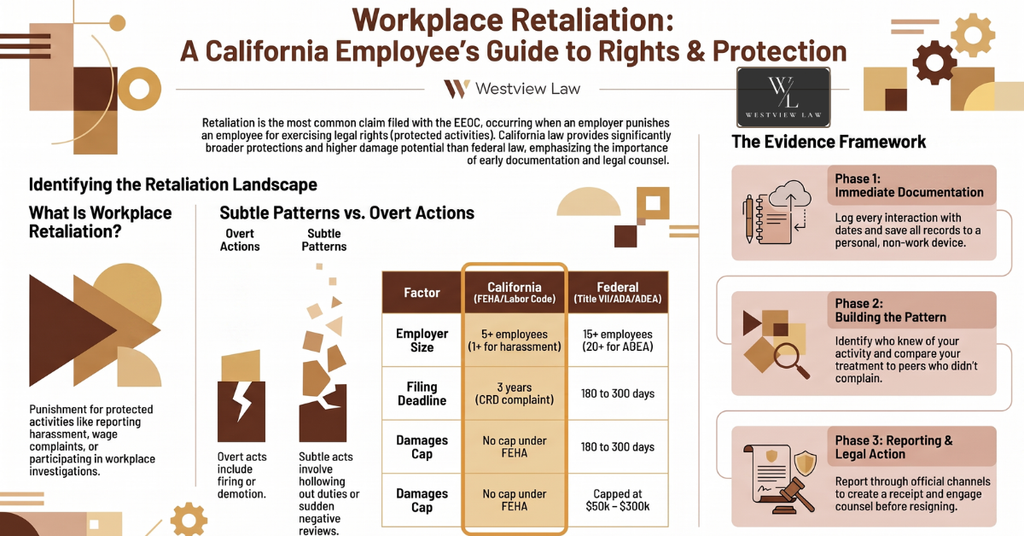
Retaliation occurs when an employer punishes you for protected activity, and the punishment counts, whether it is a firing, a demotion, a pay cut, or a quiet slide into a less desirable position. California law protects you at a lower employer-size threshold than federal law, gives you three years to file a FEHA complaint, and puts no cap on damages. Proving it comes down to documentation, timing, and how the employer treated everyone else.
If any of this sounds like your job right now, talk to someone before the deadlines close. Westview Law PC represents employees across California from 1880 Century Park East, Suite 1100, Los Angeles, CA 90067, and the firm built its name on trying cases rather than avoiding them. Contact us for a free case review, bring your timeline and whatever documents you have, and find out where you stand.
Frequently Asked Questions
These are common questions from workers who believe their employer punished them for exercising a legally protected right. Understanding the potential consequences and documenting what happened can be an effective way to protect your rights.
What Is Considered Retaliation in the Workplace?
Workplace retaliation occurs when an employer takes adverse action because an employee engaged in protected activity. This can include threats, discipline, reduced hours, or other actions that could discourage an employee from engaging in related protected activity.
What Are Examples of Retaliation in the Workplace?
Examples include demotion, reduced pay or hours, negative performance reviews, discipline, threats, or termination after protected activity. These actions can have a negative impact on the employee and may constitute retaliation when they are connected to protected activity.
How Can Employees Protect Themselves From Retaliation in the Workplace?
Employees can help prevent workplace retaliation by documenting protected activity and keeping records of subsequent workplace actions. Reporting concerns through appropriate channels is an effective way to create a clear timeline if retaliation occurs.
What Should an Employee Do if They Experience Retaliation in the Workplace?
Employees should document the conduct, preserve relevant evidence, and consider reporting the retaliation through the appropriate agency or internal process. Taking these steps can help establish the connection between the protected activity and the employer's actions and address potential consequences early.
Disclaimer: This article is provided for general informational purposes only and does not constitute legal advice. Reading it does not create an attorney-client relationship with Westview Law PC. Employment laws change and every situation turns on its own facts, so you should consult a licensed California attorney about your specific circumstances. Prior results do not guarantee a similar outcome.