


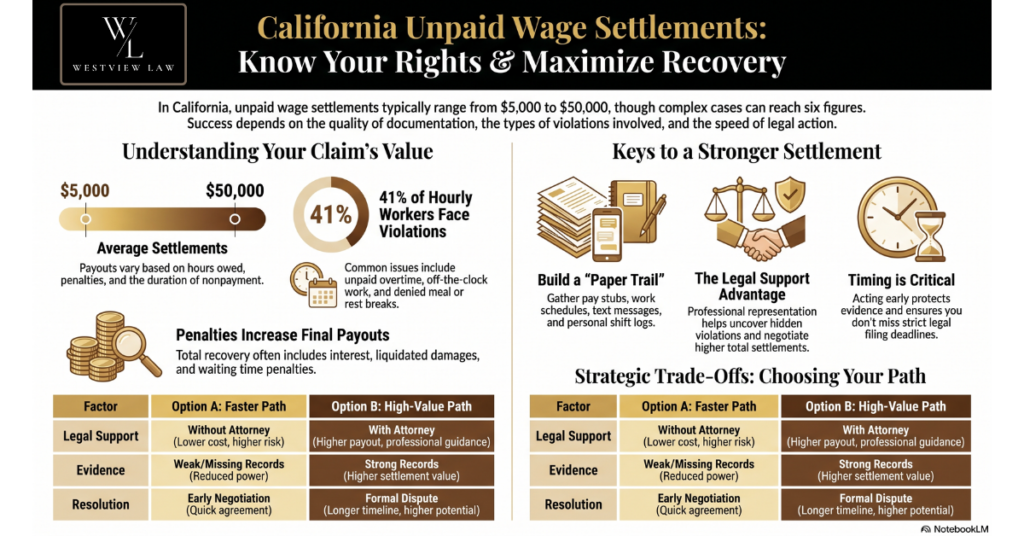
The average settlement for unpaid wages in California typically ranges from $5,000 to $50,000, depending on factors like hours owed, penalties, and employer conduct. Smaller claims may settle for a few thousand, while cases involving multiple violations or long periods of nonpayment can reach six figures. Every case is different, but strong documentation, wage and hour evidence, clear timesheets, and proof of withholding pay and legal support often increase the final payout.
Are you wondering what a fair settlement for unpaid wages in California really looks like? At Westview Law, we bring over four decades of combined experience helping employees recover unpaid wages and compensation they are rightfully owed. We understand how to assess claims, uncover wage violations, and build strong cases that maximize recovery. If you think your employer has failed to pay you properly, contact us today and let us help you take the next step with confidence.
In this blog, we will break down the typical settlement amounts for unpaid wages in California, the factors that influence payouts, and what you can expect when pursuing a claim.
What Is the Average Settlement for Unpaid Wages in California?
Many workers ask what the average settlement for unpaid wages in California looks like, but there is no single number that fits every case. Settlements usually depend on how much pay was missed, how long the problem lasted, and whether overtime pay, meal breaks, or rest breaks were also denied. Some cases are small, while others grow larger over time. The main purpose of a settlement is to recover wages that should have been paid in the first place.
The average settlement for unpaid wages refers to the range of amounts that workers often receive when their claims are resolved. Some people may recover a few hundred dollars, while others receive thousands when penalties, liquidated damages, and interest are added. Understanding settlement options is important because not every case ends the same way. Some resolve quickly through negotiation, while others may require formal legal action.
California provides employees with strong protections when wages are withheld or underpaid. Workers may be entitled to unpaid earnings, missed overtime, waiting time penalties, and other compensation depending on the facts of the case. These protections may involve federal minimum wage rules, local minimum wage ordinances, state minimum wage requirements, and other labor laws that help pay workers fairly.
California and federal laws may both apply depending on the claim, helping employees respond with confidence. Consulting a lawyer and taking action early often improves the chances of a better outcome.
How Does Settlement for Unpaid Wages Work?
Settlement for unpaid wages usually starts when a worker notices missing pay, unpaid overtime, denied breaks, or minimum wage violations. The employee gathers pay stubs, schedules, and any records that show hours worked. These details help prove what is owed. Once the facts are clear, the settlement process can begin.
The average settlement is often calculated by adding unpaid wages and missed overtime first. Interest, penalties, and other damages may also be included depending on the case. If the employer owes wages for long periods, the amount may increase. Strong records often make the estimate more accurate.
Many unpaid wage claims are settled through direct negotiation, mediation, or settlement negotiations. An employer may offer payment to avoid a longer dispute or legal costs. Workers can review the offer and ask for better terms if needed. Clear evidence often helps during these talks.
If the parties fail to reach an agreement, they may initiate legal procedures through a labor agency or court. Workers may also review wage laws, state labor laws, and federal wage laws before filing. Both sides may present records, witness statements, and payroll documents. A judge or hearing officer may decide what should be paid. Once resolved, the worker receives the final settlement amount.
Benefits of Understanding Average Settlements for Unpaid Wages

Understanding average settlements for unpaid wages provides workers with a clearer view of what their claim may be worth. It helps remove some of the guesswork during a stressful situation. Knowing possible outcomes can also build confidence when taking action. That knowledge often leads to smarter decisions from the start.
Learning about common settlement amounts gives insight into potential compensation for lost pay. It can show whether an offer seems fair or too low. This information also helps workers develop better negotiation strategies. Excellent records, clear timelines, and quick action can improve settlement results and help workers obtain fair compensation.
It also helps people avoid common mistakes during wage disputes. Some workers accept low offers because they do not know their rights. Others wait too long and lose helpful evidence. Understanding the process makes it easier to protect your wages and move forward.
Key Trade-Offs That Affect Your Unpaid Wage Settlement Outcome
Before moving forward with a claim, it helps to understand the key choices that can affect your outcome. Small decisions can change how much you recover and how long the process takes. Some options lead to faster results, while others may increase your potential settlement. The table below breaks down these trade-offs so you can clearly see what each path may mean for your case.
| Factor | Option A | Option B | Trade-Off |
|---|---|---|---|
| Speed of Resolution | Early negotiation/mediation | Court or formal dispute | Faster resolution vs potentially higher payout but longer timeline |
| Evidence Quality | Strong records (pay stubs, schedules) | Weak or missing documentation | Higher settlement value vs reduced negotiating power |
| Timing of Action | Act early | Delay filing a claim | Better access to evidence and stronger case vs risk of lost rights or deadlines |
| Settlement Path | Direct settlement with the employer | Legal action through agency/court | Quicker agreement vs more structured but slower resolution |
| Legal Support | With attorney | Without attorney | Higher potential settlement and guidance vs lower cost but more risk of underpayment |
| Claim Complexity | Simple wage issue | Multiple violations (overtime, penalties) | Faster, smaller claims vs larger but more complex settlements |
How Can a Legal Representative Help You Claim a Settlement for Unpaid Wages?

David Safvati, founding partner at Westview Law, explains, “Most unpaid wage cases are worth more than people initially think.” A legal representative helps you understand your rights under the California Labor Code and what you’re actually owed. They review your pay records, hours worked, and employer practices to spot violations you might miss. This can include unpaid overtime, missed breaks, minimum wage, or overtime violations.
They also handle the heavy lifting. Your lawyer gathers evidence, calculates the full value of your claim, and deals directly with your employer or their legal team. If necessary, they can file a claim with the California Labor Commissioner’s Office or take your case to court. An experienced employment lawyer or attorney can also explain deadlines and filing options.
Most importantly, they help you maximize your settlement. Legal representatives know how to include penalties, interest, damages, attorney fees, and other amounts that increase your payout. They also negotiate on your behalf, so you don’t feel pressured to accept less than you deserve.
What Is the Timeline for Settlement of Unpaid Wage Cases?
The timeline for settlement for unpaid wage cases can vary based on the facts and how quickly both sides respond. Some simple claims may settle in a few weeks, while harder disputes can take months. It often begins with an initial consultation and case review. During this stage, records like pay stubs, schedules, and messages are examined.
After review, the case may move into negotiation or mediation to reach an agreement. If both sides cooperate, this phase can move faster and save time. Once terms are accepted, the final settlement is prepared, and payment is issued. Compensation may arrive soon after signing, depending on the agreement and payment process.
Why Does Timing Matter in Unpaid Wage Claims
Timing matters in unpaid wage claims because waiting too long can limit your options. Quick decisions help protect records like pay stubs, schedules, and messages. These details are often useful when proving what you are owed. Acting early can also reduce stress and confusion later.
Many wage claims have legal deadlines for filing, and missing them can hurt your case. Long disputes may also create financial pressure when bills continue to grow. The sooner you seek guidance, the quicker you can understand your rights. Timely legal action often improves the chances of a smoother outcome.
What Evidence Do You Need to Win an Unpaid Wage Claim?
Studies show 41% of hourly workers report wage-related violations, including unpaid overtime and off-the-clock work. However, to win an unpaid wage claim, you need clear and reliable evidence. This helps show the hours you worked and the pay you were supposed to receive. Without proof, it becomes more difficult to support your case or calculate what is owed. Strong records make a big difference in the outcome.
We regularly remind our clients, “Good documentation is one of the strongest tools you have.” Useful evidence includes pay stubs, time sheets, work schedules, and bank statements. Emails, text messages, or messages from your employer can also help show instructions or hours worked. Even personal notes or a written log of your shifts can support your claim if official records are missing. The more consistent your information is, the stronger your case becomes.
It also helps to keep anything that shows violations, like unpaid overtime or missed breaks. These details can increase the value of your claim. If you are unsure what counts as evidence, an employment attorney can help you organize everything properly. Good preparation often leads to a better and faster resolution.
Average Payout Examples for Unpaid Wage Cases

When people ask about unpaid wage cases, they often want real examples of what payouts can look like. The truth is, there is no single fixed amount. Data shows that around 30,000 workers file wage claims each year with the California Labor Commissioner’s Office. Each case depends on how much money is owed, how long the issue lasted, and whether penalties apply. Some cases are small, while others can become quite significant.
For simpler cases, payouts may range from a few hundred to a few thousand dollars. These usually involve short-term underpayment or a limited number of missed hours. More serious cases, such as unpaid overtime or longer periods of wage violations, can lead to settlements in the tens of thousands. When multiple violations are involved, the total amount can increase rapidly.
In higher-value cases, payouts can reach six figures, especially when employer conduct is repeated or intentional. Penalties, interest, and additional damages can also raise the final amount. This is why documentation and timing matter so much. Speaking with an employment attorney can help you understand what your case might realistically be worth.
A common example involves a worker who noticed several months of unpaid overtime and missing breaks. At first, they were unsure how to prove what they were owed. They gathered pay stubs, work schedules, and text messages that documented their hours. Still, they were not confident about the next step. They then consulted an employment attorney at Westview Law, who reviewed their records and identified additional violations they had missed. The attorney helped calculate the full value of the claim, including penalties and interest. With this guidance, the worker was able to negotiate a stronger settlement and avoid accepting a low initial offer.
Ready to Claim Settlement for Unpaid Wages?
Unpaid wage settlements in California can vary a lot. Some cases resolve for a few thousand dollars, while others reach much higher amounts depending on how long the wages were unpaid and the penalties involved. Things like overtime violations, missed breaks, and employer conduct all play a role. The more evidence you have, the stronger your claim tends to be.
Taking action is worthwhile if you believe you are owed wages. With an experienced employment lawyer, you can understand your options, calculate what you’re owed, and learn how to recover compensation, back wages, and any additional penalties available under California law. Even a quick consultation can give you clarity and confidence about your next steps.
At Westview Law, we bring over four decades of combined experience handling unpaid wage claims across California. We understand how employers try to minimize payouts, and We know how to challenge unfair employer tactics with strong evidence and smart legal strategy. Our team of skilled employment lawyers in California is committed to helping you recover every dollar you’re owed, including penalties and damages. Contact us today for a free consultation and take the first step toward securing the settlement you deserve.
Frequently Asked Questions
Many workers have questions about the average settlement for unpaid wages and how the process works. Based on our experience, we’ve addressed some of the most common questions so employees better understand their options.
How Is the Average Settlement for Unpaid Wages Calculated?
It is usually based on unpaid wages, missed overtime, denied breaks, overtime hours, wage and hour violations, and illegal deductions. Interest or penalties may also be added in some cases.
What Is the Typical Range for Settlements in Unpaid Wages Cases?
There is no fixed amount because every case is different. Smaller claims may settle for a few hundred or a few thousand dollars, while larger disputes involving wage theft or multiple violations may reach tens of thousands or more.
How Long Does It Take to Receive a Settlement for Unpaid Wages?
Some claims settle in a few weeks, while others take several months. Cases involving class action lawsuit issues or independent contractors may take longer.
Can I Negotiate the Amount of a Settlement for Unpaid Wages?
Yes, many settlements can be negotiated, and good records can help you ask for a fairer amount. Strong pay stubs, employment contract terms, and evidence that an employer acted willfully may strengthen your negotiating position.
Are Settlements for Unpaid Wages Taxable?
Some parts of a settlement may be taxable depending on how the payment is classified. Back pay, liquidated damages, attorney fees, and legal fees may be treated differently.
What Are the Legal Steps to Take if My Employer Refuses to Pay Wages?
Gather your pay records, schedules, and messages first. You may then contact the appropriate agency, seek legal recourse, or review rights under the Fair Labor Standards Act, overtime laws, and wage and hour laws.
Disclaimer: The information provided on this blog is for general informational purposes only and does not constitute legal advice. Reading this content does not create an attorney-client relationship. Laws and regulations vary by jurisdiction and may change over time, so you should consult a qualified employment attorney directly for advice regarding your specific situation. Past examples, case studies, or hypothetical scenarios are illustrative only and do not guarantee similar results.