


Yes, in California you can sometimes be fired after calling in sick, but not if the absence is protected by California paid sick leave laws, the FMLA, the CFRA, disability laws, or other legal protections. Federal and state laws protect sick employees who miss work for a serious health condition, to care for a covered family member, or for another protected reason. Knowing where the protections start and stop is what keeps a routine sick day from turning into a wrongful termination claim or saves your job when an employer crosses the line.
Called in sick and got fired? That doesn't always mean your employer acted legally. Westview Law helps employees understand their workplace rights and determine whether a termination may have violated state or federal employment laws. If you believe you were fired unfairly after taking sick leave, contact us today to discuss your case and learn what options may be available to you.
Below, we walk through how at-will employment interacts with sick leave, what federal and California laws protect sick employees, how the FMLA works, and what to do if you've already been let go.
Understanding At-Will Employment and Sick Leave
California is an at-will state. That means, in plain English, an employer can fire an employee for any reason or no reason at all, and an employee can quit the same way. At-will employment does not, however, hand employers unlimited firing power. The reason behind the termination still matters, and there's a long list of reasons that are off limits.
The practical implication is that an employer doesn't need to prove good cause to end the employment relationship, but they cannot fire someone for an illegal reason. Discrimination based on a protected class, retaliation for using a protected right, and termination tied to job-protected leave all sit outside what at-will allows. When a firing crosses one of those lines, it can constitute wrongful termination, and the employee may have a claim regardless of how the employer writes up the paperwork.
Most employers in California maintain a written company's sick leave policy inside the employee handbook or employment contract. Some offer paid sick leave that goes well beyond the state minimum. Others stick to the floor set by the Healthy Workplaces, Healthy Families Act and provide paid sick leave in the accrued form the statute requires.
There's a real difference between paid sick leave (you get your wages while you're out, up to your accrued sick leave balance) and unpaid leave (your job may be protected, but the paycheck stops). Knowing which bucket your time off falls into changes how you plan and how you communicate with your employer.
Misuse of sick time is one of the fastest ways to lose the protection a sick leave policy gives you. We're talking about calling in sick to extend a vacation, using sick days as cover for a second job, repeated unexcused absences with no documentation, or telling your supervisor you have the flu when coworkers later see you at a concert. Those patterns are the kind of thing employers document carefully, and they don't trigger the legal protections a real medical absence would.
When employers can show a documented pattern of abuse, the repercussions usually start with a verbal warning, move to a written warning, and end with termination. Some companies skip straight to a final warning when the misuse is obvious. Once that record exists, it follows the employee into background checks and reference calls and makes future job searches harder. The lesson isn't to avoid calling in sick when you're genuinely sick but to use the policy honestly so the law actually works for you when it has to.
What Legal Protections Do Sick Employees Have in California?
Federal law sets the floor. The Family and Medical Leave Act gives eligible employees up to 12 weeks of job-protected unpaid leave for a serious health condition, including their own illness or a covered family member's. The Americans with Disabilities Act (ADA) protects employees with a qualifying disability and requires most employers to provide reasonable accommodation, which can include modified schedules or time off, so long as it doesn't impose undue hardship.
Title VII, through the Pregnancy Discrimination Act, prohibits firing or demoting employees because of pregnancy, childbirth, or related medical conditions. These federal protections layer on top of each other and apply across the country.
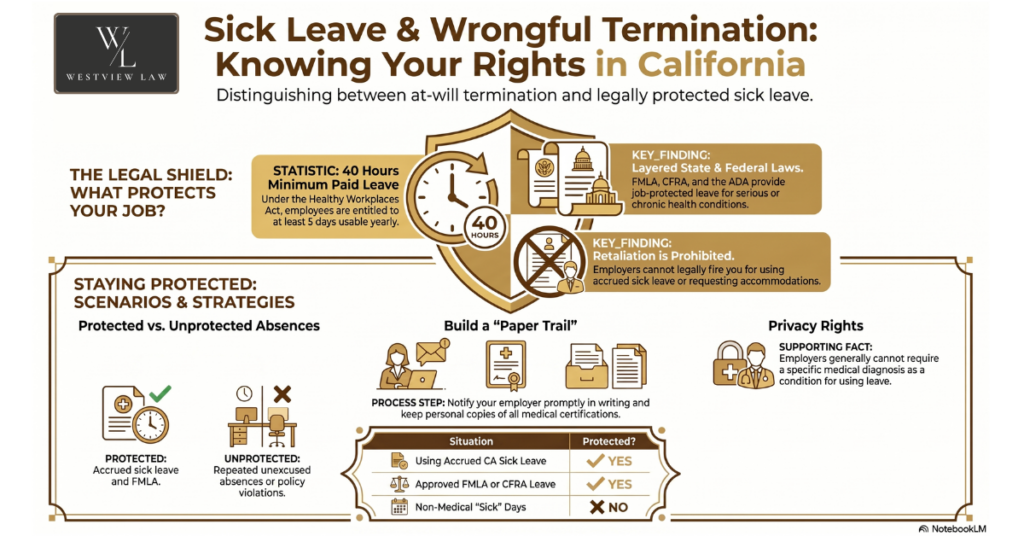
California then stacks its own protections on top. The California Family Rights Act mirrors and expands FMLA, covering more family relationships and applying to employers with five or more employees. The Healthy Workplaces, Healthy Families Act sets the state's paid sick leave floor as of the 2024 expansion, and employees accrue at least one hour of paid sick leave per 30 hours worked, with a minimum of 40 hours (or five days) usable per year.
Pregnancy Disability Leave gives up to four months of job-protected leave, including maternity leave needs tied to a qualifying condition. California Labor Code sections 230 and 230.1 add protected time off for victims of domestic violence, sexual assault, and stalking. Local laws in places like San Francisco, Los Angeles, and Oakland push the floor even higher.
Your rights as an employee when calling in sick are more concrete than people realize. You generally have to give notice the same day if the illness is sudden and advance notice when the medical reason is foreseeable.
In fiscal year 2024, retaliation was alleged in 38.7% of lawsuits filed by the EEOC, making it one of the most frequently cited bases in employment litigation. Your employer can't retaliate against you for using accrued sick leave, and under the Healthy Workplaces, Healthy Families Act, they can't require you to disclose your specific diagnosis as a condition of using accrued paid sick leave. They can ask for reasonable verification in some narrow situations, but a doctor's note demanding a diagnosis isn't the same thing as confirmation that you needed time off.
If those rights get violated, there's a clear path forward. Wage and sick-pay violations go to the California Labor Commissioner. Discrimination, harassment, and retaliation claims go to the California Civil Rights Department (formerly DFEH), or to the Equal Employment Opportunity Commission (EEOC) for federal claims.
Employees can also pursue a private lawsuit for wrongful termination, lost wages, and emotional distress damages depending on the facts. An employment lawyer can usually tell you within one consultation which agency to file with and whether your case needs a lawsuit at all.
In matters our team has handled, the patterns repeat. Workers are fired the week they request FMLA leave. Employees with chronic illness were written up for the exact absences their doctor documented. Pregnant workers are suddenly labeled "not a culture fit" after disclosing the pregnancy.
Outcomes vary by facts, but when the protected leave is properly documented, common results include reinstatement, back pay for lost wages, civil penalties under California Labor Code, and negotiated settlements that close the chapter without a trial. None of that happens automatically. It requires evidence and a timely complaint, but the protections are real when employees actually use them.
Protected vs. Unprotected Sick Leave

Not every sick-day absence receives the same level of legal protection. Whether an employer can lawfully discipline or terminate an employee often depends on the reason for the absence, the type of leave being used, and whether the employee followed applicable procedures. The table below highlights some common situations and whether they are generally more likely to be protected or unprotected under California and federal law.
| Situation | More Likely Protected | More Likely Unprotected |
|---|---|---|
| Using accrued California sick leave | ✓ | |
| Approved FMLA or CFRA leave | ✓ | |
| ADA-related medical accommodation | ✓ | |
| Repeated absences without notice | ✓ | |
| Calling in sick for non-medical reasons | ✓ | |
| Violating company attendance policies | ✓ |
What Is Protected Sick Leave Under FMLA?
The Family and Medical Leave Act, or FMLA, is the federal law that gives covered employees the right to take unpaid, job-protected leave for specific medical and family reasons. The medical leave act FMLA was passed in 1993, and the U.S. Department of Labor enforces it. Some employees do not get coverage, and some illnesses do not qualify.
Eligibility runs on three tests. The employee has to have worked for the employer for at least 12 months. They need to have logged at least 1,250 hours in the past year. And the employer has to have 50 or more employees within a 75-mile radius of the worksite. If any one of those boxes is empty, FMLA doesn't apply, though CFRA, ADA, or a local ordinance often will.
What Are the Benefits of FMLA?
The headline benefit is job protection. Eligible employees can take up to 12 weeks of unpaid leave in a 12-month period, and when they return, the employer has to put them back in the same job or an equivalent one with the same pay, benefits, and working conditions. That job-protected leave is what separates FMLA from simply calling out sick. Job security during a serious health event is the entire point of the statute.
FMLA leave covers a defined list of situations, including an employee's own serious health condition, caring for a spouse, child, or parent with a serious health condition, bonding with a newborn or newly placed adopted or foster child, and certain qualifying military family leave events. As of March 2025, 82% of U.S. civilian workers had access to paid sick leave benefits, according to the U.S. Bureau of Labor Statistics.
A serious health condition under the statute generally means an illness, injury, or chronic condition that requires inpatient care or ongoing treatment by a healthcare provider, often tied to major life activities like working, walking, or self-care. Chronic health conditions like diabetes, asthma flare-ups, severe depression, and conditions requiring chemotherapy or dialysis routinely qualify.
Your employer also has to maintain your group health insurance during FMLA leave on the same terms as if you were still working. You keep paying your share of the premium, but you don't lose coverage because you took protected time off. That continuity matters most for employees managing a chronic illness or a family member's serious diagnosis, where losing insurance mid-treatment would be a disaster.
What Are the Limitations of the FMLA?
Plenty of situations fall outside FMLA. A one-day cold, a 24-hour stomach bug, routine checkups, and short-term illnesses that don't require ongoing treatment generally don't qualify as a serious health condition. Employees at companies with fewer than 50 employees within a 75-mile radius aren't covered.
Workers who haven't hit the 12-month or 1,250-hour thresholds are stuck waiting. Independent contractors are out entirely. In those cases, CFRA may provide coverage, as it covers California employers with five or more employees, but the FMLA itself won't.
Both sides have obligations. The employer has to give employees notice of FMLA rights, designate qualifying time off as FMLA leave, and keep benefits running.
Employees have their own duties: give the employer notice as soon as possible (30 days in advance when the medical leave is foreseeable, as soon as practicable when it isn't), provide medical certification when the employer promptly requests it, perform the essential functions of the job when on light duty, and follow normal call-in procedures unless the situation makes that impossible. Missing those steps doesn't automatically end your protection, but it gives an employer ammunition if they're looking for a reason to deny leave.
What Are the Potential Consequences of Calling in Sick Too Often?

Even when individual sick days are legitimate, a pile of absences without context can create real friction with an employer. The law doesn't grant unlimited sick days, and most companies have policies that treat repeated absences as a performance issue. Understanding how employers think about attendance and where the legal protections actually start helps you stay on the right side of the line.
1. Employer Expectations
Most employers expect employees to be at work on scheduled days, to give timely notice when they can't, and to follow the company's sick leave policy on documentation. The employee handbook usually spells out the call-in window, who to notify, and what counts as an excused absence.
Policies on excessive absenteeism vary, but a common standard is that three or more unexcused absences in a rolling window, or a pattern of Monday-Friday call-outs, triggers a formal review. Private employers can set stricter rules than the law requires, and most do.
2. Consequences of Excessive Absenteeism
When too many sick days pile up without protected leave coverage, disciplinary actions follow a familiar arc, including a verbal warning, written warning, final warning, and termination. Some employers move faster when attendance affects coworkers or operations.
Each step lands in the employee's personnel file, and that record shows up later: in internal promotion decisions, in reference calls from future employers, and sometimes in background checks for licensed industries. A termination tied to absenteeism is also harder to spin in an interview than a layoff or a mutual parting, which is why getting ahead of the problem matters.
Strategies to Mitigate Risks
Transparency and documentation are your best tools when you need to use sick time. Follow this short process to protect yourself:
1) Notify your employer promptly the moment you know you can't come in, using whatever channel the policy requires.
2) Document the valid medical reason in writing. A quick email confirming the call works so there's a record beyond a phone call.
3) Follow the company's sick leave policy on notice timing exactly, even if it feels rigid.
4) Provide medical certification or a doctor's note if the employer requests it and the request is lawful.
5) Keep copies of every text, email, and certification in a personal file you can access after you leave the job. As Taylor Markey, a Westview Law attorney, puts it, "The employees who win these cases are the ones who treated their own medical absences like a paper trail from day one."
Can an Employer Fire You for Calling in Sick Too Much?
Yes, in scenarios where the absences aren't legally protected. If an employee isn't FMLA-eligible, isn't covered by CFRA, doesn't have a qualifying disability under the ADA, and isn't using accrued paid sick leave under the Healthy Workplaces, Healthy Families Act, an employer fire decision based on attendance can be perfectly legal under at-will employment. Unprotected absences, undocumented patterns, and call-outs that violate the employee handbook are all fair game for discipline.
The fight in most wrongful termination cases is about whether the absences were protected or not. A documented pattern of abuse, surveillance footage, social media posts, and coworker statements support the employer. Documented protected leave, medical certification, FMLA designation notices, and written accommodation requests support the employee. When the documentation is clean on the employee's side, and the firing happens right after a leave request, that timing is hard for an employer to explain away.
If you've been fired and you suspect a protected reason, preserve evidence first. Save your emails, your call-in records, the employee handbook, your doctor's certifications, and any text messages with your supervisor. File a complaint with the Labor Commissioner for sick-pay issues, the CRD for discrimination and retaliation, or the EEOC for federal claims, and watch the deadlines, because some are as short as 180 days. Then talk to an employment lawyer who handles these claims regularly, because the strategy depends heavily on what kind of employer, what kind of leave, and what kind of paper trail you're working with.
Knowing your company's policy and your legal protections matters before something goes wrong, not after. We also advise employers on building defensible sick leave policies so they don't end up on the wrong side of one of these lawsuits in the first place. Either way, the earlier you get advice, the more options you have.
Were You Fired for Calling In Sick?
Sick leave rights in California are layered, and the layers are what protect you. At-will employment gives employers wide discretion, but FMLA, CFRA, the ADA, the Healthy Workplaces, Healthy Families Act, and California Labor Code §§ 230 and 230.1 all carve out real protections for sick employees. The difference between a lawful firing and wrongful termination usually depends on whether the absence fell within one of those protections and whether you documented it.
If you think you were fired for a protected reason, don't sit on it. Deadlines for filing complaints with state and federal agencies move quickly, evidence disappears, and witnesses move on. Getting an employment lawyer involved early gives you the best chance of making informed decisions about whether to file a complaint, negotiate a separation, or take the case further.
Can you get fired for calling in sick? The answer depends on the circumstances, but many employees have legal protections when taking legitimate sick leave. At Westview Law, our employment attorneys in California help workers understand their rights and evaluate whether a termination may have violated state or federal law. If you were fired after calling in sick, contact us today for a confidential free consultation to discuss your situation and explore your legal options.
Frequently Asked Questions
This FAQ section answers common questions about calling in sick and your workplace rights. It explains when an employer may take action and when legal protections may apply.
Can You Get Fired for Calling in Sick in California?
Yes, in some situations, an employer can fire an employee for calling in sick. However, if the absence is protected by laws such as FMLA, CFRA, the ADA, or California paid sick leave laws, the termination may be unlawful.
What Protections Are in Place for Employees Who Call In Sick in California?
California employees may have protections under paid sick leave laws, CFRA, FMLA, the ADA, and other workplace laws. The protections available depend on factors such as the reason for the absence, the size of the employer, and the employee's work history.
What Steps Should I Take if I Need to Call In Sick?
Notify your employer as soon as possible and follow the company's call-out procedures. Keep copies of any messages, emails, or medical documents related to your absence.
Can My Employer Require a Doctor’s Note for Calling in Sick?
In some situations, an employer may ask for medical documentation, especially for longer absences or protected leave requests. However, employees are not always required to disclose specific medical details or diagnoses.
How Can I Avoid Getting Fired for Calling in Sick?
Follow your employer's sick leave policy and keep records of your absences and communications. If you need ongoing medical leave or accommodations, make requests in writing and ensure any protected leave is properly documented.
Disclaimer: This article is for general informational purposes only and does not constitute legal advice. Reading this content or contacting Westview Law does not create an attorney-client relationship. Sick leave laws and protections change; consult a qualified California employment attorney about your specific situation.