




To sue an employer for discrimination in California, you usually start by filing a complaint with the California Civil Rights Department (CRD) or the EEOC and submitting key evidence like emails, records, and witness details. Thereafter, you must obtain a “Right to Sue” letter, which allows you to move your case into court within strict deadlines. Once issued, you can file a lawsuit in state or federal court, and the process typically takes several months to years, depending on complexity and settlement discussions involving employment discrimination matters.
Westview Law has extensive experience representing employees in California discrimination claims, guiding clients through every stage from filing administrative complaints to pursuing lawsuits in court. Our team understands the legal standards, deadlines, and evidence needed to build strong employment cases. We are committed to helping workers protect their rights and hold employers accountable for unlawful discrimination involving employment discrimination. If you believe you’ve been discriminated against at work, contact us for a confidential consultation and clear guidance on your next steps.
In this blog, we will walk you through how to sue an employer for discrimination in California, including the legal process, key filing steps, and what to expect when pursuing a claim.
What Are Your Legal Rights and Options if You Face Employer Discrimination in California?
If you face employer discrimination in California, you have strong legal rights at work. Employers cannot treat you unfairly because of race, sex, age, religion, disability, or other protected traits and characteristics. They also cannot punish you for reporting discrimination. Knowing your rights early can help you protect your job and future.
One major protection is the California Fair Employment and Housing Act (FEHA). FEHA gives workers broad protection against harassment, retaliation, and unfair treatment. It often covers more employees and situations than federal law. This law can apply to hiring, firing, pay, promotions, and workplace conditions.
Another key anti-discrimination law is Title VII of the Civil Rights Act. This federal law bans discrimination based on race, color, religion, sex, sexual orientation, and national origin. It applies to many employers across the country. Workers in California may use it along with state protections.
The Americans with Disabilities Act (ADA) protects workers with disabilities. Employers must provide reasonable accommodations when possible. This may include schedule changes, equipment, or workspace adjustments. They cannot fire or mistreat someone for having a disability.
If discrimination happens, you have several options. You can file with the California Department of Fair Employment and Housing (DFEH), now known as the Civil Rights Department, or with the Equal Employment Opportunity Commission (EEOC). You may also speak with an employment lawyer and file a lawsuit. Quick action matters because legal deadlines and time limits can limit your claim.
What Is the Legal Process and Procedure to Sue an Employer for Discrimination?
If you believe you were treated unfairly at work because of a protected characteristic, such as your race, gender, age, disability, religion, gender identity, or marital status, California law gives you a structured legal path to seek justice. However, you cannot usually jump straight into court.
The process starts with administrative complaints and moves step-by-step toward a formal complaint or lawsuit if the issue is not resolved. Here’s how the legal process and procedure typically work when suing an employer for discrimination in California.
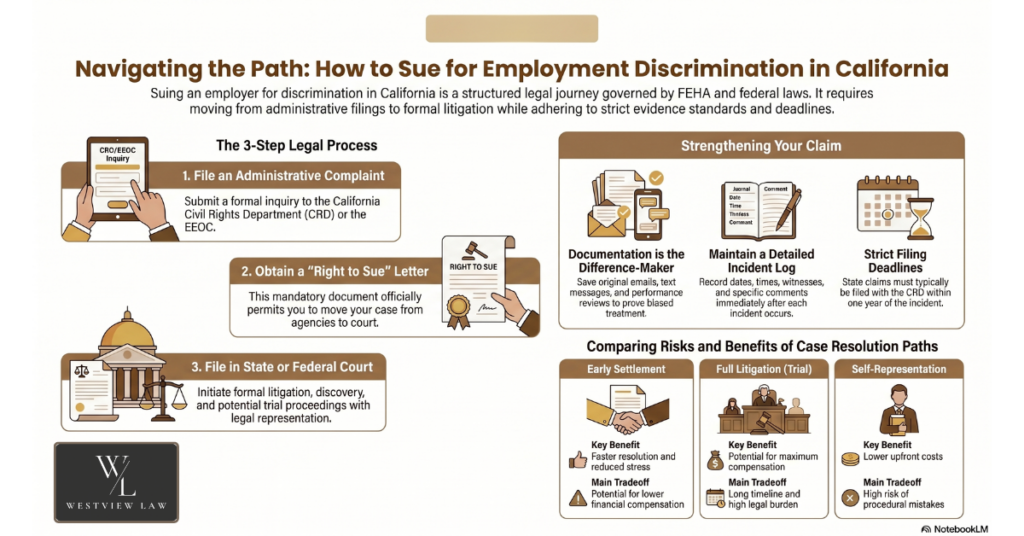
Step 1: File a Complaint With the Appropriate Agency (DFEH or EEOC)
The first step in the filing process is filing a formal discrimination complaint with either the California Civil Rights Department or a federal agency such as the EEOC. You may begin with an online inquiry or an intake interview or choose to file a charge. These agencies are responsible for investigating workplace employment discrimination claims before a lawsuit can proceed. This complaint process often begins with an online inquiry or intake submission.
You will need to complete intake forms that describe the discriminatory conduct, identify your employer, and explain when the incidents occurred. Supporting documentation such as emails, text messages, performance reviews, witness names, and timelines can significantly strengthen your complaint. In many cases, this is how you file a complaint and begin the administrative process.
Step 2: Agency Review and Investigation
After your complaint is filed, the agency begins by reviewing the information and deciding whether to investigate further. They may request additional documents, contact your employer for a response, or attempt informal resolution through mediation. The agency may review alleged discriminatory practices or whether the employer failed to address complaints internally.
This stage is important because it determines whether your case can be resolved without going to court. In some cases, the agency may dismiss the complaint early, while in others, they may conduct a full investigation into workplace practices, discriminatory behavior, and employer conduct.
Step 3: Obtain a “Right to Sue” Letter
If the agency does not resolve your claim, or if you choose to move forward sooner, you can request a “Right to Sue” notice. This document officially permits you to file a lawsuit in court.
Once issued, it triggers strict deadlines, usually 1 year under California law for state claims or 90 days for federal claims. Missing these deadlines can permanently bar your case, so timing is critical. This step often satisfies administrative exhaustion requirements before you can pursue legal action.
Step 4: File a Lawsuit in State or Federal Court
With a Right to Sue letter in hand, you can formally file a discrimination lawsuit against your employer. This involves submitting a legal complaint in either California state court or federal court, depending on the nature of your claims and which federal laws apply.
The lawsuit begins the litigation process, including discovery, depositions, motions, and potentially settlement negotiations or trial. At this stage, having legal representation is especially important because procedural rules become more complex and strategic.
What Are the Evidence and Documentation Requirements When Filing an Employer Discrimination Claim?

We often tell clients, "Strong documentation is often the difference-maker." If you are facing workplace discrimination and harassment, strong evidence can help support your claim. Good documentation shows what happened, when it happened, and who was involved. Clear records often make it easier to prove unfair treatment and that discrimination occurred. The more organized your evidence is, the stronger your case may be.
Emails, text messages, chat logs, and other written communications can be very useful. These records may show biased comments, unfair instructions, retaliation, or a specific discriminatory act. Save copies of important messages in a safe place. Do not make any changes, as original records hold greater significance.
Witness statements can also strengthen your claim. Coworkers, clients, or others who saw the behavior may confirm what happened. Employment records matter too, including schedules, write-ups, pay records, and performance reviews. These documents may show sudden unfair changes, discriminatory treatment, or inconsistent treatment.
Keep a detailed log of every incident as soon as it happens. Write the date, time, location, people involved, and what was said or done. Store digital files in folders and back them up securely. Keep physical papers in one safe place so nothing gets lost. Include details about when the alleged discriminatory act occurred and any response by management, as this may help show illegal discrimination, repeated discriminatory practices, or a specific hostile work environment.
How Do Timelines and Important Deadlines Work?
If you face workplace discrimination, deadlines are crucial. Waiting too long can limit your right to file a claim. Acting early also helps protect evidence and witness memories. Knowing the timeline can make the process less stressful.
In California, many claims must be filed with the California Department of Fair Employment and Housing (DFEH) within one year of the discrimination date. The Equal Employment Opportunity Commission (EEOC) often requires federal claims to be filed within 300 days. Some federal employment discrimination claims have separate rules. Missing these deadlines may hurt your case. It is smart to file as soon as possible because strict time limits may apply.
The legal process can take months or sometimes longer. Some cases settle quickly, while others move into investigation or court. Complex facts, more witnesses, and disputed evidence can slow things down. An attorney can help you understand the likely timeline for your claim.
Filing, Lawsuits, and Settlement Tradeoffs in California Discrimination Cases
Once you understand the legal process of suing for discrimination in California, the next step is knowing how your choices at each stage can impact your case. From filing with an agency to deciding whether to settle or go to court, each option comes with its own benefits and tradeoffs. The table below breaks down these key decisions so you can see what to expect and make more informed choices moving forward.
| Stage | What You Do | Key Benefit | Main Tradeoff / Risk |
|---|---|---|---|
| File with CRD or EEOC | Submit a complaint and evidence to government agency | Required first step. Can trigger investigation | Can be slow and may not fully resolve case |
| Request “Right to Sue” | Ask agency for permission to go to court | Lets you move forward with a lawsuit. | Starts strict deadlines (90 days–1 year) |
| File Lawsuit in Court | File complaint in state or federal court | Full legal remedies available (damages, reinstatement) | Longer, more complex, higher legal burden |
| Self-Representation | Handle case without a lawyer | Lower upfront cost | Higher risk of mistakes and weaker case strategy |
| Hire Employment Lawyer | Work with legal counsel through the process. | Stronger evidence, strategy, and negotiation power | Legal fees (often contingency-based) |
| Early Settlement | Resolve before trial | Faster resolution, reduced stress | May result in lower compensation |
| Full Litigation (Trial) | Proceed through discovery and court judgment | Potential for maximum compensation | Long timeline, uncertainty, higher stress |
What Are Potential Outcomes and Compensation?

If you file a workplace discrimination lawsuit, several outcomes are possible. Some cases end quickly, while others take more time. The result often depends on the facts and evidence. A strong case can lead to financial recovery, fair compensation, and workplace changes.
Many claims are resolved through settlement agreements. This means both sides agree on terms without a trial. A settlement may include money, policy changes, or other relief. It can save time and reduce stress for everyone involved. EEOC data also shows that many discrimination cases are resolved before trial through mediation or settlement programs, helping both employees and employers avoid lengthy court battles.
Some cases go to court and end with a judgment for the worker. If the court finds discrimination happened, it may award damages. The employer may also be ordered to change harmful practices and take remedial action. In some cases, the worker may be reinstated to their job.
Compensation can include back pay and lost wages. Emotional distress damages may cover anxiety, stress, or harm caused by the treatment. Punitive damages may apply when the conduct was especially harmful. Every case is different, so the final amount can vary.
What Are Common Challenges and How to Address Them?
Filing a workplace discrimination lawsuit can come with challenges. Many workers feel stressed and unsure where to begin. Some problems can slow a case or weaken evidence. Knowing these issues early can help you respond better.
One common challenge is the lack of direct evidence. Discrimination is not always stated openly or put in writing. In many cases, proof comes from patterns, timing, or whether an employer treats one worker differently from others.
Another concern is employer retaliation, as some matters may also involve sexual harassment or an employer's failure to correct misconduct. Some workers fear being terminated, demoted, ignored, or treated differently after speaking up. The law often protects employees from retaliation for reporting misconduct. Keeping records of any negative changes can help support your claim.
Seeking legal counsel early can make a big difference. A lawyer can guide deadlines, strategy, and evidence collection. Expert witnesses or forensic evidence may also strengthen complex cases. Early action often gives you more options and better protection.
Why Is Professional Legal Representation Important?
According to the EEOC, workers file more than 60,000 workplace discrimination charges each year across the country. If you are facing workplace discrimination, having a lawyer can be very helpful. These cases often involve strict deadlines and detailed legal rules. A discrimination lawyer can protect your rights and reduce costly mistakes. Strong guidance can also alleviate stress during difficult times.
Legal representation assists with intricate procedures from the beginning to the end. A lawyer can file claims, gather evidence, and handle communication with employers. They can also negotiate settlements or take the case to court if needed. This support often improves your position and confidence.
When choosing a lawyer in California, search for experience in employment law. This can be especially important where claims involve age discrimination, religious practices, or multiple legal issues. Ask about their results in cases similar to yours. Read reviews, check credentials, and discuss fees clearly. Choosing the right lawyer can significantly impact your case.
For example, a California employee experienced ongoing workplace discrimination based on repeated unfair treatment and exclusion from key work opportunities. After documenting emails, performance changes, and gathering witness statements, they decided to consult an employment lawyer for guidance.
The lawyer helped them file a complaint with the California Civil Rights Department, secure a “Right to Sue” letter, and build a strong case for court. Before trial, the employer agreed to a favorable settlement that included compensation for lost wages and emotional distress, along with policy changes in the workplace.
What Are the Next Steps and Action Items After Filing an Employer Discrimination Lawsuit?

Once you’ve filed a discrimination lawsuit against an employer, the process doesn’t slow down but becomes more structured and strategic. What you do next can directly affect the strength of your case, the evidence available, and ultimately the outcome. Here are the key next steps and action items to focus on after initiating legal action.
- Document Everything in DetailStart or continue keeping a clear, detailed record of every relevant incident. Include dates, times, what was said or done, and who was present. Keep copies of emails, texts, performance reviews, HR complaints, and any other workplace records. These details help your lawyer build a stronger, fact-based case.
- Contact a Qualified Employment Lawyer for Ongoing GuidanceIf you haven’t already, make sure you are working with an experienced employment attorney. They can help you understand your rights and guide you through each stage of the lawsuit. Even after filing, your lawyer becomes your main point of contact for strategy decisions and legal updates. A good consultation early on can also clarify what evidence matters most moving forward.
- Maintain Regular Communication with Your LawyerStay in touch with your attorney and respond quickly to any requests for information or documents. This helps keep your case moving efficiently without unnecessary delays. Your lawyer may also update you on settlement opportunities, court deadlines, or employer responses. Consistent communication ensures you are never caught off guard.
- Stay Informed About Case DevelopmentsMake an effort to understand the general progress of your case, even if your lawyer handles the legal details. Ask questions when something is unclear so you know what to expect next. Being informed helps you make better decisions about settlement offers or trial options. It also reduces stress because you understand where things stand in the process.
Ready to File an Employer Discrimination Lawsuit in California?
Suing an employer for discrimination in California involves a clear but structured legal process. It usually starts with filing a complaint with the California Civil Rights Department or the EEOC, followed by an investigation and the issuance of a “Right to Sue” letter. From there, you can move forward by filing a lawsuit in state or federal court if the issue is not resolved.
The timeline can vary depending on the complexity of the case, but strict deadlines always apply, so timing matters. Because the process involves detailed rules, evidence gathering, and court procedures, it’s important to stay organized and informed at every step. If you believe you have a claim, consulting an experienced employment attorney can help you understand your options and protect your rights from the very beginning.
Are you wondering what it takes to actually sue your employer in California after experiencing workplace discrimination? Westview Law helps employees cut through the confusion and take the right legal steps, from filing with the CRD or EEOC to pursuing a lawsuit in court. With profound experience in California employment law, our team of skilled employment lawyers knows how to build strong, evidence-backed discrimination claims. Contact us today for a free consultation.
Frequently Asked Questions
If you are thinking about suing your employer for discrimination in California, you may have many important questions. These FAQs explain the process, deadlines, and what to expect in simple terms.
What Are the Steps to Sue an Employer for Discrimination in California?
You usually start by gathering evidence such as emails, records, and witness names. Then you file a complaint with the California Civil Rights Department or the Equal Employment Opportunity Commission (EEOC) before filing a lawsuit in court.
How Much Does It Cost to Sue an Employer for Discrimination in California?
Costs can include filing fees, attorney fees, and expenses for records or experts. Some lawyers work on contingency, which means they may only get paid if you win or settle.
Can I Sue My Employer for Discrimination Without a Lawyer in California?
Yes, you can represent yourself and file a claim without a lawyer. However, discrimination cases can be complex, so legal help often improves your chances.
What Is the Statute of Limitations for Suing an Employer for Discrimination in California?
The deadline depends on the type of claim and where it is filed. Many cases require filing an administrative complaint first, so acting quickly is important.
Are There Any Successful Discrimination Cases Against Employers in California?
Yes, many workers in California have won settlements or court judgments in discrimination cases. Results depend on the facts, evidence, and strength of the claim.
Disclaimer: The information provided on this blog is for general informational purposes only and does not constitute legal advice. Reading this content does not create an attorney-client relationship. Laws and regulations vary by jurisdiction and may change over time, so you should consult a qualified employment attorney directly for advice regarding your specific situation. Past examples, case studies, or hypothetical scenarios are illustrative only and do not guarantee similar results.