


A wrongful termination lawsuit is a legal claim filed when an employer fires an employee for an illegal reason, such as discrimination, retaliation, refusing to break the law, or breach of an employment contract. To bring one, you preserve documentation, file an EEOC charge or its state equivalent, and work with an employment attorney who can pursue compensation through a settlement or trial. Strict deadlines apply, often as short as 180 days, so acting quickly matters.
At Westview Law, our California employment team has over 13 years of experience handling wrongful termination and workplace discrimination cases. We have recovered more than $146 million for workers across the state, including major verdicts and significant settlements. Our team has managed hundreds of cases involving retaliation, whistleblower claims, and discrimination under California’s FEHA protections. If you were fired and believe the reason was illegal, schedule a free case evaluation with our team to find out where you stand.
In this post, we will explain what wrongful termination lawsuits are, the steps involved in filing a claim, and how employees can protect their legal rights after being fired.
What Is Wrongful Termination
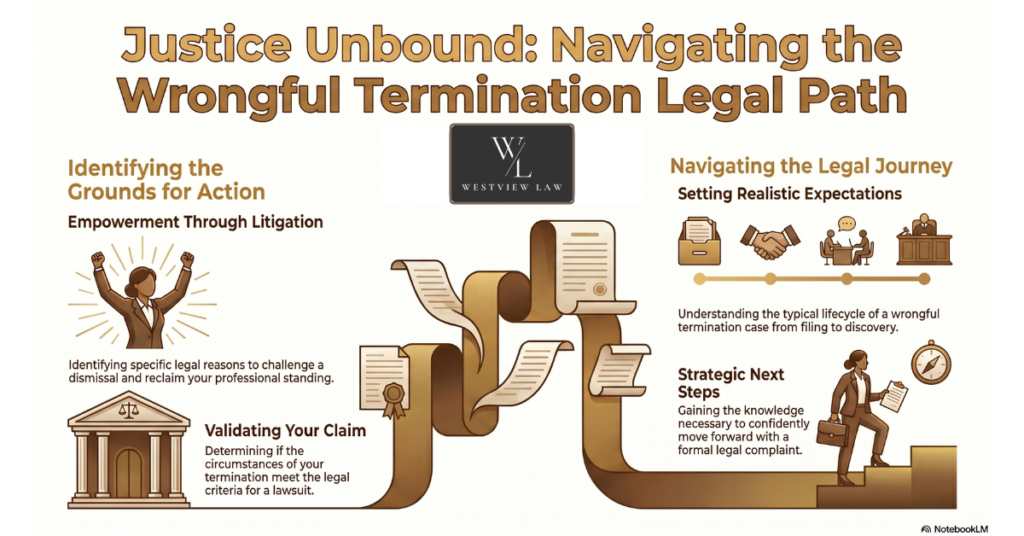
Wrongful termination is the firing of an employee for a reason that the law prohibits. That includes discrimination based on a protected characteristic, retaliation for reporting a company's illegal activities or other unlawful conduct, refusal to participate in unlawful activity, and dismissal that breaches an express or implied employment contract. It does not cover every unfair employment termination because most US workers are employed “at will,” meaning an employer can let them go for any reason that is not specifically illegal.
The distinction matters because it shapes whether you have a case. Being fired for poor performance, a personality conflict, or even a manager's bad mood is usually legal, however unjust it feels. Being fired the week after you reported sexual harassment to HR, or two days after you disclosed a pregnancy, is often retaliatory. Pattern, timing, and documentation are what move a complaint from “unfair” to "actionable."
The stakes go beyond lost income. A wrongful firing can derail a career, complicate future job applications, and trigger benefits gaps that compound over months. California law recognizes that harm and allows recovery for back pay, front pay, emotional distress, attorney's fees, and, in some cases, punitive damages, which is why employers settle the strongest cases rather than fight them.
What Laws Protect Employees Against Wrongful Termination?
The EEOC received more than 88,000 workplace discrimination charges in FY 2024, showing how common employment disputes remain across the country. Federal protections form the floor, and California stacks substantial additional rights on top under federal and state laws and other relevant laws.
The major federal statutes are Title VII of the Civil Rights Act of 1964, which bars firing based on race, color, religion, sex, or national origin; the Americans with Disabilities Act (ADA), which protects qualified workers with disabilities; the Age Discrimination in Employment Act, which covers employees 40 and older; and the Family and Medical Leave Act (FMLA), which protects up to 12 weeks of unpaid leave for qualifying medical and family reasons.
California's Fair Employment and Housing Act (FEHA) extends those protections to smaller employers, five or more employees instead of fifteen, and adds protected categories that federal law does not cover, including sexual orientation, gender identity, marital status, military status, and medical conditions. The state also recognizes wrongful termination in violation of public policy, a common-law claim that lets workers sue when they were fired for refusing to commit an illegal act, exercising a legal right such as filing a workers' compensation claim, or reporting an employer's illegal conduct.
A few terms come up constantly in these cases. At-will employment is the default rule that either party can end the working relationship for any lawful reason. "Protected class" refers to the characteristics the law shields from discrimination.
"Retaliation" covers any adverse action, such as firing, demotion, or schedule change, taken because the employee engaged in a legally protected activity. Most California wrongful termination claims rest on one of three theories: discrimination, retaliation, or breach of contract.
What Are the Legal Rights of Employees in Wrongful Termination Cases?
Federal law gives every US employee a baseline under the Civil Rights Act. The Equal Employment Opportunity Commission enforces Title VII, the Americans with Disabilities Act (ADA), and the ADEA, and most federal claims start with an EEOC charge before they can move to court. The Department of Labor enforces the Family and Medical Leave Act (FMLA) and other wage and hour protections.
California workers have stronger and faster paths. The Civil Rights Department (formerly DFEH) handles FEHA claims and gives workers up to three years to file a complaint, compared to the 180-to-300-day federal window. California also allows employees to sue directly in court once a right-to-sue letter is issued.
Practical rights employees often do not realize they have: the right to a copy of their personnel file under Labor Code §1198.5, the right to final wages immediately upon termination (within 72 hours if the employee quit without notice), the right to continue health coverage through COBRA or Cal-COBRA, and the right to be free from retaliation for filing any of the above complaints.
What Are the Steps to Take After a Wrongful Termination?

When a wrongful termination occurs, it can leave you feeling stressed, confused, and unsure about what to do next. Taking the right steps early can help protect your rights and strengthen your case if you decide to pursue legal action. Here are some important steps to consider after a wrongful termination.
- Step 1: Do not sign anything on the spot.
Severance agreements almost always contain a release of claims. Once you sign, your right to sue typically goes with it. Take the agreement home, use the full review period the law gives you (often 21 or 45 days), and have an attorney read it before signing. - Step 2: Save everything before you lose access.
Forward relevant emails to a personal account, screenshot Slack threads, save performance reviews, pay stubs, your offer letter, the employment agreement, the employee handbook, the termination notice, and other relevant documents. Most employees have minutes, not days, before HR cuts off their accounts. - Step 3: Write a contemporaneous account of what happened.
Within 48 hours, sit down and write a dated narrative covering the firing meeting, the reasons given, who was present, and any relevant incidents from the weeks before. Include specific dates, times, names, and quotes where you can recall them. Courts assign more weight to notes written immediately than to recollections months later. - Step 4: Talk to an employment attorney early.
Most wrongful termination lawyers, including our team, offer free initial consultations and work on contingency, meaning you pay nothing unless we recover for you. An early conversation with legal counsel tells you whether the facts support a claim and which deadlines apply to your situation. - Step 5: Begin the Lawsuit Filing Process
Most discrimination and retaliation claims must begin with an EEOC charge or a Civil Rights Department complaint before they can become a lawsuit. We handle the filing, the agency response, and the request for a right-to-sue letter so the timing works in your favor. - Step 6: Do not miss your deadline.
Title VII charges must be filed within 180 days, extended to 300 days in California because the state has its own anti-discrimination agency. FEHA claims allow up to three years. Breach-of-contract claims have their own clock. Acting in the first month protects every option you have.
What Is the Statute of Limitations for Wrongful Termination in California?
If you are considering a wrongful termination claim in California, it is important to understand the statute of limitations, which is the legal deadline for filing your case. In many employment-related claims, the time limit can range from a few months to a few years, depending on the type of violation involved, such as discrimination, retaliation, or breach of contract. Missing these deadlines can mean losing your right to take legal action, even if your case is strong.
Because these timelines can be strict and vary based on the facts of your situation, acting quickly is essential. Speaking with an experienced employment lawyer early can help you determine the exact deadline that applies to your case and preserve your legal rights. If you believe you were wrongfully terminated in California, getting legal advice as soon as possible can make a major difference in the outcome of your claim.
Average Wrongful Termination Settlement in California
In California, wrongful termination settlements can vary a lot depending on the facts of each case. In 2026, most reported settlements typically range from about $5,000 to $100,000 for lower to mid-level claims, while stronger cases involving discrimination, retaliation, or significant lost income can reach $100,000 to $500,000 or more. Some high-value cases with strong evidence and serious employer misconduct can even exceed that range.
For example, a junior employee who was wrongfully fired after reporting harassment might settle for around $35,000 after proving lost wages and emotional distress. In another scenario, a long-term employee with strong evidence of retaliation and higher income losses could see a settlement closer to $180,000–$250,000, especially if the employer’s actions were clearly unlawful.
Every case is different, and outcomes depend heavily on evidence, salary, and how the termination happened. Speaking with an experienced employment attorney is often the best way to understand what your specific case may be worth.
At-Will Employment in California
California is an at-will employment state. By default, an employer can end the relationship for any reason, and an employee can quit on the same terms. That default does not permit employers to fire for an illegal reason. However, it shifts the burden to the employee to show that the firing crossed a legal line, such as a wrongful discharge or wrongful dismissal.
We regularly remind employees, "Constructive discharge claims can be just as serious as direct termination when a workplace becomes impossible to endure." Six well-established exceptions can support a wrongful termination claim even when you were employed at will:
- Discrimination based on a protected characteristic under FEHA or federal law, including discriminatory reasons and conduct tied to a hostile work environment, may be considered wrongful
- Retaliation for protected activity (reporting harassment, filing a workers' comp claim, whistleblowing, raising safety violations, or refusing to break the law)
- Breach of an express employment contract that limits when you can be fired
- Breach of an implied contract created by the employee handbook, length of service, or repeated assurances of continued employment
- Violation of public policy, being fired for exercising a legal right, or refusing to commit an unlawful act
- Violation of the implied covenant of good faith and fair dealing, which applies in narrower circumstances
If your firing fits any of these patterns, at-will status is not a barrier to your claim. The harder question is proof. An employment attorney can review the timing, the documents, and the conversations around the firing, then tell you which exception gives you the strongest path forward.
How to Prove Wrongful Termination in California

Proving wrongful termination is mostly about connecting two dots: the protected activity or characteristic and the firing. The closer those two events sit in time, and the stronger the documentary trail, the better the case. Courts call it the "causal connection," and it is what separates an unfair firing from an illegal one.
The documents that matter most are the ones the employer cannot easily explain away: emails showing a positive review followed by sudden criticism after you reported a problem, manager text messages, performance reviews, the offer letter, the employee handbook, the termination notice itself, and any severance agreement on the table. Save them before you lose system access, as most workers have minutes, not days, to download what they need.
Witness accounts add weight. Coworkers who heard discriminatory remarks, watched the conduct unfold, or noticed the shift in treatment can support your timeline. Your own contemporaneous notes, written within 48 hours of the firing, also carry weight in court because they predate any anticipated litigation.
The burden of proof is on the employee, which means you must present evidence that your firing was likely unlawful rather than just unfair. This often involves connecting your termination to protected actions, like filing a complaint or belonging to a protected class. The clearer your evidence and timeline, the stronger your case becomes. An experienced employment lawyer can help you organize this proof and build a solid claim.
What Is Constructive Discharge in California?
Constructive discharge in California happens when working conditions become so intolerable that an employee feels forced to resign. EEOC data shows that discharge and constructive discharge claims were involved in more than 72% of lawsuits filed in FY 2024.
Even though you technically quit, the law may treat it as a termination if a reasonable person would not have been able to stay in that environment. The conditions must be so severe and continuous that any reasonable employee in your position would have walked away too.
In these situations, quitting is considered the same as being fired. That means you may still have a wrongful termination claim even after resigning. The key question is whether your employer created or allowed conditions that made it impossible for you to continue working. An employment attorney can review the conditions, the complaints you made internally, and the timing of your resignation, then tell you whether California law treats your departure as a firing.
Filing Your Claim With the EEOC vs. The California Civil Rights Department

If you believe you were wrongfully terminated due to discrimination, unlawful reasons, or retaliation, you may need to file a claim with either the EEOC or the California Civil Rights Department. Both agencies handle workplace rights complaints, but they differ in process, timelines, and outcomes. Here is a simple comparison to help you understand the key differences.
| Factor | EEOC (Equal Employment Opportunity Commission) | California Civil Rights Department (CRD) |
|---|---|---|
| Scope | Federal discrimination laws | California state discrimination laws |
| Coverage | Applies nationwide | Focused on California workers |
| Filing Deadline | Typically 180–300 days, depending on the case | Usually up to 3 years for some claims |
| Investigation Style | Federal investigation process | State investigation and mediation options |
| Outcome Options | Right-to-sue letter or settlement | Mediation, investigation, or right-to-sue notice |
| Best For | Federal claims or multi-state employers | Stronger state-level employee protections |
Ready to Pursue a Wrongful Termination Lawsuit?
A wrongful firing is more than a lost paycheck. It can make it harder to secure a new job, affect how co-workers and future employers see you, and strain your family’s stability. The legal system gives you tools to push back, but those tools are time-limited and procedurally strict.
If you believe you were wrongfully terminated, speaking with an experienced wrongful termination lawyer is one of the most important steps you can take. An experienced lawyer can review your situation, explain your options, and help you pursue the compensation you may deserve. Westview Law can provide the professional advice, guidance, and support you need during this difficult time.
Westview Law represents California employees in wrongful termination claims against employers of every size, from small businesses to Fortune 500 companies. Schedule a free case evaluation, and we will tell you within one conversation whether you have a claim worth pursuing and what to do next.
Frequently Asked Questions
This FAQ section breaks down the most common concerns about wrongful termination simply and straightforwardly to help you better understand the process. If your situation is not covered below, the fastest way to get an answer is a free consultation with our team.
How Do I Know if I Have a Valid Claim for Wrongful Termination?
You may have a valid wrongful termination claim if you were fired for an illegal reason or for reporting illegal actions, such as discrimination, retaliation, or reporting workplace misconduct. It is best to speak with an employment lawyer who can review your situation and help determine if your rights were violated.
What Is the Process for Filing a Wrongful Termination Lawsuit?
The process usually starts with gathering evidence and filing a complaint with the appropriate agency or court. From there, your lawyer helps build your case, negotiate if possible, and proceed to a lawsuit if needed.
How Long Do I Have to File a Wrongful Termination Lawsuit?
Deadlines vary depending on the type of claim, but in California, they can be as short as a few months or up to a few years. It is important to act quickly and speak with a lawyer so you do not miss your filing deadline.
What Are the Potential Outcomes of a Wrongful Termination Lawsuit?
Possible outcomes include a financial settlement, compensation for lost wages, or a court judgment in your favor. In some cases, you may also receive damages for emotional distress or other losses caused by the termination.
How Can an Attorney Help Me With a Wrongful Termination Lawsuit?
An attorney can review your case, explain your rights, and help you gather strong evidence to support your claim for compensatory damages. They also handle negotiations and court procedures to improve your chances of a successful outcome.
Disclaimer: The information provided on this blog is for general informational purposes only and does not constitute legal advice. Reading this content does not create an attorney-client relationship. Laws and regulations vary by jurisdiction and may change over time, so you should consult a qualified employment attorney directly for advice regarding your specific situation. Past examples, case studies, or hypothetical scenarios are illustrative only and do not guarantee similar results.