


The U.S. Equal Employment Opportunity Commission (EEOC) receives over 80,000 new employment discrimination charges annually, with California consistently ranking among the states with the highest number of filings. Unfortunately, these cases can only be resolved if the employee can prove they were discriminated against; if not, the claims could be dismissed.
To prove discrimination in the workplace, you must show that you belong to a protected class, you were qualified, you experienced an adverse employment action, and that your employer’s actions were motivated by a protected characteristic rather than a legitimate reason.
If you’re experiencing workplace discrimination, our California employment attorneys at Westview Law are here to help gather evidence and guide you forward. With decades of combined experience, we evaluate your case, gather the evidence needed to prove discrimination, and fight for a fair compensation. Schedule a free consultation with our team today.
This guide explains exactly how to prove workplace discrimination in California, what evidence matters most, and the steps you can take to protect your legal rights and hold your employer accountable.
What You Need to Prove Employment Discrimination in California
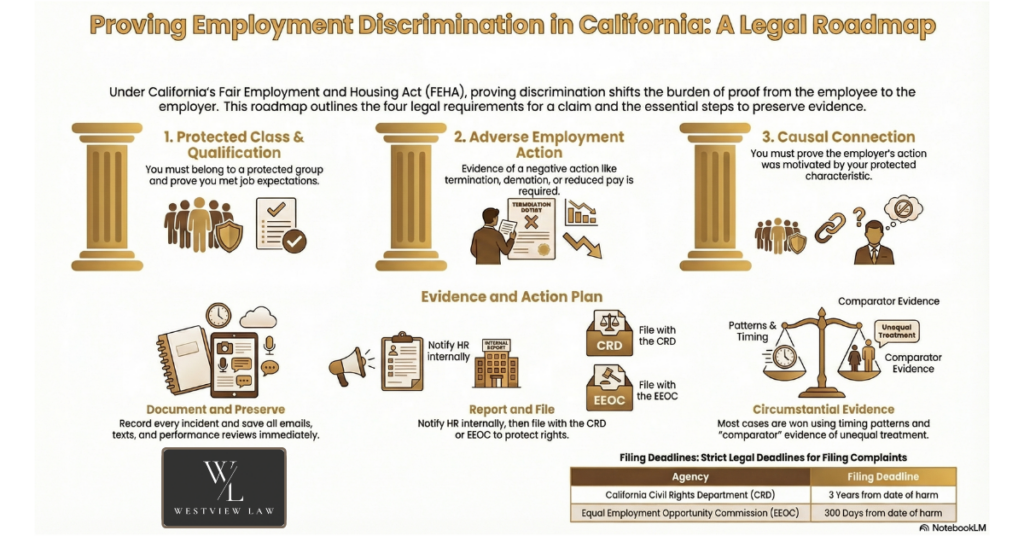
To understand how to prove employment discrimination in California, you have to focus on what the law actually requires. Under the California Fair Employment and Housing Act (FEHA), courts follow a burden-shifting framework clarified by the California Supreme Court in Harris v. Superior Court.
In line with CACI No. 2500 on disparate treatment, once an employee establishes a prima facie case of discrimination, the burden shifts to the employer to present a legitimate, non-discriminatory reason for the challenged action. So you must show the following to prove employment discrimination in California.
1. You Are Part of a Protected Class
The first step in proving employment discrimination is showing that you belong to a protected class under California law, specifically the California Fair Employment and Housing Act (FEHA). This includes characteristics such as race, national origin, gender, gender identity, sexual orientation, religion, age, and physical disability.
These are legally protected traits, meaning employers cannot base decisions on them. Many discrimination cases, including those involving racial discrimination or bias against religious beliefs, begin with establishing that the employee or job applicant falls within one of these categories.
For example, in EEOC v. iTutorGroup, Inc., the employer’s AI system automatically rejected female applicants over 55 and male applicants over 60, demonstrating clear discrimination based on age, a protected characteristic under FEHA and federal laws.
The case resulted in a $365,000 settlement for the affected applicants and required the company to invite previously rejected candidates to reapply. This shows how establishing membership in a protected class can lead to measurable legal remedies when discrimination is proven.
2. You Were Qualified for Your Position
Next, you must show that you were qualified for your role. This means you met your employer’s legitimate expectations based on your experience, skills, and performance history. Evidence you can use includes positive reviews, meeting targets, or holding the required qualifications under applicable employment laws. This step helps eliminate the argument that the employer acted for a legitimate reason unrelated to workplace discrimination.
3. You Suffered an Adverse Employment Action
To prove workplace discrimination, you must show that you experienced an adverse employment action. This refers to a negative action taken by the employer, such as termination, demotion, reduced pay, denial of promotion, workplace harassment, or a hostile work environment. In many workplace discrimination cases in California, even less obvious adverse actions, such as exclusion from opportunities or sudden discipline, can qualify if they significantly affect your employment.
4. The Employer Acted Because of Discrimination
Finally, you must prove a causal connection between your protected status and the employer’s actions. This means showing that the negative treatment was not random or justified, but based on discrimination.
This is often the hardest part of proving discrimination, because employers may offer alternative explanations. To succeed, you must show that those reasons are not credible and that discriminatory behavior was the real motive behind the decision.
In D.K. v. Intuit and HireVue, a deaf employee was denied a promotion after requesting a reasonable accommodation during an AI-assisted interview. The AI system unfairly assessed her communication style, which constituted discriminatory actions linked to her disability. While the case is ongoing, it demonstrates how proving the causal connection between a protected characteristic and an adverse action can support compensation or corrective measures.
What Evidence Can You Use to Prove Employment Discrimination?

To prove workplace discrimination, you need evidence that shows your employer’s decision was not based on a legitimate reason, but on discriminatory behavior. Successful discrimination claims are often built on a combination of direct and circumstantial evidence, along with supporting records that reveal a pattern of unfair treatment in the workplace.
Direct Evidence
Direct evidence is the strongest form of proof because it clearly and explicitly shows discrimination. This includes written or verbal direct statements by a supervisor or decision-maker. Such evidence links an adverse employment action to a protected characteristic such as race, sexual orientation, or religious beliefs. Examples include discriminatory emails, text messages, or workplace policies that openly treat a protected group differently.
Circumstantial Evidence
Most employees rely on circumstantial evidence to prove workplace discrimination, especially when there are no explicit statements. This type of evidence shows patterns or inconsistencies that suggest the employer’s explanation is not credible.
For example, suspicious timing, such as termination shortly after reporting discrimination or requesting reasonable accommodations, can indicate bias. Other signs include shifting explanations for an employer’s actions, deviations from company policies, or repeated discriminatory actions affecting employees with the same protected characteristic.
Comparator Evidence
Comparator evidence focuses on how you were treated compared to other employees in similar roles. To prove workplace discrimination, you must show that other employees outside your protected class were treated more favorably despite comparable performance or conduct.
This type of evidence is common in racial and gender discrimination cases, as well as in cases involving promotions, discipline, or wrongful termination, where unequal standards reveal discrimination based on a protected trait.
Strong Documentation
Strong documentation is critical in employment discrimination claims. Records such as performance reviews, job descriptions, training certifications, and performance reviews can demonstrate that you were qualified and met expectations. Emails, internal messages, and formal discrimination complaints to a human resource department can reveal how the situation developed.
Witness Testimony
Witness testimony from coworkers, former colleagues, supervisors, or HR personnel can provide critical support in discrimination cases. Witnesses may confirm biased remarks, unequal treatment, or patterns of discrimination in California workplaces. Even when there is no written proof, consistent testimony can strengthen your case and help show that the employer’s conduct reflects unlawful discrimination rather than a legitimate business decision.
How to Build a Strong Employment Discrimination Case

Now that you've successfully gathered the elements and evidence required to prove employment discrimination, here are steps to help you preserve evidence and build a strong case if you decide to take legal action.
Step 1: Document Every Incident
Start by recording each instance of discrimination in the workplace as it happens. Include dates, times, locations, what was said or done, and who was involved. Whether the issue involves racial discrimination, gender discrimination, or bias based on sexual orientation, consistent documentation helps establish patterns and strengthens circumstantial evidence in many discrimination cases.
Step 2: Report the Issue Internally (Carefully)
Notify your employer through a supervisor or the human resources department. Filing internal discrimination complaints creates a formal record and gives the employer an opportunity to correct the issue. This step is important because it shows that the employer was aware of the problem, especially if the employer retaliated after your report.
Step 3: Keep Copies of All Communications
Save emails, text messages, internal chats, and written responses related to your situation. These records may serve as direct evidence or help reveal inconsistencies in your employer’s explanation. Preserving this information is critical to prove workplace discrimination and demonstrate how the employer’s actions changed over time.
Step 4: File With the Appropriate Agency
If the issue is not resolved internally, you can file a complaint with the California Civil Rights Department or the Equal Employment Opportunity Commission. These agencies enforce discrimination laws and investigate claims involving unlawful discrimination. Filing is typically required before pursuing a lawsuit. You can explore your legal options before speaking with an experienced employment attorney.
Step 5: Stay Consistent in Your Account
Consistency is key when building discrimination claims. Your statements to HR, investigators, and legal representatives should align with your documentation. Any inconsistencies can weaken your case, while a clear and consistent narrative helps hold the employer accountable for discriminatory actions and protects your legal rights.
What Counts as Employment Discrimination Under California Law?
California law protects employees and job applicants from unfair treatment based on certain legally protected traits. The key statutes governing these protections are the California Fair Employment and Housing Act (FEHA) and related employment laws at both the state and federal levels.
The FEHA prohibits employers with five or more employees from discriminating, harassing, or retaliating againstemployees. This administrative body covers hiring, promotion, compensation, job assignments, training, and termination. Under FEHA laws, an employee may file a complaint if they experience workplace discrimination in California, ensuring the employer is held accountable.
FEHA protects individuals based on a wide range of protected characteristics, including race, national origin, gender identity, sexual orientation, religion, age, disability, physical disability, and medical condition. Therefore, employers cannot make decisions about hiring, promotions, pay, or discipline based on any of these traits. These rules extend to reasonable accommodations for employees with disabilities or for employees with religious practices.
Common Mistakes That Can Prevent You From Proving Employment Discrimination
Many employees weaken their claims by failing to record adverse employment actions or related communications, making it difficult to show a causal connection. Delaying reports to the Human Resource department can allow employers to offer seemingly legitimate explanations for negative treatment. Moreover, relying solely on verbal accounts or sharing details publicly can undermine credibility.
Consulting an experienced employment attorney early ensures proper guidance on state and federal laws, helps preserve evidence, and strengthens your ability to hold an employer accountable for unlawful actions.
When to Speak With an Employment Discrimination Lawyer

If you are facing workplace discrimination, especially after an adverse employment action like termination, demotion, or unequal pay, seeking legal guidance early can help you preserve evidence and avoid mistakes that could weaken your case.
You should also consider legal support if your complaints to the human resource department are ignored or followed by employer retaliation, or if your situation involves complex issues such as reasonable accommodations or overlapping state and federal laws.
An attorney can evaluate your case, identify whether the employer’s explanation is a legitimate reason or a pretext for unlawful discrimination, and guide you through filing with the California Civil Rights Department or the Equal Employment Opportunity Commission.
Looking for an Experienced Lawyer to Help You Prove Employment Discrimination?
Finding the right attorney to help gather and preserve evidence, establish a casual connection to strengthen your discrimination case, negotiate settlement, or file a claim, can be challenging. To be on the safe side and you will need an employment lawyer that has experience handling similar cases and proven results.
At Westview Law, our team understands how challenging it can be to navigate workplace discrimination. We work closely with California workers to build strong cases, protect their rights, and hold employers accountable. If you believe you’ve been treated unfairly, you can speak with our team and explore your options by scheduling a free consultation.
FAQs About Proving Employment Discrimination in California
With decades of combined experience handling employment discrimination and workplace discrimination in California, our attorneys have guided countless employees through complex legal challenges. Below are answers to some of the most common questions about how to prove workplace discrimination and protect your rights.
What is the hardest part of proving discrimination?
The most difficult part is establishing a causal connection between your protected class and the employer’s adverse employment action. Employers often provide a “legitimate reason” for their decisions, so you must show that the explanation is a pretext for discriminatory behavior. This is why strong circumstantial evidence, consistent documentation, proof of unfair treatment, and having the right legal counsel are critical in many discrimination cases.
Can I win without direct evidence?
Yes. Most discrimination claims are proven using circumstantial evidence rather than direct evidence. Courts recognize that employers rarely admit to unlawful discrimination, so patterns such as inconsistent explanations, different treatment of other employees, or suspicious timing can be enough to support a claim.
How long do I have to file a claim?
Under California law, you generally have three years to file a complaint with the California CRD. If your case also involves federal laws, you need to file with the EEOC within 300 days from the day of harm. Because deadlines can vary depending on the facts, acting quickly helps preserve your legal rights.
What if my employer denies everything?
It is common for an employer to deny wrongdoing or claim their actions were based on performance or business needs. In these situations, your case will rely on evidence that shows those reasons are inconsistent or not credible. Documents, witness testimony, and patterns of workplace discrimination can help demonstrate that the employer’s explanation is not the true reason.
How much evidence is enough to prove employment discrimination?
You do not need absolute proof, but you must present enough evidence to show that discrimination is more likely than not the reason behind the employer’s actions. You can do this by combining direct and circumstantial evidence with documentation that supports your version of events.