


Despite laws protecting employees from disability discrimination, many people with disabilities are still treated unfairly in the workplace. In 2024 alone, the EEOC filed 111 new lawsuits on behalf of victims of workplace discrimination.
If you believe you were treated unfairly at work because of a disability, proving disability discrimination in California usually requires showing four primary things: that you have a legally recognized disability, that you were qualified to do your job, that you experienced a negative employment action (such as termination, demotion, or refusal to hire), and that the action happened because of your disability.
If you’re facing disability discrimination, the employment attorneys at Westview Law can help. With 40 years of combined experience, our disability discrimination lawyers guide clients through reporting and filing disability discrimination complaints, ensuring their rights are protected and their cases are handled strategically. Schedule a free consultation with us today.
Since the process can be challenging, this article explains how to prove disability discrimination in California, the types of evidence that can support your claim, and the steps you can take if you believe your rights have been violated.
What Is Disability Discrimination Under California Law?
Discrimination often occurs when an employer bases an adverse employment action on assumptions about a person’s disability rather than their actual abilities. This can include refusing to hire a job applicant, demoting an employee after learning about a medical condition, reassigning job duties based on presumed limitations, or allowing workplace harassment related to disabilities.
Another common form of disability discrimination occurs when an employer refuses to provide reasonable accommodations to a disabled employee who needs them to perform their job duties. A recent enforcement action in EEOC v. Dollar General highlights how seriously the relevant administrative bodies handle disparate treatment. We'll use this as a case study.
In 2024, the EEOC secured a $1 million settlement with Dollar General after the retailer allegedly failed to accommodate an employee’s disability and unlawfully discharged her. This case shows that employers will and should be held liable for discriminating against employees.
What You Need to Prove Disability Discrimination in California

To successfully prove disability discrimination in California, an employee must show that the employer’s actions were not simply routine workplace decisions but were connected to the employee’s disability. While the exact details may vary depending on the situation, most claims rely on proving the following four points.
1. You Have a Legally Recognized Disability
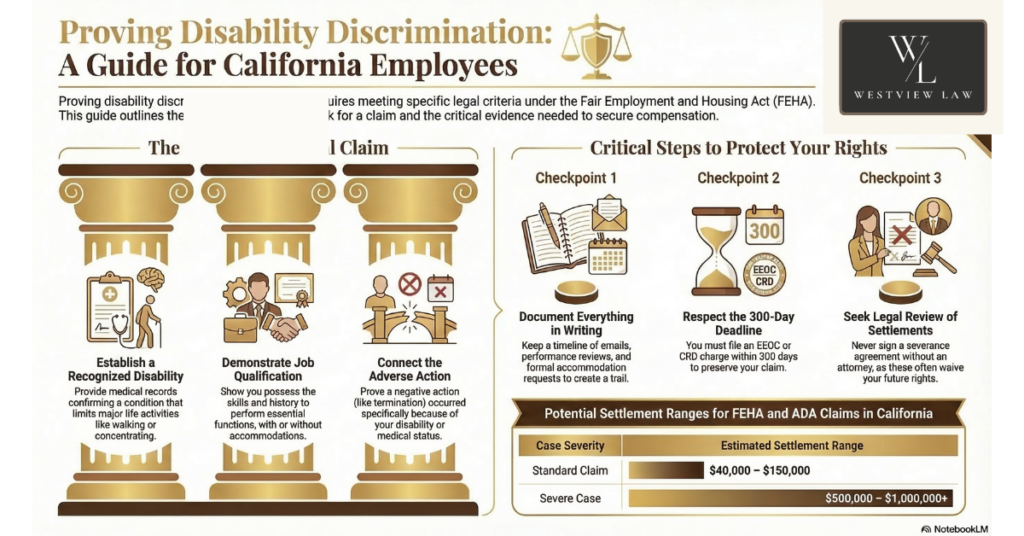
The first step is demonstrating that you have a disability recognized under the law. Under California’s Fair Employment and Housing Act (FEHA), a disability can include physical or mental conditions that limit a major life activity, such as walking, working, seeing, or concentrating. Examples may include chronic illnesses, mobility impairments, mental health conditions, or other medical conditions that affect daily functioning.
Evidence for this element may include medical records, doctor’s notes, or other documentation confirming the condition. In some cases, you may also show that your employer regarded you as having a disability, even if the condition did not substantially limit your activities.
2. You Were Qualified to Perform Your Job
You must also show that you were qualified to perform the essential functions of your job. This means you had the necessary skills, experience, education, and ability to do the work required for the position.
Employees can meet this requirement by demonstrating a history of satisfactory job performance, relevant qualifications, or positive performance reviews. If your disability required adjustments to help you perform your duties, you may also show that you could have done the job with reasonable accommodations.
3. You Experienced an Adverse Employment Action
Another key element is proving that your employer took a negative action against you. In employment law, this is often called an adverse employment action. Examples of adverse employment actions may include termination, demotion, a reduction in pay, denial of promotions, disciplinary actions, or refusal to hire. Sometimes, a hostile work environment or repeated denial of reasonable accommodations may also support a discrimination claim.
4. The Action Was Connected to Your Disability
Finally, you must show that the adverse action occurred because of your disability. This is often the most challenging part of a discrimination claim because employers may provide other explanations for their decisions.
To establish this connection, you can rely on different types of evidence, such as discriminatory comments, timing between disability disclosure and the adverse action, inconsistent explanations from the employer, or proof that other employees without disabilities were treated more favorably. Showing this link helps demonstrate that the employer’s actions were motivated, at least in part, by the employee’s disability.
Steps to Successfully Prove and Settle Disability Discrimination

If your case matches all of the above criteria and you want to take legal actions against your employer, you should understand your rights and document incidents promptly before you proceed.
1. Understand Your Legal Rights
Review key discrimination laws like the Americans with Disabilities Act (ADA), which prohibits employment discrimination based on disability, and note that most claims require an EEOC charge before a lawsuit. Familiarize yourself with what constitutes discriminatory actions, such as denial of reasonable accommodations and other actions under state and federal law.
2. Document Evidence Thoroughly
Collect all relevant proof, including emails, medical records verifying your disability, performance reviews, witness statements, and notes on denied accommodations or incidents with dates, times, and details. Keep a timeline of events to show patterns of discrimination. This evidence is crucial for interviews, investigations, and potential lawsuits.
3. Attempt Internal Resolution
Try addressing the issue with your employer first, for example, by requesting accommodations in writing and documenting your responses. Doing this shows good faith and gives your employer the opportunity to resolve matters without escalation. As always, ensure you document any internal complaints, HR interactions, and responses as additional evidence.
4. Check Filing Deadlines
If you decide to press charges, you have 300 days from the discriminatory act to file an EEOC charge, as California’s Civil Rights Department provides additional coverage beyond the standard 180 days. Missing this deadline bars your claims, so if you have less than 60 days remaining, opt for the quickest filing method, such as the CRD’s online portal.
5. Seek Professional Guidance
While it is possible to prove disability on your own, it is recommended that you consult an employment attorney or EEOC counselor early to help you avoid mistakes that could invalidate your case. An employment attorney can help evaluate the strength of your case, especially for complex disability claims.
What Compensation Can Victims of Disability Discrimination Recover?
Victims of disability discrimination in California can recover various forms of compensation through California Fair Employment and Housing Act (FEHA) claims filed with the CRD or federal ADA lawsuits, following EEOC processes. The compensations highlighted below aim to make the victim whole while punishing egregious employer conduct.
1. Economic Damages
Economic damages cover quantifiable financial losses, such as lost wages, including back pay from the discriminatory act to resolution, lost benefits like health insurance or retirement contributions, and future earnings projected based on evidence of age, skills, and career trajectory.
2. Non-Economic Damages
Non-economic damages address intangible harms with no strict cap under FEHA, encompassing emotional distress from humiliation, anxiety, or mental health impacts, pain and suffering tied to disability exacerbation or workplace trauma, and damage to reputation, such as harm to professional standing or references.
3. Punitive Damages
Punitive damages are available for malicious, oppressive, or fraudulent employer conduct under California Civil Code Section 3294, requiring proof of evil motive or conscious disregard for rights, with juries determining amounts guided by factors like employer wealth and no fixed cap as long as reasonable.
Additional compensation includes injunctive relief, such as reinstatement of employment or policy changes; attorney fees and court costs, often shifted to the employer; and civil penalties of up to $150,000 per violation under CRD for public interest cases.
Mistakes to Avoid When Trying to Prove Disability Discrimination

Building a strong disability discrimination case requires careful steps to avoid common pitfalls that can undermine evidence or legal options. Some mistakes include:
1. Failing to Document Incidents
Skipping detailed records of incidents, like dates, witnesses, emails, or denied accommodations, weakens your case during EEOC interviews or court, where concrete proof is required to prove discriminatory intent and patterns of discrimination.
2. Informal Accommodation Requests
Verbally asking for changes without written requests (e.g., emails to HR) prevents you from creating a paper trail. Without this, it will be hard to show that employers ignored their obligations under the Americans with Disabilities Act (ADA) and the California Fair Employment and Housing Act (FEHA) without a justification for undue hardship.
3. Waiting Too Long
If you decide to take legal action, delaying reports beyond the 300-day EEOC/CRD filing window bars your federal and state claims, as timely action preserves evidence and shows seriousness. Act promptly after incidents to meet deadlines and prevent employer cover-ups.
4. Accepting Severance Agreements Without Legal Review
Signing severance agreements hastily waives rights without legal review, often including broad releases that block future claims. To ensure you are getting the best end of the stick, always consult an attorney first to negotiate better terms and protections, and to find loopholes you might have missed.
Need an Employment Law Attorney For Your Disability Discrimination Case?
If you’ve experienced disability discrimination, it’s natural to feel frustrated and unsure about your next steps. An experienced employment law attorney with a proven track record can help determine whether your disability qualifies for protection and gather supporting medical records or witness statements to prove discrimination.
At Westview Law, our attorneys specialize in workplace harassment cases, including disability discrimination, helping employees and job applicants protect their rights under disability discrimination laws. We offer a free consultation to review your situation, explain your options, and guide you toward the best course of action for your employment dispute.
FAQs About Proving Disability Discrimination in California
Our experienced employment law attorneys at Westview Law have helped employees across California handle disability discrimination claims. Based on that experience, we’ve answered some of the most common questions people have about proving disability discrimination.
What qualifies as a disability under California law?
A disability is a physical or mental condition that substantially limits or limits a major life activity. This includes physical disabilities, mental disabilities, chronic illnesses, and sometimes temporary conditions that significantly affect job performance.
How hard is it to prove disability discrimination?
Proving that you’ve been treated unfairly due to a disability can be challenging because the employee must show that the employer took an adverse employment action and that the disability was a motivating factor. Victims of unequal treatment linked to disability need strong documentation and are required to prove that their employer’s actions were motivated by disability.
What evidence is strongest when proving disability discrimination?
Key evidence you need to prove disability discrimination includes written complaints, emails, job assignments, medical records, witness statements, records of reasonable accommodation requests, and any proof of adverse employment actions linked to the disability.
How much is a disability discrimination settlement in California?
Settlements vary widely based on case severity, evidence strength, lost wages, emotional distress, and employer size. While there is no standard amount, settlements could range between $40,000 to $150,000 for standard FEHA or ADA claims, and severe cases can exceed $500,000 or $1 million.
Can an employer take adverse employment action against a disabled employee?
No. It is illegal for an employer to terminate or take any adverse employment action against an employee solely because of a disability, medical condition, or mental disability. If you’ve recently been let go due to a disability, consult an employment lawyer.
Do I need a lawyer to file a disability discrimination claim?
You can file a complaint on your own, but an experienced employment law attorney can help gather evidence, navigate legal processes, and increase your chances of a successful outcome. Many attorneys, including Westview Law, offer a free consultation.